Accounting Fundamentals
\nWhat Is Accounting? Definition, Process, Examples & Exercises
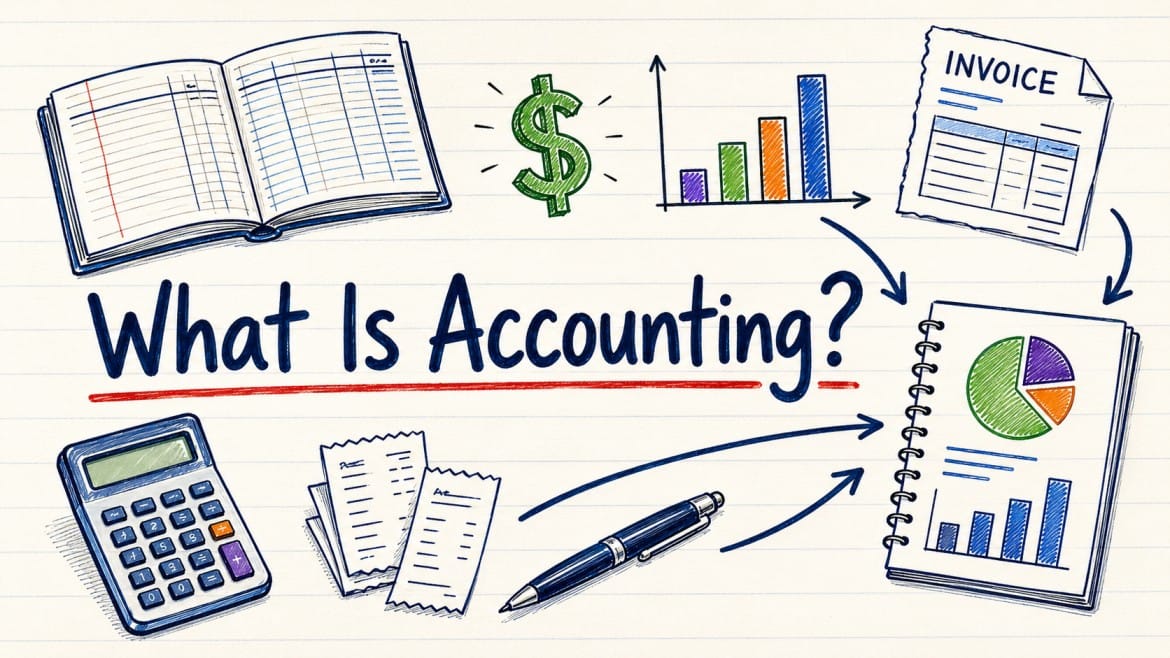
\nFoundational accounting What is Accounting? Accounting is the process of recording, classifying, summarizing, analyzing, interpreting, and communicating financial information so people can make sound economic decisions. ✎ Read · Learn · Practise · Check…
\n\n
What is Accounting?
Accounting is the process of recording, classifying, summarizing, analyzing, interpreting, and communicating financial information so people can make sound economic decisions.
✎ Read · Learn · Practise · Check
By the end of this lesson, you can…
- define accounting and distinguish it from bookkeeping;
- explain why financial information matters;
- describe all six procedures in detail;
- identify common source documents and accounts;
- apply the accounting equation to transactions;
- follow transactions through a worked example;
- identify internal and external users;
- complete practice exercises independently.
1Meaning of accounting
A business buys goods, pays wages, sells products, receives cash, borrows money, purchases equipment, and sometimes sells on credit. Each activity changes the business financially. Accounting captures those changes and turns them into organized, understandable information.
In simple words: accounting tells the financial story of an organization. It explains what resources the organization controls, what it owes, how much it earned or spent, whether it made a profit, and what decisions may be needed next.
Bookkeeping
Bookkeeping is the accurate, routine work of recording transactions and maintaining ledgers. It is an essential part of accounting, but it does not cover the whole process.
Accounting
Accounting includes bookkeeping and goes further. It summarizes records, prepares statements, compares results, explains meaning, and communicates conclusions to decision-makers.
2Why accounting matters
Without accounting, decisions would depend mainly on memory, opinion, or incomplete evidence. Accounting creates a reliable information system that connects everyday activities to the financial position and performance of the organization.
Measure performance
Accounting calculates revenue, expenses, profit, and loss for a period. It also allows comparisons with earlier months, budgets, and targets.
Control resources
Managers can track cash, inventory, equipment, customer debts, supplier balances, and loans. This reduces waste, loss, and misuse.
Support decisions
Reliable information helps people decide whether to invest, lend, expand, employ staff, discontinue a product, reduce costs, or change prices.
Meet obligations
Accurate records support tax reporting, legal compliance, audits, loan agreements, and accountability to owners and other stakeholders.
Plan the future
Past results provide a starting point for budgets, cash-flow forecasts, sales targets, and financing plans.
Protect trust
Consistent reports make it easier for owners, lenders, investors, and suppliers to trust the information provided by the organization.
3Procedure of accounting
The six procedures form one connected flow. The first three generate financial information. The last three help people use financial information.
Recording · Classifying · Summarizing
Analyzing · Interpreting · Communicating
What happens?
Every financial transaction is entered in chronological order. The record normally includes the date, explanation, monetary amount, accounts affected, and a reference to the supporting document. Recording creates the original accounting trail from which all later reports are produced.
A transaction should be recorded when it can be measured reliably in money and affects the financial position or performance of the organization.
Example
A business pays $12,000 rent by bank transfer. The payment date, amount, Rent Expense account, Cash at Bank account, and bank reference are recorded.
A manager merely discussing a possible future office does not create a recordable transaction because no measurable exchange has occurred.
What happens?
Recorded transactions are posted to appropriate ledger accounts. Accounts collect transactions with the same economic meaning. Common groups are assets, liabilities, equity, revenue, and expenses.
Correct classification matters because an amount placed in the wrong account can distort profit, assets, debts, or cash-flow information even when the amount itself is correct.
Example
The $12,000 payment is classified as Rent Expense and as a decrease in Cash. It should not be classified as Equipment because rent provides temporary use of premises rather than ownership of a long-term resource.
What happens?
Ledger balances are totalled and checked, commonly through a trial balance. Adjustments may be made for items such as unpaid expenses, depreciation, or revenue earned but not yet received. The adjusted information is then condensed into financial statements.
The income statement summarizes performance, the statement of financial position summarizes assets, liabilities, and equity, and the cash-flow statement summarizes cash movements.
Example
All rent entries are totalled for the month. Sales and all expense balances are brought together to calculate profit. Cash, equipment, supplier balances, and owner’s equity are summarized at the reporting date.
What happens?
Reported figures are broken down, compared, and related to one another. Accountants may calculate percentage changes, profit margins, liquidity measures, cost ratios, and budget variances.
Analysis does not yet explain the cause. Its purpose is to reveal relationships, trends, strengths, weaknesses, and unusual movements that require attention.
Example
Rent rose from 8% to 12% of sales. Analysis checks whether the rent amount increased, sales declined, or both occurred. It may also compare the change with the budget and previous year.
What happens?
The accountant connects the analyzed figures with operational facts and explains what the results mean. Good interpretation considers causes, consequences, uncertainty, business conditions, and the needs of the intended user.
Interpretation should be evidence-based. A possible cause should not be presented as certain unless supporting information confirms it.
Example
The rent percentage increased because a new branch opened before reaching its expected sales level. This may be temporary, but continuing weak sales would threaten profitability and cash availability.
What happens?
Relevant information is delivered to intended users through financial statements, management reports, dashboards, budgets, presentations, notes, or verbal explanations. Different users need different detail and timing.
Communication should be clear, concise, accurate, complete enough for the decision, and free from misleading emphasis or unnecessary technical language.
Example
Management receives a monthly report explaining branch sales, fixed costs, cash needs, break-even sales, risk level, and recommended actions. A lender may instead receive statements and repayment measures.
4The accounting equation
The accounting equation expresses the financial position of a business. It stays balanced after every correctly recorded transaction.
Example: Assets of $500,000 and liabilities of $180,000 produce equity of $320,000 because $500,000 = $180,000 + $320,000.
5Documents, accounts, and information quality
Reliable accounting begins with reliable evidence. A source document proves that a transaction occurred and supplies the details needed to record it correctly.
Sales invoice
Shows goods or services sold, the customer, date, amount, payment terms, and any sales tax. It supports revenue and customer-receivable records.
Purchase invoice
Shows what the business purchased and what it owes the supplier. It may support an asset, inventory, or expense entry.
Receipt or cash-register record
Provides evidence of cash received or paid. The document should identify the amount, date, reason, and parties involved.
Bank statement
Lists deposits, payments, charges, interest, and balances recorded by the bank. It is compared with the business cash records during reconciliation.
Payroll record
Supports wages, salaries, deductions, employer costs, and amounts payable to employees or authorities.
Credit note
Reduces a previous invoice because of returned goods, an overcharge, a discount, or another correction.
The five main account categories
| Category | Meaning | Examples |
|---|---|---|
| Assets | Resources controlled by the business | Cash, inventory, equipment, amounts receivable |
| Liabilities | Present obligations owed to outsiders | Supplier balances, bank loans, unpaid expenses |
| Equity | The owner’s residual interest | Owner’s capital, retained profit, drawings |
| Revenue | Income earned from business activities | Sales revenue, service fees, commission income |
| Expenses | Resources consumed to earn revenue | Rent, wages, electricity, advertising, depreciation |
Qualities of useful accounting information
Relevant
It can influence a decision by helping users predict outcomes or confirm earlier expectations.
Faithfully represented
It should be complete, neutral, and as free from error as reasonably possible.
Comparable
Consistent methods allow users to compare periods, departments, or organizations.
Timely and understandable
Information must arrive before the decision and be presented clearly to informed users.
6Who uses accounting information?
The usefulness of a report depends on its audience. Internal users usually receive detailed, frequent information. External users generally rely on standardized statements and supporting disclosures.
Managers
Plan operations, control costs, set prices, compare actual results with budgets, and decide how resources should be used.
Owners and investors
Evaluate profitability, financial position, risk, growth, and the return earned on invested capital.
Lenders and suppliers
Assess whether the organization can pay interest, repay loans, and settle trade balances when due.
Employees and government
Employees may assess stability and benefits. Government agencies use reports for taxation, regulation, statistics, and legal compliance.
7Worked example: Bright Cup Café
This example shows why accounting is more than entering figures. The same transactions must be documented, organized, summarized, examined, explained, and reported.
Follow one week through the process
Create a dated entry for each investment, purchase, credit purchase, sale, wage payment, and supplies used. Attach the bank record, invoices, sales report, payroll record, and supplies calculation.
Post the entries to Cash, Equipment, Supplies, Accounts Payable, Owner’s Capital, Sales Revenue, Wages Expense, and Supplies Expense.
Calculate ending account balances. Revenue is $24,000, recorded expenses are $6,500, and provisional profit is $17,500 before any other adjustments.
Cash remains positive. The gross cash generated from sales exceeds wages paid, but $10,000 is owed to the supplier and future operating costs remain.
The café earned a positive first-week result, but one week is not enough to establish a stable trend. Management must protect cash and monitor sales before committing to further spending.
Report the opening financial position, first-week profit, supplier obligation, cash balance, and a recommendation to prepare a four-week cash forecast.
| Item | Assets | Liabilities | Equity effect |
|---|---|---|---|
| Owner invests cash | +$100,000 | — | +$100,000 |
| Buy equipment for cash | $0 net* | — | — |
| Buy supplies on credit | +$10,000 | +$10,000 | — |
| Cash sales | +$24,000 | — | +$24,000 |
| Pay wages | −$4,000 | — | −$4,000 |
| Use supplies | −$2,500 | — | −$2,500 |
*Cash decreases by $30,000 while equipment increases by $30,000, so total assets do not change. Expenses reduce both assets and equity.
8Practice exercises
Exercise A · Is it a recordable transaction?
For every transaction, select Record or Do not record yet, then select the correct explanation.
| Transaction | Your decision | Your explanation | Feedback |
|---|---|---|---|
| The owner tells staff that the business may buy a $18,000 delivery van next month. | |||
| The business buys a computer for $2,400 cash and receives an invoice. | |||
| A customer places a $900 order but no goods have been delivered and no payment received. | |||
| The bank charges a $35 monthly service fee shown on the bank statement. | |||
| An employee damages equipment, and a repair invoice for $600 is received. |
Show suggested answers
- Do not record yet — it is only an intention; no measurable transaction has occurred.
- Record — a measurable purchase occurred and the invoice provides supporting evidence.
- Do not record yet — an order alone is not normally revenue before delivery or payment.
- Record — the bank statement proves that an expense and a reduction in cash occurred.
- Record — the $600 invoice creates a repair expense and a liability, unless it was already paid.
Exercise B · Classify the accounts
Classify each account as Asset, Liability, Equity, Revenue, or Expense.
| Account | Your classification | Feedback |
|---|---|---|
| Cash | ||
| Bank loan | ||
| Sales revenue | ||
| Rent expense | ||
| Owner’s capital | ||
| Accounts receivable | ||
| Accounts payable | ||
| Equipment |
Show suggested answers
Exercise C · Apply the accounting equation
- Assets are $82,000 and liabilities are $27,000. Calculate equity.
- Liabilities are $45,000 and equity is $70,000. Calculate assets.
- Assets are $150,000 and equity is $92,000. Calculate liabilities.
- A business begins with assets of $40,000 and no liabilities. It then borrows $15,000 from a bank. What are the new totals?
- The business pays a $3,000 expense in cash. What happens to assets and equity?
Show calculations
- Equity = $82,000 − $27,000 = $55,000.
- Assets = $45,000 + $70,000 = $115,000.
- Liabilities = $150,000 − $92,000 = $58,000.
- Assets become $55,000; liabilities become $15,000; equity stays $40,000.
- Assets decrease by $3,000 and equity decreases by $3,000 because an expense reduces profit.
Exercise D · Basic journal thinking
Study the following worked transactions carefully. For each transaction, identify the two accounts affected, decide whether each account increases or decreases, connect the change to the accounting equation, and then translate it into a debit and credit.
1Owner invests $25,000 cash
Cash is an asset. The business has received money, so its Cash asset increases.
The investment represents the owner’s claim against the business, so equity increases.
Accounting-equation effect: Assets increase by $25,000 and Equity increases by $25,000. The equation remains balanced.
Why: Debits increase assets, while credits increase owner’s equity.
2Buy equipment for $7,000 cash
Equipment is an asset. The business now controls an additional long-term resource.
Cash is also an asset. Paying the supplier reduces the amount of cash held.
Accounting-equation effect: One asset increases while another asset decreases by the same amount. Total assets, liabilities, and equity do not change.
Common mistake: The whole payment is not an expense. The business exchanged one asset, Cash, for another asset, Equipment.
3Buy inventory for $4,500 on credit
Inventory is an asset because the goods are controlled by the business and are expected to generate future sales.
The purchase was made on credit, so the business now owes the supplier. This creates a liability.
Accounting-equation effect: Assets increase by $4,500 and Liabilities increase by $4,500. No cash has been paid yet.
Why: The debit increases the Inventory asset, while the credit increases the amount owed to the supplier.
4Earn $3,200 cash revenue
The customer paid immediately, so the Cash asset increases.
The business earned income by providing goods or services. Revenue increases profit and therefore increases equity.
Accounting-equation effect: Assets increase by $3,200 and Equity increases by $3,200 through the profit earned.
Why: Cash received is debited because an asset increased. Revenue is credited because income increased.
5Pay $800 rent
Rent is a cost of using premises during the accounting period, so Rent Expense increases.
The payment takes money out of the business, so the Cash asset decreases.
Accounting-equation effect: Assets decrease by $800. The expense reduces profit, which reduces Equity by $800.
Why: Expenses normally have debit balances. Cash is credited because the asset decreased.
Exercise E · Analysis and interpretation
A shop reports the following:
| Measure | Year 1 | Year 2 |
|---|---|---|
| Sales | $120,000 | $138,000 |
| Expenses | $90,000 | $115,000 |
| Profit | $30,000 | $23,000 |
- By what percentage did sales increase?
- By what percentage did expenses increase?
- What happened to profit even though sales increased?
- Give two possible explanations and one action management should investigate.
Show suggested analysis
Sales increased by 15%. Expenses increased by about 27.8%. Profit fell by $7,000, or about 23.3%. Expenses grew much faster than sales. Possible causes include higher input prices, additional staff, inefficient operations, or unusual one-time costs. Management should identify which expense categories produced the increase before deciding whether to change prices or reduce costs.
9Common mistakes to avoid
10Self-check quiz
Complete this scored check after the practice exercises. Incorrect questions are highlighted so you know what to review.
11Lesson recap
- Accounting converts measurable financial transactions into useful information.
- Bookkeeping is the recording foundation; accounting includes the complete information and decision process.
- Recording, classifying, and summarizing generate financial information.
- Analyzing, interpreting, and communicating help people understand and use it.
- Source documents support accuracy and create an audit trail.
- The five main categories are assets, liabilities, equity, revenue, and expenses.
- The accounting equation is Assets = Liabilities + Equity.
- Internal and external users require different reports and levels of detail.
- Useful information is relevant, faithfully represented, comparable, timely, and understandable.

Nyasha Makore
Third Planner creates clear, practical educational lessons designed to turn business and finance concepts into usable skills.