Accounting
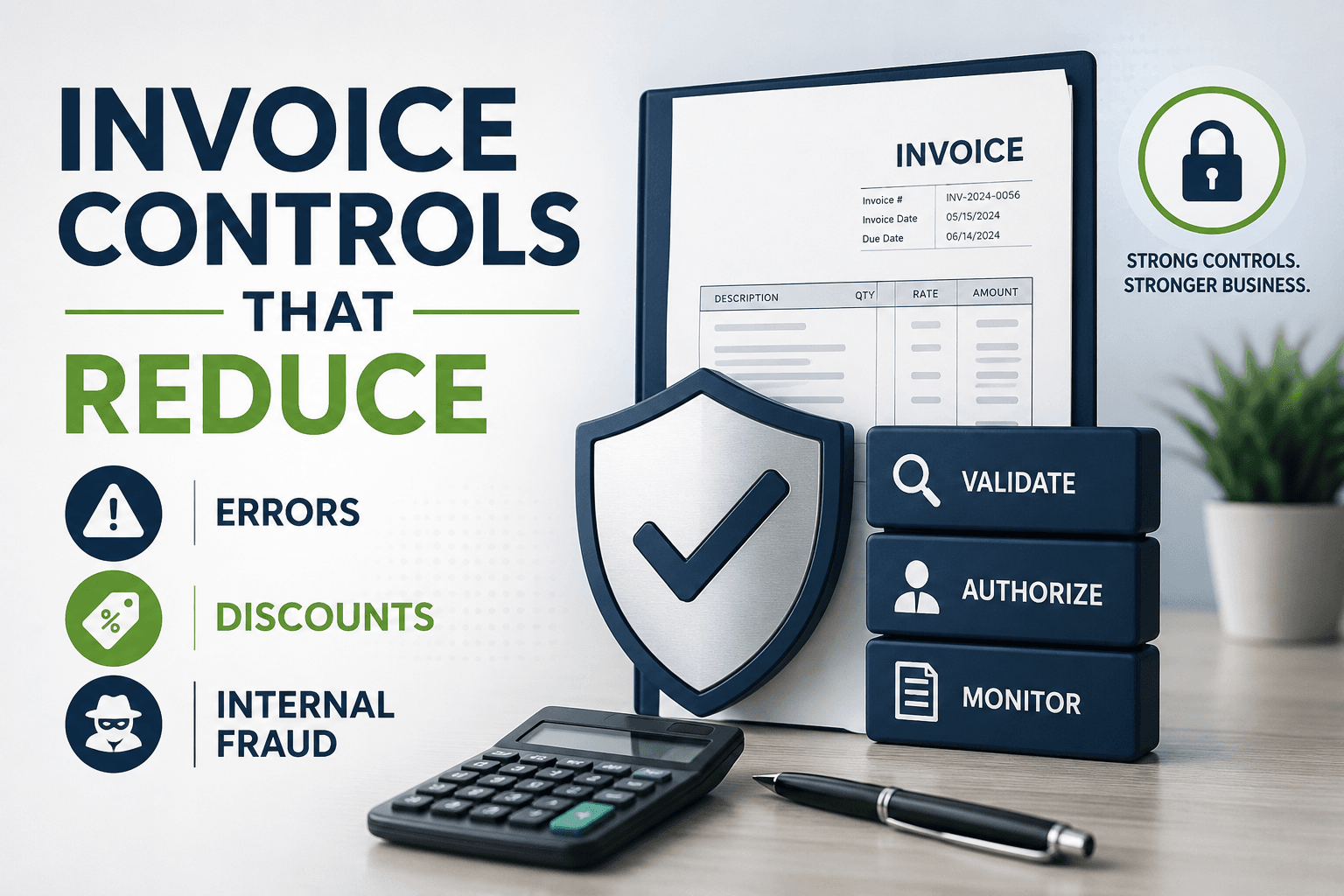
\nInvoice Controls That Reduce Errors, Discounts, and Internal Fraud
\nA deep guide to invoice controls, pricing permissions, credit notes, and fraud prevention.
\n\nA Strategic Operating Guide for Business Owners, Finance Leaders, and Professionals
Invoicing is rarely treated as a strategic function. Yet, it sits at the exact intersection of cash flow, vendor relationships, regulatory compliance, and operational discipline. When left unguarded, the accounts payable (AP) pipeline becomes a quiet drain: duplicate payments slip through, contractual discounts evaporate, tax mismatches trigger penalties, and internal fraud hides behind routine transactions.
Industry benchmarks consistently show that organizations without structured invoice controls lose 1–3% of annual procurement spend to errors and leakage. In mid-market and high-velocity environments, that figure can quietly approach 5%. More importantly, the cost isn’t just financial. Uncontrolled invoicing erodes audit readiness, damages vendor trust, and distracts leadership from growth initiatives.
This guide distills a layered, globally tested control architecture into actionable steps. It is written for owners who need clarity, finance professionals who need structure, and operators who need execution pathways.
Part I: The Triad of Invoice Vulnerabilities
Before designing controls, you must understand what they are defending against. Errors, discount leakage, and internal fraud rarely occur in isolation. They share common root causes: fragmented workflows, weak segregation of duties, poor master data governance, and a culture that treats AP as administrative rather than strategic.
1. Errors: The Silent Multiplier
- Data entry & OCR misreads: Typos in amounts, dates, or tax codes cascade into reconciliation failures.
- PO mismatches: Goods/services received differ from what was invoiced, but approvals proceed on autopilot.
- Tax & compliance drift: VAT/GST/Sales Tax rates change; invoices apply outdated or incorrect jurisdictional rules.
- Duplicate submissions: Vendors resubmit invoices after payment delays; systems fail to flag them.
Errors compound. A single misapplied tax rate across 500 invoices can trigger regulatory scrutiny. Duplicate payments rarely surface until quarter-end reconciliations, by which time cash has already left the building.
2. Discount Leakage: The Hidden Margin Tax
- Unauthorized early payments: Staff pay invoices early to clear queues, triggering discounts that weren’t budgeted or approved.
- Phantom discount adjustments: Vendors or employees manually apply post-invoice credits that bypass procurement contracts.
- Failure to capture contractual terms: Volume rebates, prompt payment incentives, and tiered pricing sit in PDFs or emails, never digitized into payable rules.
- Collusion pricing: Buyers negotiate off-book discounts with suppliers, then invoice at standard rates, pocketing the difference through personal accounts or side agreements.
Discount leakage is often mistaken for “process friction.” In reality, it’s a structural failure to digitize, enforce, and monitor commercial terms.
3. Internal Fraud: The Control Override
- Shell vendor creation: Employees register fictitious companies with addresses matching their own or a relative’s.
- Duplicate payment schemes: Real invoices are paid, then slightly altered versions are resubmitted under different reference numbers.
- Inflation & quantity padding: Units, rates, or hours are inflated on service invoices where physical delivery is hard to verify.
- Approval bypass & threshold splitting: Staff fragment invoices to stay below authorization limits or exploit managers who rubber-stamp approvals.
Fraud thrives where visibility ends. The absence of vendor master data controls, lack of independent payment release, and missing audit trails create fertile ground for exploitation.
Part II: The Four-Tier Invoice Control Architecture
Effective controls are not bureaucratic checkpoints. They are precision filters that separate legitimate transactions from anomalies while preserving operational velocity. The architecture operates across four tiers:
Tier 1: Pre-Invoice Controls (Prevention)
Controls applied before an invoice enters your system.
- Vendor Onboarding & Verification: Tax ID validation, bank account verification via micro-deposits or API, sanctions screening, and beneficial ownership disclosure.
- Contract Digitization: Extract payment terms, discount windows, pricing tiers, and penalty clauses into structured data fields.
- Purchase Order Discipline: Mandate PO coverage for all non-payroll spend. Enforce “no PO, no pay” with documented exceptions routed to procurement.
Tier 2: Receipt & Validation Controls (Authentication)
Controls applied at invoice capture.
- Three-Way Matching: PO ↔ Goods Receipt/Service Acknowledgment ↔ Invoice. Tolerances defined by materiality (e.g., ±0.5% value, ±2 units).
- Automated Duplicate Detection: Fuzzy matching on vendor name, amount, date, and reference numbers. Flags near-duplicates and altered submissions.
- Tax & Compliance Engines: Real-time validation against jurisdictional rates, reverse-charge rules, and e-invoicing mandates (e.g., EU PEPPOL, Latin America CFDI, India GSTN).
Tier 3: Approval & Authorization Controls (Routing)
Controls governing human decision points.
- Segregation of Duties (SoD): The person who creates/edits vendors cannot approve invoices. The person who approves invoices cannot release payments.
- Tiered Approval Matrices: Dynamic thresholds based on vendor risk, spend category, and historical accuracy. Exceptions route to cross-functional review.
- Discount Authorization Rules: Early payment discounts require explicit procurement/finance sign-off. System auto-calculates ROI of taking vs. skipping discounts based on cost of capital.
Tier 4: Post-Payment & Reconciliation Controls (Detection)
Controls that close the loop.
- Vendor Statement Reconciliation: Monthly automated matching of your payment ledger to vendor statements. Flags missing credits, unapplied discounts, and timing mismatches.
- Payment Run Audits: Pre-execution review of payment files against approved invoices. Random sampling of high-value or first-time payments.
- Continuous Controls Monitoring (CCM): AI-driven anomaly scoring on payment patterns, weekend approvals, round-dollar invoices, and sudden vendor address/bank changes.
Part III: Practical Implementation Roadmap (30-60-90 Days)
Owners and finance leaders need a phased approach that balances rigor with speed. Below is a scalable execution path.
Days 1–30: Diagnose & Baseline
- Map the current AP workflow. Identify every handoff, system, and approval step.
- Quantify historical leakage. Run a 12-month extract: duplicates, discount capture rate, error correction costs, fraud/exception tickets.
- Clean vendor master data. Remove inactive vendors, verify bank details, flag missing tax IDs, and consolidate duplicates.
- Draft a control policy document. Define SoD, approval thresholds, discount rules, exception handling, and vendor change protocols.
Days 31–60: Design & Automate
- Implement three-way matching with tolerance bands. Start with high-spend categories; expand gradually.
- Deploy OCR + AI validation. Ensure system flags mismatched amounts, missing POs, and tax anomalies before routing.
- Configure approval matrices. Align with your cost of capital for discount decisions. Route exceptions to a control committee (Finance + Procurement + Internal Audit).
- Establish a whistleblower & vendor dispute channel. Anonymous reporting reduces retaliation fear; vendor portals reduce email-based invoice manipulation.
Days 61–90: Operate & Institutionalize
- Run parallel processing. Keep legacy workflow for 2–4 weeks while new controls run in shadow mode. Compare outcomes.
- Train & assign accountability. AP clerks own data capture. Procurement owns contract terms. Finance owns approval routing. Audit owns monitoring.
- Launch monthly control reviews. Track KPIs, review exceptions, adjust tolerance bands, and retire obsolete rules.
- Document & audit. Prepare control narratives for external auditors. Map each control to risk type (error, discount, fraud) for clarity.
Note on Scaling: SMEs should prioritize vendor verification, duplicate detection, and SoD. Enterprises should layer AI anomaly scoring, continuous monitoring, and integrated supply chain finance platforms. The principle remains: controls must be proportional to risk, not uniformly heavy.
Part IV: Global Scenarios & Applied Lessons
Controls must adapt to market context, regulatory environments, and operational realities. Below are four globally grounded scenarios illustrating how controls translate into results.
1. Germany: Precision Manufacturing & VAT Compliance
A mid-tier automotive supplier processing 4,000 invoices monthly discovered 2.1% overpayment due to mismatched VAT codes and duplicate submissions from tier-2 subcontractors.
Control deployed: Automated three-way matching + EU VAT validation API + PEPPOL e-invoicing integration.
Result: 87% reduction in tax mismatches, €420K annual savings, and audit readiness improved from 14 to 3 days.
Lesson: In regulated markets, tax validation is not optional. Embed compliance at capture, not reconciliation.
2. Brazil: Retail Chain & Off-Contract Discount Schemes
Regional buyers negotiated informal discounts with suppliers, then allowed full-price invoices to proceed. The difference was split via personal accounts.
Control deployed: Centralized vendor portal requiring all commercial terms to be digitized. Any invoice deviating >0.5% from contract terms triggered procurement + finance co-approval. Discount ROI calculator auto-ran against company WACC.
Result: Unauthorized discount leakage dropped to near zero. Legitimate early-payment discount capture increased by 18%.
Lesson: Discounts must be governed by data, not discretion. Digitize terms, enforce deviations, and measure discount economics.
3. Singapore: Tech Startup & SaaS Duplication
Rapid scaling led to fragmented AP. Multiple departments subscribed to overlapping tools under slightly different vendor names, causing duplicate payments and untracked renewals.
Control deployed: Vendor master data governance policy + AI duplicate detection + centralized procurement intake form.
Result: Scaled from $2M to $15M AP volume without adding headcount. Duplicate payment rate fell from 1.8% to 0.12%.
Lesson: Growth magnifies control gaps. Standardize vendor identity early; automate pattern recognition before volume overwhelms manual review.
4. Kenya: Agri-Export Cooperative & Informal Supply Chains
Farmers submitted handwritten invoices. Ghost invoices and inflated rates emerged due to weak delivery verification and community trust gaps.
Control deployed: Mobile invoice capture + GPS-tagged delivery confirmation + independent cooperative audit committee rotating quarterly.
Result: Leakage reduced by 34%, repayment cycles shortened, and farmer participation increased due to transparent, auditable payouts.
Lesson: In informal economies, controls must be accessible, verifiable, and community-aligned. Technology bridges trust gaps when paired with local governance.
Part V: Metrics, Monitoring, and the Psychology of Control
Controls fail not because they are poorly designed, but because they are poorly sustained. Measurement and human behavior determine longevity.
Core KPIs to Track
| Metric | Target | What It Reveals |
|---|---|---|
| First-Pass Yield Rate | >85% | How many invoices require no manual intervention |
| Duplicate Payment Rate | <0.1% | System detection efficacy |
| Discount Capture Rate | >90% of eligible | Contract enforcement & cash optimization |
| Exception Routing Rate | <8% | Process stability & control fatigue |
| Time-to-Approve | <48 hrs (standard), <24 hrs (discount-eligible) | Operational velocity |
| Vendor Statement Reconciliation Variance | <0.5% | Post-payment accuracy |
The Psychology of Control Fatigue
Employees bypass controls when they feel punitive, slow, or disconnected from business outcomes. Counter this by:
- Framing controls as cash preservation, not restriction. Tie AP metrics to working capital and growth funding.
- Automating approvals, not humans. Use rules to route exceptions; let people solve edge cases.
- Rewarding accuracy, not speed alone. Recognize teams that maintain high first-pass yield and low exception rates.
- Publishing transparent dashboards. Visibility reduces suspicion and builds accountability.
Continuous Controls Evolution
Controls decay. Quarterly reviews should:
- Retire rules that generate false positives
- Adjust tolerance bands based on vendor performance
- Update tax/discount logic for regulatory changes
- Rotate audit sampling to prevent gaming
- Benchmark against industry peers and internal targets
Part VI: Conclusion: From Cost Center to Strategic Advantage
Invoice controls are not administrative overhead. They are the nervous system of your cash flow, the guardrails of your vendor relationships, and the foundation of your financial integrity. When designed thoughtfully, they reduce errors to near-zero, transform discounts from leakage into margin, and expose fraud before it scales.
The organizations that win in volatile markets do not simply process invoices faster. They process them smarter. They embed controls at the point of origin, automate validation, route decisions by data, and monitor outcomes continuously. They treat AP not as a back-office function, but as a strategic leverage point.
Precision in invoicing is precision in strategy. Build the architecture. Measure relentlessly. Iterate continuously. The payoff is not just saved dollars—it’s operational clarity, audit confidence, and the freedom to focus on what truly moves your business forward.
Executive Checklist: 10 Non-Negotiable Invoice Controls
- Segregate duties: Vendor creation, invoice approval, and payment release must never reside with the same person.
- Enforce PO coverage: No purchase order, no pay. Exceptions require documented, time-bound approval.
- Digitize commercial terms: Contracts, discount windows, and pricing tiers must be structured data, not PDFs.
- Automate three-way matching: Define tolerance bands; route exceptions to cross-functional review.
- Deploy duplicate detection: Fuzzy matching on amount, vendor, date, and reference numbers.
- Validate tax & compliance at capture: Integrate jurisdictional rate engines and e-invoicing standards.
- Authorize discounts explicitly: Auto-calculate ROI against cost of capital; require sign-off for early payments.
- Secure vendor master data: Bank verification, tax ID validation, sanctions screening, and change approval workflows.
- Reconcile monthly with vendors: Automated statement matching; resolve variances within 10 business days.
- Monitor continuously: AI anomaly scoring, random payment audits, whistleblower channels, and quarterly control reviews.
Implementation note: Start with vendor verification, duplicate detection, and SoD. Layer automation next. Add continuous monitoring as volume grows. Measure everything. Adjust ruthlessly. Controls that work today will need refinement tomorrow. The goal is not perfection—it’s precision, accountability, and sustainable cash discipline.

Anita Jawali
Third Planner creates clear, practical educational lessons designed to turn business and finance concepts into usable skills.