
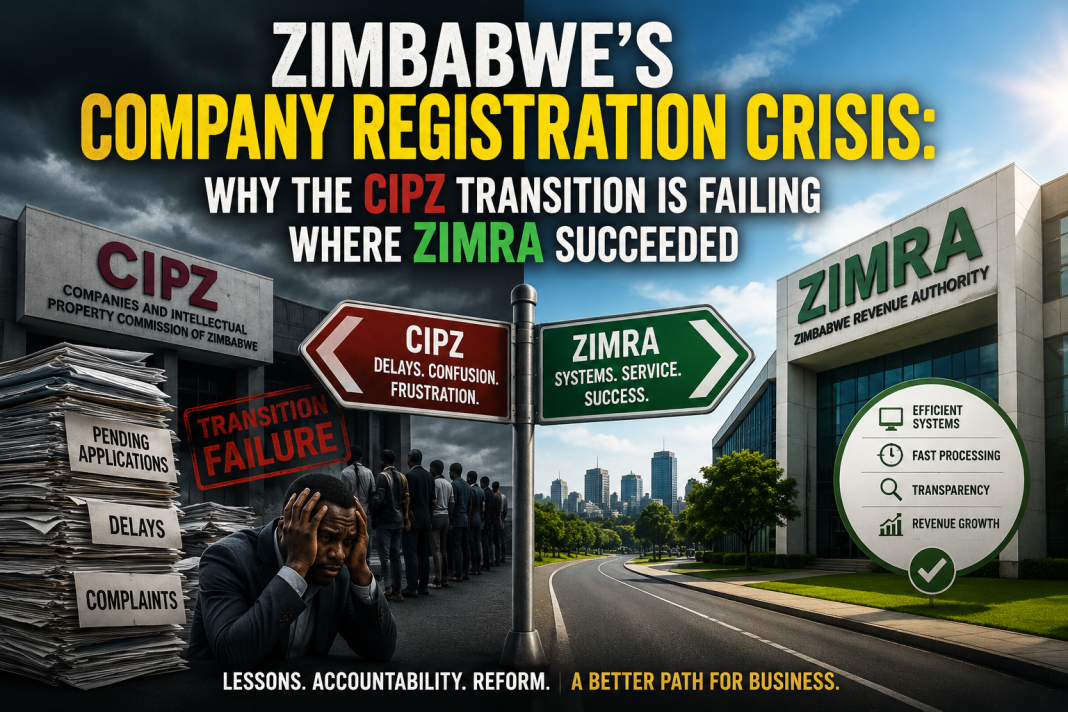
Zimbabwe’s Company Registration Crisis: Why the CIPZ Transition Is Failing Where ZIMRA Succeeded
Zimbabwe has repeatedly spoken about improving the ease of doing business, modernizing public services, and formalizing the economy through digital transformation. Yet one of the country’s most important business reforms — the migration to the Companies and Intellectual Property Office (CIPZ) platform — risks undermining those very goals.
At the center of the problem is a contradiction that thousands of businesses are now experiencing firsthand:
CIPZ introduced a modern electronic registry system, but continues to force companies with historical compliance gaps into a heavily manual process to regularize outstanding annual returns before they can fully participate in the new system.
This hybrid model — partly digital and partly paper-based — is becoming one of the biggest hidden barriers to business compliance and company registration in Zimbabwe.
And it stands in sharp contrast to how Zimbabwe Revenue Authority handled its own digital migration.
The Statutory Instrument 108 of 2025 Mandate
The crisis centers around Statutory Instrument 108 of 2025, which mandates the mandatory re-registration of all companies and Private Business Corporations (PBCs) registered before February 2024. This sweeping reform is part of Zimbabwe’s ambitious transition to a fully electronic Companies Registry system under the Companies and Other Business Entities Act [Chapter 24:31].
The critical deadline was set for April 20, 2026, with dire warnings: failure to re-register by this date would result in automatic deregistration without notice. However, the practical complexities of the process have led to significant challenges, making the deadline a source of anxiety rather than a clear directive.
The Core Requirement: Clearing Outstanding Annual Returns
The most significant bottleneck in the process is a mandatory prerequisite: companies must clear all outstanding annual returns and associated penalties before their re-registration application can be processed. This requirement, while administratively logical, has created an unexpected cascade of complications:
- Historical Record Gaps: Many companies, particularly older ones, have incomplete or lost documentation related to past annual returns. The digitization of these historical records is incomplete, forcing businesses to manually reconstruct years of filings.
- Penalty Accumulation: Penalties for late filing compound over time, making the cost of regularization prohibitive for some businesses, especially small and medium enterprises (SMEs).
- Manual Verification: Even with the intention of digitization, the verification of historical compliance often requires physical document submission and manual processing, negating the efficiency gains of the digital platform.
ZIMRA Demonstrated What Real Digital Transformation Looks Like
When ZIMRA migrated taxpayers from older SAP-based systems to eTaxes and eventually to TaRMS, the approach was fundamentally different.
The transition was not perfect, but the philosophy behind it was clear:
- taxpayer records were migrated,
- historical information was integrated,
- users could continue operating digitally,
- and compliance activities became centralized electronically through self-service platforms. (https://mytaxselfservice.zimra.co.zw/)
Today, taxpayers can:
- register taxes online,
- submit returns,
- update profiles,
- upload documents,
- and interact directly with the system electronically through TaRMS. (https://mytaxselfservice.zimra.co.zw/)
Crucially, ZIMRA did not force the majority of users back into parallel manual systems merely because they had historical records.
The migration philosophy was integration.
That is where the CIPZ process appears to be struggling.
ZIMRA’s Integrated Migration Strategy
ZIMRA’s approach to digital transformation under TaRMS exemplifies effective change management:
- Seamless Data Migration: Existing taxpayer records were carefully migrated into the new system. While not flawless, the effort was made to bring historical data along, minimizing the initial gap.
- Self-Service Empowerment: The TaRMS platform empowers taxpayers to manage their affairs largely independently. From PIN registration to return submission and payment, the process is streamlined and accessible online.
- Reduced Human Interface: By centralizing operations electronically, ZIMRA reduced the need for physical visits and interactions with officers for routine tasks, decreasing potential bottlenecks and corruption risks.
- Gradual Implementation with Support: While mandatory, the shift was supported by training programs, helpdesks, and phased rollouts, allowing users to adapt.
This strategy prioritized user experience and continuity, ensuring that the transition enhanced, rather than hindered, compliance.
CIPZ Created a “Digital Front-End” With a Manual Back-End
The current re-registration process under Zimbabwe’s Companies and Other Business Entities framework requires companies to regularize outstanding annual returns before re-registration can proceed.
On paper, the system is digital.
In practice, many businesses quickly discover that:
- old records are incomplete,
- historical annual returns are not digitized,
- documentation must be manually reconstructed,
- physical intervention is still required,
- and historical compliance often depends on intermediary assistance.
The consequence is devastating for SMEs.
Instead of a clean electronic migration, Zimbabwe effectively created:
- a digital portal sitting on top of unresolved manual archives.
This defeats the core purpose of digital transformation.
The Complexity of Re-Registration Requirements
The re-registration process under SI 108 is multifaceted, adding layers of complexity:
- Documentation Gathering: Companies must compile updated versions of key documents like CR14 (shareholders list), CR6 (directors list), Memorandum and Articles of Association, and the original Certificate of Incorporation. For older companies, locating these documents can be arduous.
- Director/Shareholder Data Collection: Comprehensive personal information (names, IDs, DOBs, contacts) must be gathered from all current and past directors/shareholders within a certain timeframe, depending on the company’s history and structure.
- Board Resolutions and Affidavits: Specific legal documents must be prepared and executed, often requiring legal expertise to ensure compliance with format and content requirements.
- Online Submission and Payment: Once all prerequisites are met, the application is submitted via the CIPZ online portal, followed by payment of the prescribed fee.
The prerequisite of clearing annual returns sits at the base of this pyramid, making progress on subsequent steps impossible until it’s resolved.
The Extension of the Deadline Is a Warning Sign
The original deadline of April 20, 2026, was perceived by many as stringent. However, the real indicator of systemic strain emerged not just from the pressure of the date itself, but from the widespread difficulties companies faced in meeting the prerequisites for re-registration. Reports indicated that numerous businesses struggled with the complex process of clearing historical obligations, leading to calls for leniency.
While no official extension of the April 20, 2026, deadline for SI 108 re-registration has been universally confirmed post-April 2026, the significant challenges reported suggest the initial timeline may have been overly optimistic given the state of historical records and the manual processes involved.
If the process were truly efficient and accessible:
- businesses would regularize themselves faster,
- backlogs would reduce naturally,
- and compliance rates would rise without repeated extensions.
Instead, many companies remained stuck outside the system because historical compliance remained difficult, expensive, and bureaucratic.
The reported challenges surrounding the deadline are a warning sign that the implementation model itself is creating friction.
The Consequences of Missing the Deadline
The statutory instrument clearly outlines the severe consequences for non-compliance by the deadline (as originally set):
- Automatic Deregistration: Companies failing to re-register are automatically struck off the register without further notice.
- Loss of Legal Existence: The deregistered company ceases to exist as a legal entity, losing its capacity to trade, hold assets, enter contracts, or operate bank accounts.
- Asset Forfeiture: Any remaining company assets revert to the State under the principle of bona vacantia.
- Personal Liability: Directors and shareholders may become personally liable for the company’s outstanding debts.
- Criminal Liability: Continuing to trade under the name of a deregistered company is illegal and carries criminal penalties.
- Name Availability: The company name becomes free for registration by another entity.
These consequences underscore the critical importance of the re-registration process and highlight the risks associated with any systemic failures or delays.
The Biggest Victims Are SMEs
Large corporations can absorb:
- legal costs,
- company secretarial fees,
- compliance consultants,
- and administrative delays.
Small businesses cannot.
For SMEs, startups, family businesses, and informal enterprises attempting to formalize, the process becomes overwhelming.
A business owner may discover that:
- several years of annual returns are outstanding,
- penalties have accumulated,
- historical CR documents are missing,
- filings must be manually prepared,
- and specialized intermediaries are now required.
This immediately transforms compliance from a simple administrative obligation into a financial burden.
The SME Disadvantage
Small and Medium Enterprises (SMEs) form the backbone of Zimbabwe’s economy, yet they are disproportionately affected by the current CIPZ re-registration process:
- Limited Resources: SMEs typically lack dedicated legal or administrative staff capable of navigating complex regulatory procedures. They often rely on the owner-manager, who may not have the time or expertise.
- Financial Constraints: The cost of hiring consultants, paying accumulated penalties, and sourcing historical documents can represent a significant portion of an SME’s capital, acting as a deterrent to compliance.
- Time Poverty: Small business owners are often deeply involved in daily operations. The time required to gather documents, liaise with authorities, and manage the re-registration process can significantly disrupt business activities.
- Lack of Information: Smaller entities might be less informed about the specific requirements, deadlines, and procedures, leading to delays and potential errors.
- Risk of Formalization Hurdles: The difficulty of the re-registration process acts as a significant barrier for informal businesses considering formalization, pushing them further away from the formal economy.
The complexity of the process inadvertently favors larger, resource-rich entities while penalizing smaller, potentially more dynamic players.
The Rise of the “Compliance Middleman Economy”
One of the most troubling outcomes of the current system is the emergence of an unofficial compliance economy built around intermediaries.
Because the process is difficult for ordinary business owners to navigate independently, many are forced to rely on:
- consultants,
- agents,
- runners,
- company secretaries,
- and middlemen.
Entire businesses are now built around helping companies “fix” historical compliance issues.
Many charge substantial fees because:
- the process is time-consuming,
- knowledge of procedures is specialized,
- and the average entrepreneur struggles to navigate the system alone.
In effect, compliance has become monetized through administrative complexity.
This creates a dangerous situation:
the harder the process becomes, the more dependent businesses become on intermediaries.
That is the opposite of what digital transformation is supposed to achieve.
Profiteering Through Bureaucracy
The intricate nature of the re-registration process has inadvertently created a niche market for compliance facilitators:
- Consultants and Agents: Offer services to guide companies through the process, often charging substantial fees for their expertise.
- Company Secretaries: Licensed professionals who handle the administrative and legal aspects, crucial for preparing board resolutions and affidavits, but commanding high fees.
- Runners and Process Servers: Facilitate document delivery and collection between businesses and CIPZ, adding another layer of cost.
- Information Brokers: Individuals who claim to have inside knowledge of procedures or shortcuts, sometimes charging premium rates.
While legitimate professional services are valuable, the necessity of relying on intermediaries for basic compliance indicates a failure of the system to be user-friendly and direct. It shifts power and cost away from the state and towards private actors, potentially introducing inefficiencies and rent-seeking behavior.
A Digital System Should Reduce Dependency — Not Increase It
The purpose of digitization is not simply to create an online portal.
True digital transformation means:
- simplifying workflows,
- reducing human bottlenecks,
- integrating historical records,
- automating processes,
- and allowing direct interaction between citizens and government systems.
ZIMRA understood this principle with TaRMS.
A taxpayer does not need a “middleman” merely to access their tax profile.
The system itself performs the role of integration.
CIPZ, however, still places too much weight on historical manual reconstruction.
That creates friction at every stage.
The Ideal of Self-Service Governance
Effective digital government platforms aim for self-service:
- Direct Access: Citizens and businesses interact directly with the system.
- Automated Processing: Wherever possible, applications, payments, and verifications are handled automatically.
- Transparency: Users can track the status of their requests and understand the process clearly.
- Reduced Corruption Risk: Minimizing human touchpoints reduces opportunities for malfeasance.
- Scalability: Digital systems can handle large volumes of users efficiently.
The current CIPZ process, particularly the requirement for historical regularization involving manual steps, undermines these ideals.
The Hidden Economic Damage
The consequences extend beyond inconvenience.
When company compliance becomes expensive and frustrating:
- businesses avoid formalization,
- informal trading increases,
- compliance culture weakens,
- and government loses revenue visibility.
Many businesses now operate in a grey zone:
- active commercially,
- but not fully regularized corporately.
This weakens:
- corporate governance,
- investor confidence,
- access to finance,
- and the integrity of the national business registry itself.
Ironically, the system designed to improve corporate transparency may actually be discouraging participation.
Broader Economic Implications
The dysfunction in the company re-registration process has wider ramifications:
- Stunted Formalization: The difficulty of the process discourages informal businesses from joining the formal sector, limiting the government’s ability to tax them and provide support.
- Reduced Investment Confidence: An opaque and cumbersome company registration system deters both domestic and foreign investment, as investors seek predictable and efficient regulatory environments.
- Credit Access Barriers: Formally registered and compliant companies find it easier to access credit from financial institutions. Difficulties in maintaining good standing can impede this access.
- Weakened Corporate Governance: When companies struggle with basic compliance, it often reflects broader weaknesses in internal governance structures, affecting long-term sustainability and trust.
- Resource Misallocation: Significant time and money spent on navigating compliance processes could otherwise be invested in productive business activities.
- Informal Economy Growth: As formal compliance becomes harder, the informal economy may expand, reducing tax revenue and social protection coverage.
Zimbabwe Already Has a Working Example
The frustrating reality is that Zimbabwe already demonstrated it can execute large-scale digital transitions successfully.
The TaRMS migration by ZIMRA showed that:
- legacy systems can be integrated,
- users can transition electronically,
- and compliance can become more efficient rather than more difficult. (zimra.co.zw)
The lesson should have been obvious:
A digital migration succeeds when the burden of transition is carried primarily by the system — not by the end user.
Under the current CIPZ approach, too much of that burden has been shifted onto businesses themselves.
Learning from ZIMRA’s Success
CIPZ could learn valuable lessons from ZIMRA’s TaRMS implementation:
- Investment in Data Cleansing: ZIMRA likely invested significantly in migrating and validating historical taxpayer data before launch. CIPZ needs similar investment in digitizing and validating historical company filings.
- Phased Approach: ZIMRA rolled out TaRMS gradually, focusing on specific user groups initially. CIPZ could consider phasing re-registration by company size or age, allowing for better resource allocation and troubleshooting.
- Integrated Historical Solutions: Instead of requiring businesses to fix past issues before joining the new system, ZIMRA allowed users to access their profiles and manage historical issues within the new system. CIPZ could implement mechanisms for uploading, verifying, and processing outstanding returns electronically, perhaps with simplified procedures or amnesty periods.
- Robust Support Systems: ZIMRA established helpdesks and communication channels. CIPZ needs equally strong support, especially for complex historical issues.
- Focus on User Experience: TaRMS was designed with the taxpayer journey in mind. The CIPZ re-registration process, while functional in parts, feels burdensome due to its prerequisites.
What Needs to Change
If Zimbabwe genuinely wants to improve formalization and business registration, several reforms are necessary.
1. Full Digitization of Historical Records
Outstanding annual returns and legacy files should be electronically integrated into the CIPZ environment wherever possible.
This requires a massive data entry and validation project. Scanning and indexing historical paper filings would allow the system to recognize a company’s status and outstanding obligations automatically, removing the need for businesses to manually reconstruct them from scratch. Where complete digitization isn’t immediately feasible, CIPZ should develop standardized electronic forms and processes for uploading supporting documentation and paying associated penalties online, streamlining the regularization step.
2. Simplified Historical Regularization
Government should consider:
- simplified amnesties,
- automated penalty calculations,
- bulk regularization mechanisms,
- and electronic submission of legacy returns.
Introducing a time-limited amnesty period with reduced or waived penalties for clearing old annual returns could incentivize quick compliance. Automated penalty calculation tools within the portal would provide clarity. For companies with extensive backlogs, offering a bulk submission option for multiple past years simultaneously would save time.
3. True Self-Service Compliance
Businesses should be able to:
- regularize,
- update,
- file,
- and pay
entirely online without compulsory intermediaries.
The re-registration portal needs to evolve into a comprehensive self-service hub. Beyond the initial re-registration, it should allow for ongoing management like updating director/shareholder details, filing annual returns, and accessing company certificates – all without needing to visit an office or hire an agent. The historical regularization steps should be fully integrated into this online workflow.
4. Reduced Administrative Friction
The system should prioritize:
- speed,
- accessibility,
- transparency,
- and affordability.
Streamlining the documentation requirements, simplifying the language used in forms and instructions, ensuring the online platform is reliable and user-friendly, and providing clear timelines for processing applications are crucial. The goal should be to minimize the time and effort required from businesses, not maximize administrative hurdles.
5. Integration Across Government Platforms
A modern business environment requires integration between:
- CIPZ,
- ZIMRA,
- NSSA,
- PRAZ,
- local authorities,
- and financial institutions.
Businesses should not repeatedly reconstruct the same information across disconnected systems.
Inter-agency data sharing would allow, for example, CIPZ to verify a company’s ZIMRA compliance status automatically, or for ZIMRA to confirm company registration details instantly. This would eliminate redundant reporting and reduce the risk of discrepancies.
Addressing the Root Causes
Beyond the immediate procedural fixes, addressing the underlying causes of the backlog is essential:
- Prevent Future Gaps: Ensure the new system is robust enough to prevent the accumulation of outstanding returns again. Implement automated reminders and potentially streamlined annual return processes going forward.
- Strengthen CIPZ Capacity: Invest in the technical infrastructure, staff training, and operational capacity of CIPZ to handle the volume and complexity of the transition effectively.
- Clear Communication: Provide consistent, timely, and easily understandable communication about the process, deadlines, and any changes to policy or procedure.
Conclusion
Zimbabwe’s transition to CIPZ was supposed to modernize company administration and improve ease of doing business.
Instead, the continued dependence on manual historical filings has created:
- bottlenecks,
- compliance fatigue,
- excessive intermediary dependence,
- and rising costs for SMEs.
The comparison with ZIMRA’s migration to TaRMS is unavoidable.
ZIMRA moved taxpayers into the future by integrating systems and reducing friction.
CIPZ, by contrast, risks trapping businesses between two worlds:
a digital interface sitting on top of a manual compliance structure.
The Statutory Instrument 108 re-registration mandate, while aiming for a modern, transparent registry, has stumbled on the execution of integrating historical data and streamlining the path for existing businesses to join the new system. The requirement to clear past dues through potentially archaic and manual processes negates the benefits of the new digital front-end.
And until that contradiction is resolved, many businesses will continue choosing the informal route — not because they reject compliance, but because the process of becoming compliant has become unnecessarily difficult, costly, and time-consuming. This defeats the very purpose of formalization and digital transformation.
To salvage this initiative, CIPZ must urgently focus on simplifying the historical regularization process, investing in digitizing legacy records, and making the entire journey from start to finish truly electronic and user-centric. Only then can the promise of SI 108 be fulfilled.

