
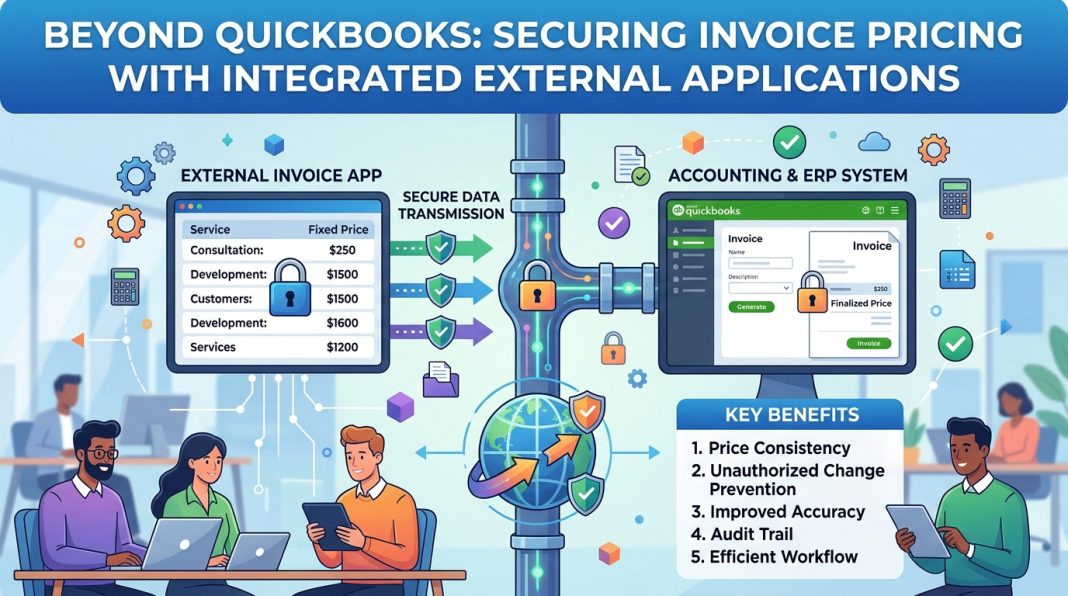
QuickBooks Desktop and QuickBooks Online have long served as the financial backbone for millions of small and mid-sized enterprises. Their strength lies in intuitive bookkeeping, robust reporting, and seamless tax compliance. However, when businesses scale, introduce complex pricing structures, or operate in regulated industries, a critical vulnerability emerges at the point of invoice creation: QuickBooks lacks native, field-level price controls.
While the platform excels at recording financial transactions, it was never engineered to enforce pricing policies, restrict unauthorized discounts, or mandate approval workflows at the invoicing stage. This architectural gap leaves companies exposed to margin erosion, internal fraud, compliance failures, and operational friction. The solution is not to patch QuickBooks with fragile workarounds, but to strategically decouple invoicing control from the ledger by deploying an external, purpose-built invoicing application that syncs bidirectionally with QuickBooks.
The Inherent Weaknesses of QuickBooks Price Control
QuickBooks’ permission model is fundamentally coarse. Once a user is granted access to create or edit invoices, the system implicitly trusts them to modify any field on that transaction. This design creates several critical control weaknesses:
- No Field-Level Price Permissions: Administrators cannot restrict access to the unit price or rate field independently. Invoice access equals full price-editing rights.
- Absence of Tolerance Bands or Hard Locks: There is no native mechanism to enforce minimum advertised prices (MAP), fixed wholesale rates, or percentage-based discount limits at the line-item level.
- No Approval Workflows for Price Overrides: If a sales rep or clerk changes a price, QuickBooks does not trigger a manager approval queue, request justification, or log the override event separately from the final transaction amount.
- Reactive, Not Preventive, Audit Trails: QuickBooks logs the final invoice state but does not capture the act of changing a price, who made the change, when it occurred, or why. During audits, reconciling unauthorized discounts requires manual forensic analysis.
- Rigid Price Level Limitations: While QuickBooks supports price levels, they are static, difficult to enforce dynamically across customer groups, and can be overridden without restriction by any user with invoice access.
- Inability to Enforce Separation of Duties: Businesses requiring maker-checker controls cannot natively configure a workflow where one user drafts an invoice and another must approve pricing before posting.
These limitations are not oversights; they are architectural realities. QuickBooks was designed as a post-transaction ledger, not a real-time sales governance platform.
Why Internal Workarounds and External Scripts Fall Short
Many IT teams attempt to bridge this gap with custom automation: Python scripts polling via COM/QBXML, database triggers, or third-party middleware that monitors for price deviations. While conceptually sound, these approaches suffer from fatal operational flaws:
- Reactive Correction: External scripts can only detect and revert violations after the invoice is saved. By then, the customer may have received a discounted quote, the transaction may have triggered downstream workflows, or the fraud may have already occurred.
- COM/SDK Fragility: QuickBooks’ desktop API relies on single-threaded COM sessions that are highly susceptible to modal dialog blocks, session timeouts, and
ticket parameter is invaliderrors. A correction script that fails silently leaves violations unaddressed. - Audit Fragmentation: External logging systems operate outside QuickBooks’ native audit trail. Reconciling price changes across disparate systems increases compliance risk and auditor scrutiny.
- Performance Degradation: Aggressive polling (e.g., every 1–2 seconds) to achieve near-real-time correction consumes system resources, triggers QuickBooks UI locks, and destabilizes multi-user environments.
Workarounds treat the symptom, not the disease. They add cost, complexity, and failure points without eliminating the underlying control gap.
The Strategic Solution: External Invoicing + QuickBooks Integration
The most robust, enterprise-grade approach is to shift invoice creation and pricing enforcement to an external application, while retaining QuickBooks as the system of record for accounting, tax, and financial reporting.
In this architecture, the external application acts as the controlled front-end for sales and billing. It enforces pricing policies, user permissions, and approval workflows at the point of entry. Once an invoice is finalized and compliant, it syncs automatically to QuickBooks as a read-only or controlled-write transaction. QuickBooks remains the ledger; the external app becomes the governance layer.
What a Linked External Application Can Do That QuickBooks Cannot
A purpose-built invoicing platform integrated with QuickBooks delivers capabilities that are architecturally impossible within QuickBooks itself:
| Control Requirement | QuickBooks Native Capability | External Integrated Application |
|---|---|---|
| Field-Level Price Locks | ❌ Not supported | ✅ Hard-lock prices per item, customer, or contract |
| Discount Tolerance Bands | ❌ Not supported | ✅ Allow ±X% deviation; block or flag outside range |
| Manager Approval Workflows | ❌ Not supported | ✅ Route overrides to designated approvers before posting |
| Mandatory Justification Logging | ❌ Not supported | ✅ Require reason codes, comments, and digital signatures |
| Role-Based Pricing Access | ❌ Coarse module-level only | ✅ View-only, edit-within-limits, or full override roles |
| Real-Time Override Audit Trail | ❌ Logs final state only | ✅ Logs user, timestamp, old price, new price, and approval status |
| Franchise/MAP Compliance Enforcement | ❌ Manual policing required | ✅ System blocks non-compliant pricing at save |
| Sync Reliability | ❌ COM/session-dependent | ✅ API-driven, queue-based, retry-managed, cloud-native |
Architecture & Data Flow: How It Works in Practice
A production-ready integration follows a clean, secure data flow:
- Master Data Sync: Items, customers, tax codes, and price lists sync from QuickBooks to the external app on a scheduled or real-time basis.
- Invoice Creation & Validation: Sales staff or billing clerks create invoices in the external app. The system validates every line against configured price rules, customer agreements, and tolerance thresholds.
- Approval Routing (If Triggered): If a price falls outside allowed parameters, the invoice routes to a manager dashboard for review, justification, and electronic approval.
- Finalization & Sync: Once compliant, the invoice is marked as finalized. The external app pushes the transaction to QuickBooks via secure API or middleware. QuickBooks records it as a standard invoice; no manual entry required.
- Payment & Reconciliation: Payments collected in QuickBooks or payment gateways sync back to the external app for customer account reconciliation and reporting.
- Audit & Compliance: All pricing decisions, overrides, and approvals are stored in the external app’s immutable audit log. QuickBooks receives only the finalized, compliant transaction.
This architecture eliminates COM session conflicts, modal dialog blocks, and reactive correction loops. Control happens before the data ever touches the ledger.
Business Impact: From Reactive Correction to Proactive Control
Deploying an external invoicing application linked to QuickBooks delivers measurable operational and financial benefits:
- Margin Protection: Unauthorized discounts are blocked at creation, not corrected days later. Pricing integrity is enforced by design, not by hope.
- Fraud Prevention: Internal collusion, commission manipulation, and AR skimming schemes are neutralized because price changes require system validation or managerial approval.
- Audit Readiness: Regulators, franchisors, and external auditors receive complete, timestamped override logs with mandatory justifications. No more reconciling fragmented audit trails.
- Operational Efficiency: Accounting teams stop chasing price discrepancies, manually adjusting invoices, or running forensic reports. Reconciliation time drops significantly.
- Scalability & Flexibility: Pricing rules can be updated centrally, rolled out instantly across users, and tailored by region, product line, or customer tier without disrupting QuickBooks configurations.
Conclusion: Control the Source, Protect the Ledger
QuickBooks remains an excellent financial ledger, but it was never designed to govern sales transactions at the point of creation. Relying on its native permissions or fragile external scripts to enforce pricing policies is a strategic misalignment that exposes businesses to margin leakage, compliance risk, and internal fraud.
The modern solution is architectural: decouple invoicing control from the accounting ledger. By deploying an external, purpose-built invoicing application that enforces granular price rules, approval workflows, and audit logging at the source, businesses transform pricing from a vulnerability into a controlled, compliant, and auditable process. QuickBooks continues to serve as the system of record; the external application becomes the system of governance.
Don’t patch the ledger. Control the source. Evaluate your invoicing architecture today, and align your technology stack with your fiduciary responsibility.
About the Author
Nyasha Makore is a QuickBooks Applications Developer specializing in financial workflow automation, SDK integrations, and accounting system security. With deep expertise in QBXML architecture and third-party application development, he helps businesses bridge native platform limitations with robust, compliant automation solutions. For technical consultations or development inquiries, contact via WhatsApp: +263773167539.

