

Small business decisions in Zimbabwe often become difficult because finance, tax, insurance, technology, and operations are treated as separate conversations. In practice they are connected. A weak invoice process can create tax errors. A poor contract can damage cash flow. A missing insurance schedule can leave a business exposed after a loss. This guide looks at multi-currency bookkeeping through a practical business lens, with the aim of helping owners, accountants, bookkeepers, finance teams, and advisers build a stronger operating system rather than another file of disconnected notes.
The article is written for growing businesses, not only large companies. A retailer, consulting firm, logistics operator, manufacturer, farm supplier, clinic, school, contractor, or online seller may not have a large finance department, but it still needs clean records, clear responsibilities, sensible controls, and evidence that can survive a bank review, investor discussion, tax query, insurance claim, or audit request. The same thinking also helps businesses outside Zimbabwe because many of the underlying problems are global: late payments, poor documentation, unclear ownership, manual spreadsheets, weak cyber hygiene, and decisions made without reliable numbers.
Why multi-currency bookkeeping matters in Zimbabwe
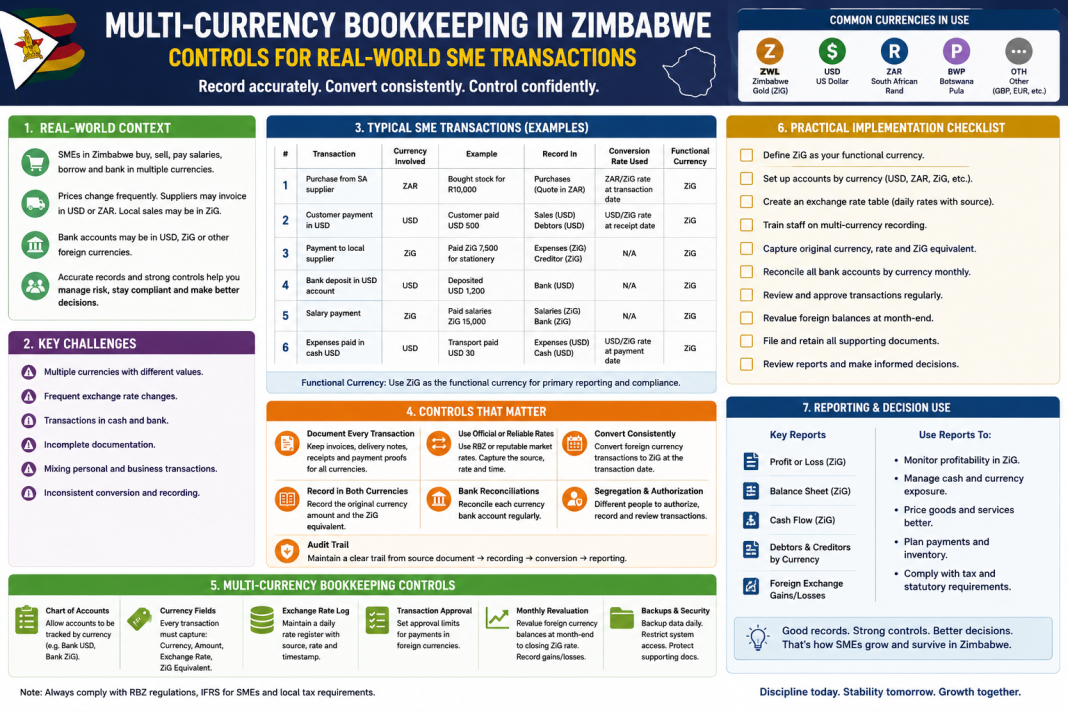
Zimbabwean businesses often operate in a complex currency environment, which makes bookkeeping discipline essential. The risk is not only exchange differences. It is the confusion that happens when invoices, receipts, bank accounts, cash tills, supplier bills, and management reports do not use consistent currency logic. Multi-currency bookkeeping should help owners understand real performance rather than hide uncertainty inside manual adjustments.
For a business owner, the danger is not only non-compliance. The danger is making decisions with partial information. If a business does not know which customers pay slowly, which costs are fixed, which risks are uninsured, which employees or contractors create obligations, or which systems hold the only copy of important documents, the owner may believe the business is healthier than it is. multi-currency bookkeeping should therefore be treated as part of management discipline, not as paperwork completed only when a lender, auditor, or authority asks for it.
In Zimbabwe, the practical environment can include currency pressure, changing customer demand, import and supplier constraints, informal-market competition, uneven digital adoption, and differences between urban and regional business conditions. Those realities do not remove the need for strong controls; they make controls more important. A simple but consistent system is usually better than an impressive policy that nobody follows.
A practical example
A Harare retailer may sell in more than one currency, pay some suppliers in foreign currency, pay staff partly through bank transfers, and hold cash in tills. If the business records only summary amounts without currency detail, it may not know true margin, cash exposure, or stock replacement cost. A Bulawayo services firm may invoice regional clients in foreign currency but pay local costs differently. Both need clear currency coding and reconciliations.
The lesson is that multi-currency bookkeeping is not a single decision. It is a chain of decisions: what evidence is created, who reviews it, how it is stored, how exceptions are handled, and how quickly management reacts when the numbers or documents stop making sense. Many African small businesses operate with real entrepreneurial strength, but the administrative side often develops after the business has already grown. That creates a gap between commercial activity and formal records. Closing that gap is where better finance and operations work begins.
What good practice looks like
Good practice starts with a written view of the business process. The document does not need to be long, but it should answer who does what, what evidence is required, what system is used, and what review happens before money moves or commitments are made. For multi-currency bookkeeping, the following controls are especially useful:
- Set a documented currency policy for invoicing, receipts, supplier bills, cash holdings, and reporting.
- Record the transaction currency separately from the reporting currency.
- Reconcile each bank account, mobile wallet, and cash till by currency.
- Use approved exchange-rate sources and keep evidence of rates used for material transactions.
- Review realised and unrealised exchange differences separately from trading profit.
These controls work best when they are built into routine work. For example, a monthly finance meeting can review overdue invoices, bank reconciliations, insurance renewals, payroll exceptions, software access, tax deadlines, and supplier concentration in one sitting. The meeting does not need to be formal, but it should produce decisions and assigned actions. A business that reviews risks and numbers monthly will usually respond faster than a business that waits for year-end accounts.
Records and evidence to keep
The strength of any Accounting process depends on evidence. Evidence protects the business when memories fade, staff leave, systems change, or a third party asks questions months later. In practical terms, the business should keep:
- Invoices, receipts, and supplier bills showing currency clearly.
- Bank statements, cash counts, till reconciliations, and wallet statements.
- Exchange-rate evidence and policy notes.
- Stock-costing records showing replacement-cost assumptions.
- Management accounts separating operating profit from exchange movements.
The point is not to keep documents for the sake of keeping documents. The point is to make the record easy to understand later. File names should be clear. Digital folders should follow a structure that another person can use. Where possible, key records should be linked to transactions in accounting software or stored in a shared business drive with restricted access. A receipt saved only in one person’s phone gallery is not a reliable business record.
Numbers management should review
A useful management report turns records into decisions. For multi-currency bookkeeping, these measures give owners a clearer view of whether the system is working:
- Cash and bank balances by currency.
- Gross margin by product line after replacement-cost review.
- Exchange gains or losses by month.
- Unreconciled currency differences.
- Supplier and customer exposure by currency.
The specific targets will differ by sector, size, and country, but the habit is the same. Track a few important numbers every month. Compare them with last month and with the same period last year if the business has history. Ask why the movement happened. Decide what will change. The quality of the conversation matters more than the number of charts.
Common mistakes to avoid
The most expensive mistakes are often quiet at the beginning. They do not look dramatic when they start, but they compound. A missing contract clause can become a collection problem. A weak backup process can become a business continuity failure. A manual payroll adjustment can become a tax or labour dispute. A cheap insurance policy can become a rejected claim because the cover did not match the real risk.
- Mixing currencies in one spreadsheet column without labels.
- Using exchange differences to hide stock or cash-count problems.
- Failing to reconcile cash tills by currency.
- Pricing from historical cost when replacement cost has changed.
- Not explaining currency assumptions in management reports.
Another common mistake is copying a system from another country without adapting it. A South African, Nigerian, Kenyan, Egyptian, Moroccan, or Canadian business may use similar accounting concepts, but banking systems, tax administration, customer behaviour, legal processes, and documentation expectations can differ. Global templates are useful, but they should be localised before being used as business policy.
Using technology without losing control
Technology can make multi-currency bookkeeping easier, but it can also hide weak processes behind attractive dashboards. Accounting software, payroll systems, document tools, AI assistants, cloud drives, e-signature platforms, and bank feeds all need governance. The business should decide who has access, what approvals are required, how data is backed up, and how changes are reviewed. A tool that saves time but removes accountability is not a control improvement.
AI is useful for drafting checklists, summarising contracts, extracting information from documents, comparing insurance clauses, preparing cash-flow scenarios, or turning messy notes into a first version of a policy. But the final decision should remain with a responsible person. AI can misunderstand context, miss local requirements, or produce confident wording that needs professional review. For Zimbabwe businesses, the safest approach is to use AI as a productivity assistant and keep human review for tax, legal, insurance, payroll, and financing decisions.
A 30-day improvement plan
A business does not need to fix everything at once. The following 30-day plan is realistic for an owner-managed business or small finance team:
- Week 1: list the current process, the people involved, the systems used, and the documents created.
- Week 2: identify the biggest gaps, such as missing approvals, unclear filing, old supplier terms, weak insurance records, or manual spreadsheet risk.
- Week 3: update one policy or checklist and test it on real transactions rather than leaving it as a document nobody uses.
- Week 4: review the first results, assign ownership, and add the process to the monthly management routine.
This approach is deliberately simple. Most small businesses do not fail because they lacked a perfect framework. They struggle because nobody owned the basics consistently. A monthly routine, clear evidence, and a short checklist can prevent many problems before they become expensive.
Global lessons for Zimbabwe businesses
Businesses in countries with dollarisation, high inflation, or cross-border trade face similar bookkeeping issues. Zimbabwean SMEs can borrow global multi-currency controls from exporters, NGOs, and regional traders: separate currency tracking, documented rates, frequent reconciliations, and clear management explanations.
The global lesson is not that African businesses must copy Europe, North America, or Asia. The better lesson is that formalisation helps businesses negotiate. Clean records support bank applications. Good insurance schedules support claims. Strong payroll files reduce disputes. Reliable management accounts help owners decide when to expand, hire, borrow, or slow down. A business with organised information has more options.
Final thoughts
Multi-currency bookkeeping in Zimbabwe is not just a technical accounting task. It is a survival tool for pricing, cash control, tax readiness, and honest management reporting.
This article is general business information, not tax, legal, insurance, or financial advice. Rules and market practice can change, and businesses should confirm country-specific requirements with a qualified adviser before making formal decisions. The practical value is in the discipline: understand the risk, keep evidence, review numbers, and improve the process before pressure arrives.

