
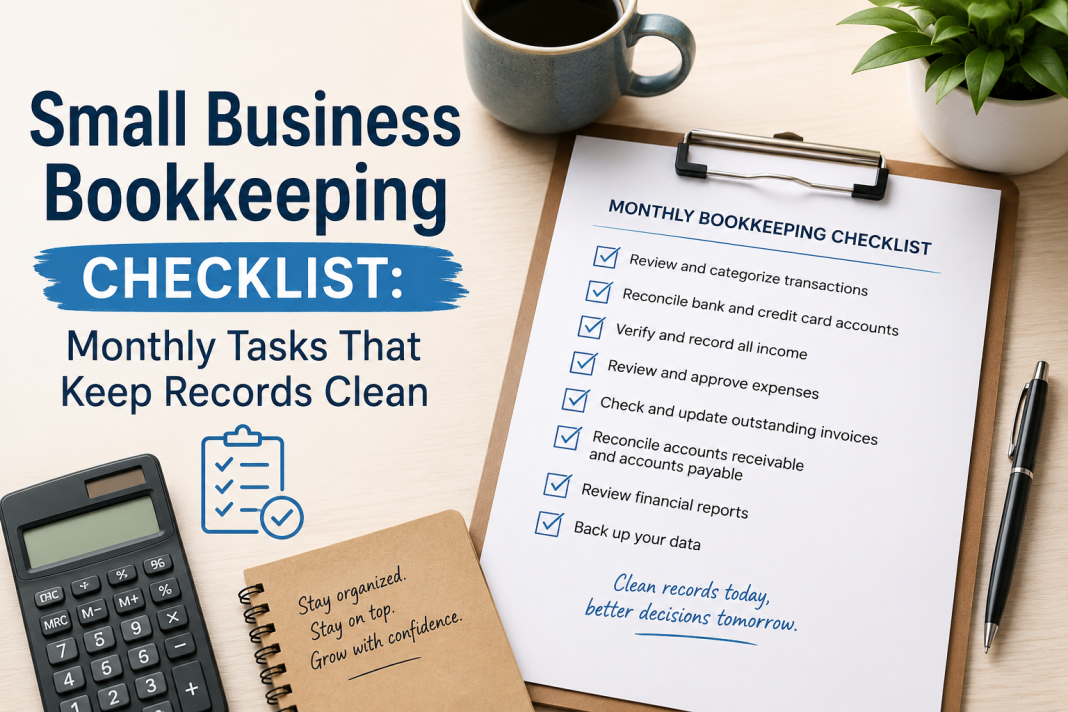
Small Business Bookkeeping Checklist: Monthly Tasks That Keep Records Clean
The alarm clock hadn’t even chimed 6 AM when Jennifer Martinez found herself staring at a towering pile of receipts scattered across her kitchen table. Her graphic design business had grown from a solo operation to a team of five employees, and with that growth came an avalanche of financial documentation that seemed to multiply exponentially each month. The coffee ring stains on invoices from March were still visible, mixing with newer receipts from April that arrived just yesterday. Jennifer’s heart sank as she realized she was already three weeks behind on her bookkeeping, and tax season was looming just two months away. The familiar knot of anxiety tightened in her stomach as she envisioned the IRS audit she’d heard about from a colleague—complete with disorganized records, missed deductions, and thousands of dollars in penalties. As she reached for her laptop to tackle the mountain of paperwork, Jennifer knew something had to change. That morning, fueled by desperation and determination, she began researching systematic approaches to monthly bookkeeping that could transform her chaotic financial management into an organized, efficient process. What she discovered would not only save her business but also restore her peace of mind and free up precious time for creative work that had been sacrificed to administrative chaos.
The Foundation: Understanding Why Monthly Bookkeeping Matters
Monthly bookkeeping isn’t just about compliance or satisfying your accountant’s requests—it’s about maintaining the financial health of your business and preserving your mental well-being. The monthly bookkeeping process serves as a vital checkpoint that prevents small problems from becoming catastrophic failures, while providing the insights necessary for informed business decisions.
The Compounding Effect of Neglect
Small business owners often fall into the trap of thinking that bookkeeping can wait until “things slow down,” but this mindset creates a compounding problem. Each month of neglect adds complexity to the next month’s tasks, as transactions pile up, receipts get lost, and memories fade about the purpose of specific expenditures. Jennifer’s experience illustrates this perfectly—what started as a few missed weeks became a months-long backlog that threatened the entire business’s financial stability.
The emotional impact of this compounding neglect cannot be understated. Business owners begin to dread opening their books, creating a cycle of avoidance that worsens the problem. The anxiety of facing an ever-growing backlog leads to procrastination, which in turn creates more anxiety. Breaking this cycle requires establishing consistent monthly routines that prevent the accumulation of financial chaos.
The Peace of Mind Factor
Conversely, maintaining clean, organized books provides immeasurable peace of mind. When Jennifer finally implemented a systematic monthly bookkeeping routine, she experienced an immediate reduction in financial anxiety. Knowing that her records were current and accurate allowed her to focus on growing her business rather than worrying about compliance issues or tax complications.
This peace of mind extends beyond personal comfort—it affects decision-making quality, relationship with financial professionals, and overall business confidence. When you know your financial position is clear and accurate, you can make strategic decisions with confidence rather than operating from a position of uncertainty.
The Core Monthly Tasks: Building Your Foundation
Task 1: Bank Reconciliation (Week 1 Priority)
Bank reconciliation serves as the cornerstone of accurate bookkeeping, ensuring that your recorded transactions match your actual bank activity. This process involves comparing your accounting records with your bank statements to identify any discrepancies, unauthorized charges, or recording errors.
The Reconciliation Process
Begin by gathering your bank statements for all business accounts—checking, savings, credit cards, and any other financial instruments. Print or download electronic copies for easy reference. Next, review your accounting software’s bank register, which should contain all recorded transactions for the month.
The reconciliation process involves:
- Starting with your previous month’s ending balance
- Adding all deposits recorded in your books
- Subtracting all withdrawals, checks, and debits recorded in your books
- Comparing the calculated balance to your actual bank statement balance
Identifying Common Reconciliation Issues
During the reconciliation process, you may encounter several common issues:
Outstanding Checks: Checks written in the current month that haven’t cleared the bank yet. These create a temporary discrepancy that will resolve in future months.
Deposits in Transit: Deposits made late in the month that appear in your books but not yet in the bank statement.
Bank Errors: Occasionally, banks make errors that require correction through their customer service process.
Recording Errors: Mistakes in your bookkeeping that need adjustment, such as transposed numbers or incorrect amounts.
Emotional Impact of Reconciliation
The bank reconciliation process can be anxiety-inducing, especially when discrepancies are discovered. However, viewing reconciliation as a protective measure rather than a chore can transform the experience. Each reconciliation confirms the accuracy of your records and protects against fraud or errors that could harm your business.
Jennifer initially dreaded reconciliation, associating it with discovering problems or making corrections. Once she understood that reconciliation was actually protecting her business and providing peace of mind, she began to view it as a valuable monthly ritual rather than a burdensome task.
Task 2: Accounts Receivable Management (Week 1 Priority)
Managing accounts receivable involves tracking money owed to your business and ensuring timely collection. This process directly impacts your cash flow and business sustainability, making it a critical monthly task.
Invoice Review and Aging Analysis
Begin by reviewing all outstanding invoices, categorizing them by age:
- Current (0-30 days): Recently issued invoices still within normal payment terms
- 30-60 days: Invoices approaching late payment status
- 60-90 days: Significantly overdue invoices requiring immediate attention
- Over 90 days: Potentially uncollectible debts requiring write-off consideration
Collection Activities
Based on the aging analysis, implement appropriate collection activities:
- Follow-up communications: Send polite reminders to customers approaching late payment status
- Escalation procedures: Implement formal collection processes for significantly overdue accounts
- Write-off decisions: Determine which accounts are unlikely to be collected and remove them from receivables
Customer Payment Trend Analysis
Track customer payment patterns to identify reliable payers and chronic late payers. This information helps in making decisions about credit terms, deposit requirements, and customer relationships.
Jennifer discovered that three of her largest clients consistently paid within 15 days, while two others regularly took 60-90 days. This insight allowed her to adjust her cash flow planning and negotiate better payment terms with slow-paying clients.
Task 3: Accounts Payable Organization (Week 2 Priority)
Managing accounts payable involves organizing and scheduling payments to vendors, suppliers, and service providers. This process ensures that your business maintains good relationships with creditors while optimizing cash flow.
Vendor Payment Tracking
Create a comprehensive list of all vendors and their payment terms:
- Net 15: Payment due within 15 days of invoice date
- Net 30: Payment due within 30 days of invoice date
- Net 60: Payment due within 60 days of invoice date
- Other terms: Special arrangements or milestone-based payments
Payment Scheduling
Organize payments based on:
- Due dates: Prioritize payments coming due soonest
- Cash flow considerations: Delay non-urgent payments if cash is tight
- Early payment discounts: Take advantage of discounts for prompt payment
- Vendor relationships: Prioritize payments to key suppliers or partners
Expense Verification
Review all incoming invoices to verify:
- Accuracy of amounts charged
- Authorization for services or products received
- Proper categorization for tax purposes
- Compliance with purchase orders or contracts
Task 4: Revenue Recognition and Categorization (Week 2 Priority)
Proper revenue recognition ensures that income is recorded in the correct accounting period and properly categorized for tax and management purposes.
Sales Review and Classification
Review all sales transactions for the month, ensuring they’re properly categorized:
- Product sales vs. service revenue
- Different service categories or product lines
- Tax-exempt vs. taxable sales
- Domestic vs. international sales
Contract and Project Tracking
For businesses with long-term contracts or projects:
- Track percentage of completion for ongoing projects
- Recognize revenue according to contract terms
- Monitor project profitability and adjustments
- Update billing schedules and client communications
Seasonal and Cyclical Adjustments
Consider seasonal business patterns when recognizing revenue:
- Accrue revenue for services to be delivered in future periods
- Defer revenue for prepaid services or subscriptions
- Adjust for seasonal variations in business activity
Task 5: Expense Review and Categorization (Week 2 Priority)
Thorough expense review ensures that all business expenditures are properly recorded, categorized, and compliant with tax regulations.
Receipt Organization and Verification
Gather and organize all receipts for the month:
- Physical receipts requiring scanning or photo capture
- Electronic receipts from online purchases
- Credit card and bank statement reconciliations
- Business meal and entertainment expenses
Expense Category Review
Verify that expenses are properly categorized:
- Office supplies vs. equipment purchases
- Travel expenses vs. entertainment costs
- Professional services vs. consulting fees
- Vehicle expenses vs. mileage deductions
Tax-Deductible Expense Verification
Ensure that business expenses comply with tax regulations:
- Verify business purpose for all claimed deductions
- Separate personal and business expenses clearly
- Maintain proper documentation for audit purposes
- Apply appropriate depreciation for business assets
Task 6: Payroll Processing and Tax Remittances (Week 3 Priority)
For businesses with employees, payroll processing is a critical monthly task that involves calculating wages, withholding taxes, and remitting payments to government agencies.
Employee Time Tracking and Wage Calculation
Review and verify employee time records:
- Hourly employees: Calculate regular and overtime hours
- Salaried employees: Verify salary payments and deductions
- Independent contractors: Process 1099 payments and reporting
- Bonuses and commissions: Calculate and record additional compensation
Tax Withholding Calculations
Calculate required tax withholdings:
- Federal income tax: Based on employee W-4 forms and current tax tables
- Social Security and Medicare: Fixed percentages applied to wages
- State income tax: Varies by state and employee residency
- Local taxes: Applicable in certain jurisdictions
Tax Deposit and Reporting
Remit required tax payments to government agencies:
- Federal tax deposits: Typically due semi-weekly or monthly
- State tax deposits: Follow state-specific schedules
- Quarterly reporting: File required forms for tax deposits
- Annual reporting: Prepare W-2s for employees and 1099s for contractors
Task 7: Tax Preparation and Planning (Week 3 Priority)
Monthly tax preparation activities help ensure compliance and optimize tax planning throughout the year rather than scrambling during tax season.
Estimated Tax Calculations
Calculate and plan for estimated tax payments:
- Federal estimated taxes: Quarterly payments based on current year income
- State estimated taxes: Vary by state and payment schedule
- Safe harbor calculations: Determine minimum payments to avoid penalties
- Quarter-end adjustments: Account for seasonal income variations
Deduction Tracking and Documentation
Monitor deductible expenses throughout the year:
- Business use of home: Track qualifying expenses and usage percentages
- Business meals: Document business purpose and participants
- Travel expenses: Maintain detailed records of business trips
- Equipment purchases: Track qualifying business assets for depreciation
Compliance Monitoring
Stay current with tax law changes and compliance requirements:
- New tax regulations: Monitor changes affecting your business type
- Industry-specific rules: Stay informed about sector-specific requirements
- State and local changes: Track varying requirements across jurisdictions
- Professional updates: Consult with tax professionals about changes
Task 8: Financial Statement Preparation (Week 4 Priority)
Monthly financial statements provide insights into business performance and help identify trends, problems, and opportunities.
Income Statement Generation
Prepare and review the monthly profit and loss statement:
- Revenue analysis: Compare current month to prior periods
- Expense analysis: Identify unusual or concerning trends
- Profit margin calculations: Monitor profitability across categories
- Seasonal adjustments: Account for business cycle variations
Balance Sheet Review
Examine the monthly balance sheet to assess financial position:
- Asset tracking: Monitor changes in business assets
- Liability management: Review debt levels and payment schedules
- Equity changes: Track retained earnings and owner contributions
- Liquidity assessment: Evaluate cash and near-cash resources
Cash Flow Statement Analysis
Analyze monthly cash flow patterns:
- Operating activities: Review cash generated from business operations
- Investing activities: Track cash used for business investments
- Financing activities: Monitor borrowing and repayment activities
- Cash flow trends: Identify patterns and potential issues
Task 9: Budget vs. Actual Analysis (Week 4 Priority)
Comparing actual performance to budgeted expectations helps identify variances and improve future planning.
Revenue Variance Analysis
Compare actual revenue to budgeted amounts:
- Identify reasons for significant variances
- Adjust future budgets based on actual performance
- Investigate unexpected revenue changes
- Update sales forecasts and projections
Expense Variance Analysis
Review expense variances compared to budget:
- Identify areas of overspending or underspending
- Determine causes of significant variances
- Adjust budget categories as needed
- Implement cost control measures where necessary
Profitability Analysis
Analyze profitability variances:
- Compare actual profit margins to budgeted targets
- Identify factors affecting profitability
- Assess impact of pricing and cost changes
- Update profitability expectations and goals
Task 10: Record Retention and Organization (Ongoing Priority)
Maintaining organized, accessible records is essential for compliance, audits, and business continuity.
Document Digitization
Convert paper documents to digital format:
- Scan receipts and invoices for permanent records
- Organize digital files with consistent naming conventions
- Back up digital records to multiple locations
- Maintain searchable digital archives
Physical File Organization
Keep physical documents organized and accessible:
- Alphabetical filing systems for vendors and customers
- Chronological organization for transaction records
- Separation of tax-related and general business documents
- Secure storage for confidential information
Retention Schedule Compliance
Follow established retention requirements:
- Tax records: Keep for minimum required periods (usually 3-7 years)
- Employment records: Maintain for specified periods
- Contract documents: Keep until expiration plus retention period
- Insurance records: Maintain during policy periods plus extensions
Advanced Monthly Tasks: Taking Your Bookkeeping to the Next Level
Task 11: Key Performance Indicator (KPI) Tracking
Beyond basic bookkeeping, track KPIs that provide insights into business health and growth potential.
Financial KPIs
Monitor key financial metrics:
- Gross profit margin: Percentage of revenue remaining after direct costs
- Net profit margin: Percentage of revenue remaining after all expenses
- Current ratio: Measure of short-term liquidity and financial stability
- Days sales outstanding: Average time to collect receivables
Operational KPIs
Track operational metrics related to financial performance:
- Customer acquisition cost: Total cost to acquire new customers
- Customer lifetime value: Expected revenue from customer relationships
- Inventory turnover: Rate of inventory replacement and sales
- Employee productivity: Revenue per employee or cost per employee
Task 12: Credit Management and Risk Assessment
Monitor and manage credit-related risks that could impact your business.
Credit Limit Reviews
Assess and adjust credit limits for customers:
- Review customer payment history and reliability
- Adjust limits based on business relationship changes
- Monitor concentration risk with large customers
- Implement credit holds for problematic accounts
Vendor Credit Management
Manage your business’s credit relationships:
- Monitor credit utilization across vendors
- Negotiate favorable payment terms where possible
- Maintain good relationships with key suppliers
- Monitor vendor financial stability and reliability
Task 13: Technology Integration and Automation
Leverage technology to streamline bookkeeping processes and reduce manual effort.
Software Updates and Maintenance
Keep bookkeeping software current and functional:
- Install software updates and security patches
- Backup data regularly and test recovery procedures
- Train staff on new features and improvements
- Troubleshoot technical issues promptly
Integration Optimization
Maximize integration between different business systems:
- Connect bank feeds for automatic transaction imports
- Link e-commerce platforms for sales data import
- Integrate payment processors for fee tracking
- Connect CRM systems for customer data accuracy
The Emotional Journey: From Chaos to Control
Overcoming Bookkeeping Anxiety
The emotional aspect of bookkeeping often gets overlooked, but it’s crucial for long-term success. Many small business owners experience anxiety, guilt, or overwhelm when facing bookkeeping tasks. Addressing these emotional barriers is essential for maintaining consistent practices.
Jennifer’s transformation from bookkeeping anxiety to confidence illustrates this journey. Initially, she avoided opening her books for weeks, creating a cycle of stress and procrastination. By breaking down tasks into manageable weekly segments and celebrating small victories, she gradually built confidence and reduced anxiety.
Building Confidence Through Consistency
Consistent monthly bookkeeping builds confidence in several ways:
- Predictability: Regular routines reduce uncertainty about financial status
- Control: Current records provide confidence in decision-making
- Security: Compliant records reduce audit and penalty risks
- Clarity: Clear financial pictures enable better strategic planning
The Satisfaction of Financial Clarity
There’s genuine satisfaction in having clean, organized books. The feeling of accomplishment when completing monthly tasks, the relief of knowing your records are current, and the confidence that comes from financial clarity all contribute to improved business management and personal well-being.
Technology Tools and Resources: Making Monthly Tasks Easier
Accounting Software Selection
Choose accounting software that fits your business size and complexity:
- QuickBooks Online: Comprehensive features for growing businesses
- Xero: User-friendly interface with strong automation features
- Wave: Free option suitable for very small businesses
- FreshBooks: Designed for service-based businesses
Automation Features to Leverage
Maximize automation to reduce manual work:
- Bank feeds: Automatic transaction imports from financial institutions
- Receipt capture: Mobile apps for instant receipt scanning
- Invoice automation: Scheduled billing and reminder systems
- Payroll integration: Direct deposit and tax calculation automation
Professional Resources
Don’t hesitate to seek professional help when needed:
- Bookkeeping services: Outsourced bookkeeping for busy business owners
- CPA consultations: Periodic reviews and tax planning advice
- Business advisors: Strategic guidance for financial management
- Software training: Professional training for complex systems
Common Mistakes to Avoid: Learning from Others’ Errors
Mixing Personal and Business Expenses
One of the most common and costly mistakes is commingling personal and business expenses. This creates compliance issues, complicates tax preparation, and makes financial analysis impossible.
Inconsistent Categorization
Using inconsistent expense categories makes financial analysis difficult and can lead to missed deductions during tax season.
Ignoring Small Transactions
Small transactions may seem insignificant individually, but they compound over time and can represent significant amounts when aggregated.
Delaying Problem Resolution
Ignoring discrepancies or problems in bookkeeping tends to make them worse over time, creating larger issues that are more difficult to resolve.
Building Your Personal Monthly Routine
Creating Your Ideal Schedule
Design a monthly bookkeeping schedule that fits your business cycle and personal preferences:
- Week 1: Bank reconciliation and accounts receivable
- Week 2: Accounts payable and expense review
- Week 3: Payroll and tax preparation
- Week 4: Financial statements and analysis
Setting Up Your Workspace
Create a dedicated space and system for bookkeeping:
- Physical space: Organized desk area with adequate lighting
- Digital tools: Reliable computer with necessary software
- Supply organization: Filing systems, scanners, and storage solutions
- Backup systems: Multiple backup methods for data security
Establishing Accountability
Create systems to hold yourself accountable:
- Calendar appointments: Schedule bookkeeping tasks like important meetings
- Progress tracking: Monitor completion of monthly tasks
- Reward systems: Celebrate successful completion of bookkeeping milestones
- Consequence planning: Identify what happens if tasks aren’t completed
Conclusion: Your Path to Financial Clarity and Peace of Mind
Implementing a systematic monthly bookkeeping routine transforms your relationship with your business finances from anxiety-inducing chaos to confidence-building clarity. The ten core monthly tasks outlined in this checklist provide a comprehensive framework for maintaining clean, accurate records while freeing up time for business growth and personal well-being.
Jennifer’s transformation from overwhelmed entrepreneur drowning in receipts to confident business owner with organized finances illustrates the profound impact that consistent bookkeeping can have. The journey requires commitment, patience, and sometimes professional help, but the rewards—in terms of business success, peace of mind, and personal satisfaction—are well worth the effort.
Remember that bookkeeping is not just about compliance—it’s about creating the financial foundation that enables your business to thrive. Each month you maintain clean records, you’re building confidence, reducing risk, and gaining insights that inform better business decisions. Start with the basics, be consistent, and gradually incorporate more advanced practices as your comfort level grows.
The goal is not perfection, but progress. Even implementing a few of these monthly tasks consistently will improve your financial management and reduce stress. As you develop your routine and see the benefits, you’ll naturally want to expand your practices and enjoy the satisfaction of truly understanding your business’s financial health.
Your business deserves the clarity and control that comes from clean bookkeeping. Your future self will thank you for establishing these habits today. The journey from chaos to control begins with the first step—committing to a systematic monthly approach to your business finances.

