

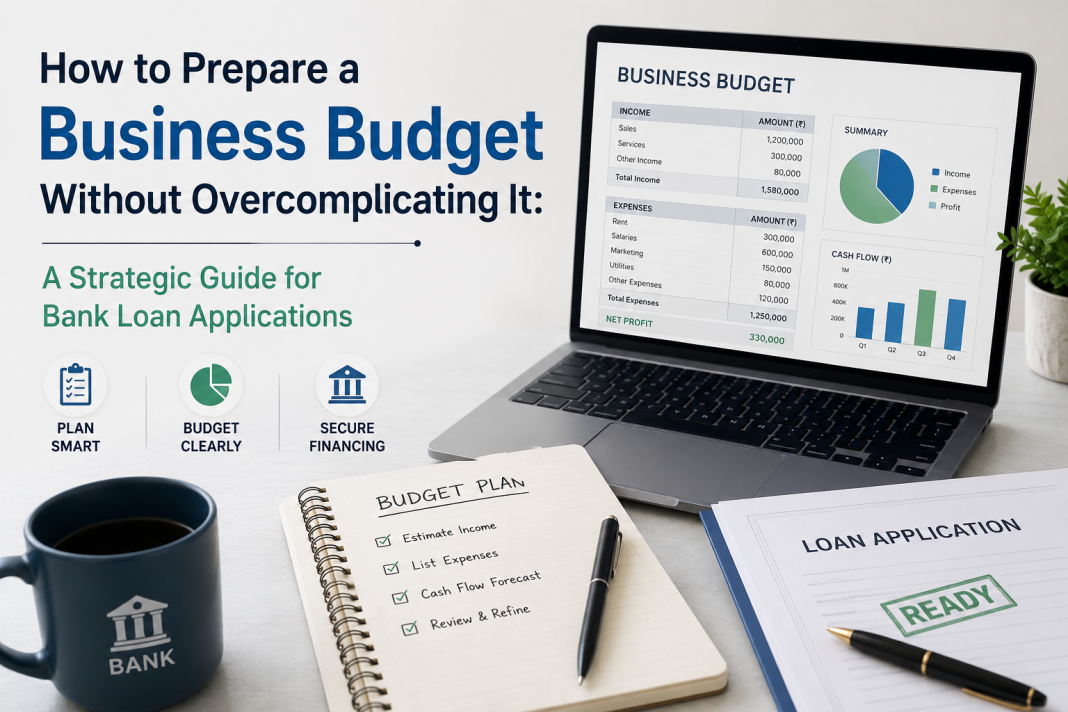
How to Prepare a Business Budget Without Overcomplicating It: A Strategic Guide for Bank Loan Applications
Maria Santos stared at the blank spreadsheet on her laptop screen, her heart racing as she imagined the loan officer’s reaction to her budget presentation. Her small manufacturing business had grown steadily over three years, but now she needed a substantial loan to expand operations and purchase new equipment. The loan officer had specifically requested a detailed budget showing how the funds would be used and how the business would repay the loan. One wrong number, one overlooked expense, or one unrealistic projection could mean the difference between business growth and stagnation.
This scenario plays out countless times as entrepreneurs seek financing for their ventures. The budget you present to a bank isn’t just a financial document—it’s a narrative about your business’s future, your management capabilities, and your commitment to responsible stewardship of borrowed funds. Getting it right can secure the capital you need; getting it wrong can close doors to growth opportunities.
Understanding the Bank’s Perspective: What Lenders Really Want to See
When banks review your loan application, they’re not just looking at numbers—they’re evaluating your business acumen, your understanding of market dynamics, and your ability to execute plans. Banks want to see evidence that you understand your business inside and out and that you can navigate the complexities of growth while maintaining financial discipline.
Banks are essentially making two assessments:
- Can you repay the loan? They want to see positive cash flow projections that demonstrate your ability to service debt while maintaining operational expenses.
- Do you understand your business? They want to see that you grasp the relationship between expenses, revenue, and profitability, and that your projections are grounded in reality rather than wishful thinking.
Consider the emotional weight of this process. The loan officer sitting across from you has been trained to identify potential risks and warning signs. Every assumption you make, every number you present, and every projection you offer will be scrutinized. The confidence you project comes not from bold claims, but from thorough preparation and realistic planning.
The Foundation: Start with What You Know
Begin your budget preparation by focusing on your existing business operations. This isn’t the time for wild speculation or optimistic projections—it’s time for honest assessment of your current financial position.
Historical Financial Performance
Start with your actual financial results from the past 12-24 months. This serves multiple purposes:
- Provides a baseline for reasonable projections
- Demonstrates consistency in your business operations
- Shows your ability to manage finances responsibly
- Builds credibility with lenders who can verify your claims
For example, if your business has consistently generated $50,000 in monthly revenue, projecting $100,000 monthly revenue immediately raises questions. Instead, analyze factors that contributed to your current revenue level and determine realistic growth potential based on market conditions, capacity constraints, and competitive positioning.
Fixed vs. Variable Expenses
Understanding your cost structure is crucial for lenders because it reveals your business’s sensitivity to volume changes:
Fixed Expenses: Costs that remain relatively constant regardless of business volume
- Rent/mortgage payments
- Insurance premiums
- Loan payments
- Salaries for core staff
- Equipment lease payments
Variable Expenses: Costs that fluctuate with business activity
- Raw materials or inventory purchases
- Commission-based compensation
- Shipping and delivery costs
- Utilities that vary with production
- Marketing expenses tied to sales volume
This distinction is emotionally important because it shows lenders that you understand business fundamentals. When sales drop, variable expenses decrease, providing some protection against losses. When sales increase, you know which expenses will rise and which will remain stable.
Simplifying the Budget Structure: The Three-Column Approach
Instead of creating complex multi-year projections with dozens of line items, use a simplified three-column approach that focuses on what matters most to lenders:
Column 1: Current Operations (Baseline)
Show your current monthly or annual financial position without considering the loan. Include:
- Current revenue streams
- Existing fixed and variable expenses
- Current profit margins
- Cash flow patterns
Column 2: Loan Impact (What Changes)
Detail specifically how the loan will change your operations:
- New equipment purchases and depreciation
- Additional staff salaries
- Increased production capacity
- Higher utility costs
- Enhanced marketing capabilities
Column 3: Projected Results (Post-Investment)
Show the expected financial position after implementing loan-funded improvements:
- Increased revenue capacity
- Higher fixed costs (loan payments)
- Improved efficiency metrics
- Enhanced competitive position
This approach provides clarity without overwhelming complexity. Lenders can easily see the connection between the loan and expected outcomes, making their decision-making process more straightforward.
Revenue Projections: Grounding Optimism in Reality
Revenue projections often cause the most anxiety for business owners because they require forecasting future market conditions. Here’s how to approach this critical component without overcomplicating the process:
Market-Based Projections
Rather than relying solely on optimistic assumptions, ground your projections in market research and competitive analysis:
Current Market Share Analysis
- What percentage of your target market do you currently serve?
- How much additional market share is realistically achievable?
- What factors limit your current market penetration?
Capacity-Based Projections
- What is your current production capacity?
- How will the loan help increase capacity?
- What are the realistic limits of your expanded capacity?
Seasonal and Cyclical Factors
- Does your business experience seasonal fluctuations?
- Are there economic cycles that affect your industry?
- How will these factors influence your projections?
Conservative Growth Assumptions
Banks appreciate conservative, well-reasoned projections over aggressive, unrealistic ones. Consider these approaches:
Percentage-Based Growth
Instead of absolute numbers, use percentage increases based on historical performance:
- If you’ve grown 10% annually for the past three years, projecting 12-15% growth shows ambition while remaining credible
- If you’re entering new markets, project modest initial growth (5-8%) that accelerates as you establish market presence
Milestone-Based Projections
Link revenue increases to specific achievements:
- Month 6: New product line launches, adding $X in monthly revenue
- Month 12: Market expansion reaches full capacity, achieving projected revenue levels
- Month 18: Efficiency improvements reduce costs, improving profit margins
Expense Management: The Heart of Credibility
Lenders pay close attention to expense projections because they reveal your understanding of business operations and your commitment to financial discipline.
Operating Expenses Post-Loan
Detail how the loan will affect your ongoing expenses:
New Fixed Costs
- Loan principal and interest payments
- Additional insurance for new equipment
- Maintenance contracts for upgraded systems
- Potential rent increases for expanded space
Variable Cost Changes
- Increased inventory requirements
- Higher utility costs from expanded operations
- Additional transportation/shipping expenses
- Expanded marketing budget for increased capacity
Cost Control Measures
Show lenders that you understand the importance of expense management:
Efficiency Improvements
- How will new equipment or processes reduce per-unit costs?
- What automation will eliminate manual processes?
- How will increased volume create purchasing power advantages?
Monitoring Systems
- What metrics will you track to ensure expenses stay on budget?
- How will you adjust if expenses exceed projections?
- What triggers would prompt operational changes?
Cash Flow: The Lifeline of Your Business
Cash flow projections are often more important to lenders than profit projections because they show your ability to meet financial obligations as they come due.
Monthly Cash Flow Projections
Create a simple monthly cash flow forecast for the first year post-loan:
Cash Inflows
- Projected sales revenue
- Loan proceeds (month of funding)
- Any other cash sources
Cash Outflows
- Operating expenses (fixed and variable)
- Loan payments (principal and interest)
- Equipment purchases
- Working capital investments
Net Monthly Change
- Shows whether you’ll have sufficient cash for operations
- Highlights potential cash shortfalls that need addressing
Working Capital Considerations
Many businesses underestimate the working capital requirements that accompany growth:
- Inventory Investment: Expansion often requires higher inventory levels
- Accounts Receivable: Increased sales may mean higher outstanding receivables
- Payment Terms: How will your payment terms change with larger suppliers/customers?
The Loan Repayment Plan: Demonstrating Financial Responsibility
This section is where your budget proves its worth. Show lenders exactly how you’ll repay the loan while maintaining business operations and growth.
Debt Service Coverage Ratio
Calculate and explain your debt service coverage ratio:
- Debt Service Coverage Ratio = Annual Net Income / Annual Loan Payments
- Most banks prefer ratios of 1.25 or higher
- Show how this ratio changes over the loan term
Amortization Schedule Integration
Include your loan amortization schedule in your projections:
- Principal and interest payments for each month/year
- How loan payments affect cash flow throughout the term
- Plans for refinancing or early repayment if possible
Contingency Planning
Address what happens if projections don’t materialize:
- What cost reductions could you implement?
- Which revenue streams are most reliable?
- How long could you sustain operations with reduced income?
Visual Presentation: Making Complex Information Accessible
Your budget doesn’t need to be a wall of numbers. Use simple visual elements to communicate key information:
Key Metrics Dashboard
Create a summary page showing:
- Revenue growth trajectory
- Profit margin trends
- Cash flow patterns
- Debt service coverage ratios
Simple Charts and Graphs
Use basic bar charts or line graphs to show:
- Monthly revenue projections
- Expense categories
- Cash flow trends
- Loan payment impact
Narrative Context
Accompany your numbers with brief explanations:
- Why you chose specific projection percentages
- What assumptions underlie your forecasts
- How you plan to achieve projected results
Common Pitfalls to Avoid: Learning from Others’ Mistakes
Overly Optimistic Projections
Maria’s competitor submitted a budget showing 200% revenue growth in the first year. The loan officer immediately questioned the realism, and the application was rejected. Stick to projections that are ambitious but achievable based on market conditions and your business capabilities.
Ignoring Seasonal Variations
A retail business owner projected steady monthly revenue without considering holiday seasonality. When challenged by the loan officer, he couldn’t explain how he’d handle the typical December surge followed by January decline. Always account for predictable business cycles.
Underestimating Expenses
Another applicant projected minimal operating expense increases despite planning significant business expansion. The loan officer noted that increased volume typically requires more staff, higher utilities, and greater maintenance costs. Always consider the full impact of growth on expenses.
Missing Cash Flow Timing
A service business showed strong annual profits but failed to address quarterly payment patterns from large clients. The cash flow analysis revealed months when loan payments would be due before sufficient cash was available. Always align cash inflows and outflows.
The Human Element: Demonstrating Management Capability
Beyond the numbers, your budget demonstrates your ability to run a business effectively:
Decision-Making Process
Show how you arrived at your projections:
- Market research conducted
- Competitor analysis performed
- Industry trend evaluation
- Internal capability assessment
Risk Awareness
Acknowledge potential challenges:
- Economic downturn impacts
- Competitive pressures
- Supply chain disruptions
- Regulatory changes
Adaptability Planning
Demonstrate flexibility:
- How you’ll adjust if projections aren’t met
- Alternative strategies for different scenarios
- Monitoring systems for early warning signs
- Contingency plans for various challenges
Preparing for Questions: Anticipating Lender Concerns
Your budget should anticipate the questions lenders will ask:
“What if your projections are too optimistic?”
Have alternative scenarios ready:
- Conservative projections (75% of primary estimates)
- Moderate growth projections (90% of primary estimates)
- Base case projections (100% of primary estimates)
“How do you know these numbers are achievable?”
Support your projections with:
- Market research data
- Customer commitments or letters of intent
- Historical growth patterns
- Competitive analysis
“What makes you different from competitors?”
Highlight your competitive advantages:
- Unique value proposition
- Market positioning
- Operational efficiencies
- Customer loyalty factors
Final Review: Ensuring Credibility and Accuracy
Before presenting your budget, conduct a thorough review:
Mathematical Verification
- Double-check all calculations
- Ensure totals match subtotals
- Verify that cash flow balances properly
- Confirm loan payment calculations
Reasonableness Check
- Compare projections to historical performance
- Assess against industry benchmarks
- Evaluate market conditions
- Consider competitive landscape
Documentation Preparation
- Gather supporting market research
- Prepare customer references
- Compile competitive analysis
- Organize financial records
The Emotional Journey: From Anxiety to Confidence
Creating a loan budget can feel overwhelming, especially when your business’s future depends on the outcome. However, approaching this task systematically transforms anxiety into confidence. Each assumption you verify, each calculation you check, and each scenario you consider builds your confidence in the budget’s accuracy and your business’s potential.
Remember that banks want to lend money to qualified borrowers. They’re not trying to find reasons to say no—they’re trying to ensure that loans will be repaid successfully. A well-prepared, realistic budget demonstrates that you’re a responsible borrower who understands your business and can manage borrowed funds effectively.
Conclusion: Your Budget as a Gateway to Growth
Your loan application budget is more than a financial document—it’s a strategic tool that demonstrates your business acumen, financial discipline, and growth potential. By focusing on realistic projections, comprehensive expense management, and clear repayment plans, you create a compelling case for your loan request.
The key to success lies in simplicity without sacrificing thoroughness. Present clear, well-reasoned projections that demonstrate your understanding of business fundamentals and your ability to execute growth plans responsibly. Avoid the temptation to overcomplicate your budget with unnecessary detail, but ensure you address all aspects that lenders care about.
Your budget should tell a story of responsible growth, careful planning, and realistic optimism. When lenders read your budget, they should see a business owner who understands market dynamics, manages resources effectively, and can deliver on promises. This combination of financial acumen and strategic thinking creates the confidence lenders need to approve your loan request.
Start with what you know, build projections on solid foundations, and present your case with clarity and confidence. Your business growth depends on it, and with the right approach, your budget will become the key that unlocks the capital you need to achieve your goals.

