LATEST ARTICLES

Zimbabwe’s Internet Illusion: Why Econet Smart4U Is Losing Trust While NetOne BBB Is Winning the Conversation

For years, Econet Wireless Zimbabwe has dominated Zimbabwe’s mobile internet market with a near-unquestioned grip on consumers. Its coverage remains unmatched in many areas, EcoCash is deeply embedded into daily life, and for millions of Zimbabweans, Econet is not just a network — it is infrastructure.

But the rise of Smart4U has exposed something uncomfortable about Zimbabwe’s telecom industry:

The difference between marketing internet and delivering internet.

And increasingly, Zimbabweans are beginning to notice.


The Seductive Promise of Smart4U

On paper, Smart4U sounds revolutionary.

Unlimited internet.
Affordable pricing.
Calls and SMS included.
Personalized bundles.
Thirty-day validity.

At first glance, it feels like Econet finally listened to ordinary Zimbabweans struggling under crushing data costs.

A user sees:

  • $15 for “unlimited” internet
  • $23 for “unlimited” internet
  • voice minutes included
  • SMS included

And naturally, the conclusion is:

“This is finally affordable internet.”

But that is precisely where the psychological trap begins.

Because Smart4U is not truly selling unlimited internet.

It is selling the idea of unlimited internet.

And those are not the same thing.


The Fair Usage Policy Nobody Truly Understands

The entire Smart4U ecosystem revolves around something Econet repeatedly references but never clearly defines:

The Fair Usage Policy (FUP). (econet.co.zw)

Econet openly states that:

  • speeds may be reduced after thresholds are reached,
  • thresholds may change,
  • users are selected through internal criteria,
  • speeds are not guaranteed,
  • tethering is not supported. (econet.co.zw)

That alone would be acceptable — if the limits were transparent.

But they are not.

Users are never clearly told:

  • what their real high-speed cap is,
  • when throttling begins,
  • how severe throttling becomes,
  • what network priority Smart4U users receive,
  • or why performance varies so wildly.

Instead, customers are thrown into a vague “best effort” pool after crossing invisible thresholds. (Paynow)

This creates one of the most frustrating customer experiences imaginable:

You never know whether your internet is working normally or whether you are already being punished by the system.


Smart4U’s Biggest Problem: It Feels Dishonest

This is where public frustration becomes emotional rather than technical.

The criticism surrounding Smart4U is not simply about speed.

It is about trust.

Consumers can tolerate limits.
Consumers can tolerate caps.
Consumers can tolerate lower speeds on cheaper plans.

What they struggle to tolerate is ambiguity.

And Smart4U thrives on ambiguity.

Econet markets “unlimited” connectivity while simultaneously designing a system where users often report:

  • inability to stream reliably,
  • severe throttling,
  • unusable upload speeds,
  • poor performance during peak hours,
  • failure to send media files,
  • inconsistent browsing experience. (Reddit)

The contradiction is glaring.

How can a product advertise freedom while delivering restriction?

How can “unlimited internet” become so slow that even Instagram pictures fail to load?

At that point, the debate stops being technical.

It becomes philosophical.

Because consumers begin asking:

“What exactly did I buy?”


The Psychological Manipulation of Smart4U

Perhaps the most brilliant — and controversial — thing about Smart4U is how it psychologically locks users into dependence.

Users complain constantly.
Users mock the bundle publicly.
Users call it “SmartScam.”
Users joke:

“Smart4U unotenga data but network unozvionera.”

And yet they keep buying it.

Why?

Because Econet understands something fundamental about Zimbabwe’s telecom market:

People are not buying Smart4U because it is excellent.

They are buying it because alternatives historically felt worse.

This is not customer loyalty.

This is market captivity.

And that distinction matters.


Why NetOne BBB Changed the Conversation

Then came NetOne Big Beautiful Bundles (BBB).

Suddenly, the conversation shifted.

Instead of selling “unlimited” internet governed by mysterious policies, NetOne introduced something radically simple:

  • 100GB for $45
  • 150GB for $80
  • 200GB for $130
  • fixed allocations
  • defined validity
  • advertised speed expectations (netone.co.zw)

That transparency alone became disruptive.

Because users finally knew:

  • what they were paying for,
  • what they were receiving,
  • and what would happen when the bundle ended.

No illusion.
No hidden thresholds.
No undefined “fairness.”

Just data.

And in modern internet economics, predictability is powerful.


Smart4U Is Not SmartSuite — And That Is The Problem

Many consumers initially assumed Smart4U would behave similarly to Econet’s SmartSuite offerings.

But SmartSuite was designed more as a structured broadband replacement:

  • more stable,
  • more predictable,
  • optimized for fixed environments,
  • intended for shared connectivity.

Smart4U, by contrast, feels heavily traffic-managed.

And users quickly notice the difference.

A Smart4U connection often feels like:

  • heavily deprioritized traffic,
  • restricted throughput,
  • aggressive congestion management,
  • bandwidth rationing disguised as unlimited access.

The result is a package that technically keeps you online while functionally limiting what you can meaningfully do online.

That distinction is crucial.

Because modern internet usage is not merely about “being connected.”

It is about:

  • Zoom calls,
  • cloud backups,
  • YouTube uploads,
  • remote work,
  • large file transfers,
  • streaming,
  • online education,
  • digital business operations.

An internet connection that only reliably supports WhatsApp text messaging is not modern broadband.

It is digital survival mode.


Econet’s Core Problem: Market Dominance Without Pressure

The deeper issue here is not merely Smart4U.

It is what happens when a dominant telecom operator faces limited competitive pressure.

For years, Econet could:

  • shape pricing,
  • define consumer expectations,
  • normalize vague terms,
  • and rely on network superiority to retain customers.

But BBB represents something dangerous for Econet:

A competitor finally competing on value perception.

Even people who have not yet switched to NetOne are beginning to ask:

“Why am I paying for uncertainty?”

That question alone is strategically significant.


NetOne Is Not Perfect — But It Is Clearer

To be fair, NetOne still struggles with:

  • inconsistent coverage in some regions,
  • congestion in certain areas,
  • infrastructure limitations,
  • and public skepticism rooted in historical performance. (Techzim)

But BBB succeeds where Smart4U fails:

Expectation management.

NetOne is not promising magical unlimited internet.

It is promising measurable internet.

And consumers increasingly prefer brutal honesty over marketing poetry.


The Tragedy of Zimbabwe’s Internet Economy

The saddest part is that Smart4U could have transformed internet accessibility in Zimbabwe.

If properly implemented, it had the potential to:

  • democratize internet access,
  • empower students,
  • help freelancers,
  • support SMEs,
  • reduce digital exclusion,
  • and create affordable productivity connectivity.

Instead, many users describe it as:

  • unreliable,
  • unpredictable,
  • frustrating,
  • and psychologically exhausting.

Not because the idea was bad.

But because the execution damaged trust.


The Future: Consumers Are Becoming More Intelligent

Zimbabwean consumers are no longer passive.

They now:

  • compare speeds,
  • test latency,
  • share experiences online,
  • expose throttling,
  • discuss FUPs,
  • benchmark providers,
  • and publicly critique telecom behavior.

The telecom industry is entering a new era where marketing alone is no longer enough.

Consumers want:

  • transparency,
  • consistency,
  • predictability,
  • and dignity.

And whichever network delivers those first will dominate the next decade.

Right now, NetOne BBB is winning something more important than pricing wars.

It is winning the perception war.

And in telecommunications, perception eventually becomes market reality.


The Deeper Implications for Digital Trust

The growing skepticism towards Smart4U reflects a broader shift in how Zimbabweans view digital services. In an economy where every dollar counts and financial resources are stretched thin, consumers demand clarity and reliability. The ambiguity surrounding Smart4U’s Fair Usage Policy doesn’t just frustrate users—it erodes confidence in the entire digital ecosystem.

When users cannot predict whether their internet connection will support basic video conferencing or file uploads, it impacts their ability to engage in remote work, online learning, or e-commerce. This uncertainty creates a barrier to digital inclusion, the very problem Smart4U was supposedly designed to solve.


The Transparency Advantage: Why Clarity Wins

NetOne’s approach with BBB, despite its own challenges, highlights a critical lesson: consumers value knowing exactly what they’re purchasing. Even if the quantity seems smaller compared to an ambiguous “unlimited” offering, the guarantee of a specific data amount provides peace of mind and allows users to plan their digital activities effectively.

This preference for transparency extends beyond telecommunications. In a market where trust in institutions and services has been tested by economic volatility, consumers gravitate towards options that minimize risk and maximize predictability. Businesses that understand and cater to this need position themselves advantageously in the marketplace.


The Competitive Landscape Ahead

The emergence of NetOne BBB as a credible alternative signals a healthy evolution in Zimbabwe’s telecom sector. Competition drives innovation, efficiency, and ultimately, better value for consumers. For Econet, the challenge is no longer just maintaining market share through network dominance, but earning it through superior service and honest communication.

If Econet wishes to reclaim the trust lost through Smart4U’s opacity, it must address the core issue: the disconnect between marketing promises and user experience. This might involve revising the FUP to be more transparent, offering clearer speed guarantees, or restructuring the bundles to align more closely with user expectations.


Conclusion: The Price of Trust

The narrative around Smart4U versus NetOne BBB transcends simple product comparison. It illustrates the fundamental importance of trust in digital services. In Zimbabwe’s evolving digital landscape, companies that prioritize clear communication, reliable service, and predictable value propositions will thrive.

Econet’s historical dominance cannot shield it indefinitely from the consequences of eroding consumer trust. Meanwhile, NetOne’s opportunity lies not just in offering competitive bundles, but in establishing itself as the provider that respects the intelligence and financial constraints of its customers. The future of Zimbabwe’s internet market will likely belong to the company that best balances affordability, transparency, and performance.

Zimbabwe’s Internet Illusion: Why Econet Smart4U Is Losing Trust While NetOne BBB Is Winning the Conversation

For years, Econet Wireless Zimbabwe has dominated Zimbabwe’s mobile internet market with a near-unquestioned grip on consumers. Its coverage remains unmatched in many areas, EcoCash is deeply embedded into daily life, and for millions of Zimbabweans, Econet is not just a network — it is infrastructure.

But the rise of Smart4U has exposed something uncomfortable about Zimbabwe’s telecom industry:

The difference between marketing internet and delivering internet.

And increasingly, Zimbabweans are beginning to notice.


The Seductive Promise of Smart4U

On paper, Smart4U sounds revolutionary.

Unlimited internet.
Affordable pricing.
Calls and SMS included.
Personalized bundles.
Thirty-day validity.

At first glance, it feels like Econet finally listened to ordinary Zimbabweans struggling under crushing data costs.

A user sees:

  • $15 for “unlimited” internet
  • $23 for “unlimited” internet
  • voice minutes included
  • SMS included

And naturally, the conclusion is:

“This is finally affordable internet.”

But that is precisely where the psychological trap begins.

Because Smart4U is not truly selling unlimited internet.

It is selling the idea of unlimited internet.

And those are not the same thing.


The Fair Usage Policy Nobody Truly Understands

The entire Smart4U ecosystem revolves around something Econet repeatedly references but never clearly defines:

The Fair Usage Policy (FUP). (econet.co.zw)

Econet openly states that:

  • speeds may be reduced after thresholds are reached,
  • thresholds may change,
  • users are selected through internal criteria,
  • speeds are not guaranteed,
  • tethering is not supported. (econet.co.zw)

That alone would be acceptable — if the limits were transparent.

But they are not.

Users are never clearly told:

  • what their real high-speed cap is,
  • when throttling begins,
  • how severe throttling becomes,
  • what network priority Smart4U users receive,
  • or why performance varies so wildly.

Instead, customers are thrown into a vague “best effort” pool after crossing invisible thresholds. (Paynow)

This creates one of the most frustrating customer experiences imaginable:

You never know whether your internet is working normally or whether you are already being punished by the system.


Smart4U’s Biggest Problem: It Feels Dishonest

This is where public frustration becomes emotional rather than technical.

The criticism surrounding Smart4U is not simply about speed.

It is about trust.

Consumers can tolerate limits.
Consumers can tolerate caps.
Consumers can tolerate lower speeds on cheaper plans.

What they struggle to tolerate is ambiguity.

And Smart4U thrives on ambiguity.

Econet markets “unlimited” connectivity while simultaneously designing a system where users often report:

  • inability to stream reliably,
  • severe throttling,
  • unusable upload speeds,
  • poor performance during peak hours,
  • failure to send media files,
  • inconsistent browsing experience. (Reddit)

The contradiction is glaring.

How can a product advertise freedom while delivering restriction?

How can “unlimited internet” become so slow that even Instagram pictures fail to load?

At that point, the debate stops being technical.

It becomes philosophical.

Because consumers begin asking:

“What exactly did I buy?”


The Psychological Manipulation of Smart4U

Perhaps the most brilliant — and controversial — thing about Smart4U is how it psychologically locks users into dependence.

Users complain constantly.
Users mock the bundle publicly.
Users call it “SmartScam.”
Users joke:

“Smart4U unotenga data but network unozvionera.”

And yet they keep buying it.

Why?

Because Econet understands something fundamental about Zimbabwe’s telecom market:

People are not buying Smart4U because it is excellent.

They are buying it because alternatives historically felt worse.

This is not customer loyalty.

This is market captivity.

And that distinction matters.


Why NetOne BBB Changed the Conversation

Then came NetOne Big Beautiful Bundles (BBB).

Suddenly, the conversation shifted.

Instead of selling “unlimited” internet governed by mysterious policies, NetOne introduced something radically simple:

  • 100GB for $45
  • 150GB for $80
  • 200GB for $130
  • fixed allocations
  • defined validity
  • advertised speed expectations (netone.co.zw)

That transparency alone became disruptive.

Because users finally knew:

  • what they were paying for,
  • what they were receiving,
  • and what would happen when the bundle ended.

No illusion.
No hidden thresholds.
No undefined “fairness.”

Just data.

And in modern internet economics, predictability is powerful.


Smart4U Is Not SmartSuite — And That Is The Problem

Many consumers initially assumed Smart4U would behave similarly to Econet’s SmartSuite offerings.

But SmartSuite was designed more as a structured broadband replacement:

  • more stable,
  • more predictable,
  • optimized for fixed environments,
  • intended for shared connectivity.

Smart4U, by contrast, feels heavily traffic-managed.

And users quickly notice the difference.

A Smart4U connection often feels like:

  • heavily deprioritized traffic,
  • restricted throughput,
  • aggressive congestion management,
  • bandwidth rationing disguised as unlimited access.

The result is a package that technically keeps you online while functionally limiting what you can meaningfully do online.

That distinction is crucial.

Because modern internet usage is not merely about “being connected.”

It is about:

  • Zoom calls,
  • cloud backups,
  • YouTube uploads,
  • remote work,
  • large file transfers,
  • streaming,
  • online education,
  • digital business operations.

An internet connection that only reliably supports WhatsApp text messaging is not modern broadband.

It is digital survival mode.


Econet’s Core Problem: Market Dominance Without Pressure

The deeper issue here is not merely Smart4U.

It is what happens when a dominant telecom operator faces limited competitive pressure.

For years, Econet could:

  • shape pricing,
  • define consumer expectations,
  • normalize vague terms,
  • and rely on network superiority to retain customers.

But BBB represents something dangerous for Econet:

A competitor finally competing on value perception.

Even people who have not yet switched to NetOne are beginning to ask:

“Why am I paying for uncertainty?”

That question alone is strategically significant.


NetOne Is Not Perfect — But It Is Clearer

To be fair, NetOne still struggles with:

  • inconsistent coverage in some regions,
  • congestion in certain areas,
  • infrastructure limitations,
  • and public skepticism rooted in historical performance. (Techzim)

But BBB succeeds where Smart4U fails:

Expectation management.

NetOne is not promising magical unlimited internet.

It is promising measurable internet.

And consumers increasingly prefer brutal honesty over marketing poetry.


The Tragedy of Zimbabwe’s Internet Economy

The saddest part is that Smart4U could have transformed internet accessibility in Zimbabwe.

If properly implemented, it had the potential to:

  • democratize internet access,
  • empower students,
  • help freelancers,
  • support SMEs,
  • reduce digital exclusion,
  • and create affordable productivity connectivity.

Instead, many users describe it as:

  • unreliable,
  • unpredictable,
  • frustrating,
  • and psychologically exhausting.

Not because the idea was bad.

But because the execution damaged trust.


The Future: Consumers Are Becoming More Intelligent

Zimbabwean consumers are no longer passive.

They now:

  • compare speeds,
  • test latency,
  • share experiences online,
  • expose throttling,
  • discuss FUPs,
  • benchmark providers,
  • and publicly critique telecom behavior.

The telecom industry is entering a new era where marketing alone is no longer enough.

Consumers want:

  • transparency,
  • consistency,
  • predictability,
  • and dignity.

And whichever network delivers those first will dominate the next decade.

Right now, NetOne BBB is winning something more important than pricing wars.

It is winning the perception war.

And in telecommunications, perception eventually becomes market reality.


The Deeper Implications for Digital Trust

The growing skepticism towards Smart4U reflects a broader shift in how Zimbabweans view digital services. In an economy where every dollar counts and financial resources are stretched thin, consumers demand clarity and reliability. The ambiguity surrounding Smart4U’s Fair Usage Policy doesn’t just frustrate users—it erodes confidence in the entire digital ecosystem.

When users cannot predict whether their internet connection will support basic video conferencing or file uploads, it impacts their ability to engage in remote work, online learning, or e-commerce. This uncertainty creates a barrier to digital inclusion, the very problem Smart4U was supposedly designed to solve.


The Transparency Advantage: Why Clarity Wins

NetOne’s approach with BBB, despite its own challenges, highlights a critical lesson: consumers value knowing exactly what they’re purchasing. Even if the quantity seems smaller compared to an ambiguous “unlimited” offering, the guarantee of a specific data amount provides peace of mind and allows users to plan their digital activities effectively.

This preference for transparency extends beyond telecommunications. In a market where trust in institutions and services has been tested by economic volatility, consumers gravitate towards options that minimize risk and maximize predictability. Businesses that understand and cater to this need position themselves advantageously in the marketplace.


The Competitive Landscape Ahead

The emergence of NetOne BBB as a credible alternative signals a healthy evolution in Zimbabwe’s telecom sector. Competition drives innovation, efficiency, and ultimately, better value for consumers. For Econet, the challenge is no longer just maintaining market share through network dominance, but earning it through superior service and honest communication.

If Econet wishes to reclaim the trust lost through Smart4U’s opacity, it must address the core issue: the disconnect between marketing promises and user experience. This might involve revising the FUP to be more transparent, offering clearer speed guarantees, or restructuring the bundles to align more closely with user expectations.


Conclusion: The Price of Trust

The narrative around Smart4U versus NetOne BBB transcends simple product comparison. It illustrates the fundamental importance of trust in digital services. In Zimbabwe’s evolving digital landscape, companies that prioritize clear communication, reliable service, and predictable value propositions will thrive.

Econet’s historical dominance cannot shield it indefinitely from the consequences of eroding consumer trust. Meanwhile, NetOne’s opportunity lies not just in offering competitive bundles, but in establishing itself as the provider that respects the intelligence and financial constraints of its customers. The future of Zimbabwe’s internet market will likely belong to the company that best balances affordability, transparency, and performance.
Navigating Zimbabwe’s SI 108 Company Re-Registration: A Critical Deadline and the Broader African Business Registration Landscape

Zimbabwe’s SI 108 Re-Registration: A Deep Dive into the Critical 2026 Deadline and the Broader African Business Registration Landscape

The Zimbabwean business ecosystem stands at a critical juncture. The April 20, 2026, deadline for mandatory re-registration under Statutory Instrument 108 of 2025 looms large, presenting a complex and high-stakes challenge that could fundamentally alter the legal existence of thousands of non-compliant entities. This initiative is not merely an administrative update; it represents a fundamental restructuring of the national business registry, with profound implications for corporate governance, economic formalization, and the rule of law.

Understanding SI 108: The Mandate, the Mechanism, and the Motivation

SI 108 is a statutory instrument issued under the Companies and Other Business Entities Act [Chapter 24:31]. At its core, it mandates the complete re-registration of all companies and Private Business Corporations (PBCs) that were incorporated before February 2024. This is not a simple renewal or update; it is a requirement to reapply for legal existence under the new legislative framework and within the new electronic system managed by the Companies and Intellectual Property Office of Zimbabwe (CIPZ).

The Legislative Foundation and Objectives

The foundation for this massive undertaking is the Companies and Other Business Entities Act [COBE Act], which replaced the older Companies Act. The government has articulated several key strategic objectives for this transition:

  1. Data Cleansing and Registry Accuracy: One of the primary motivations is to address the proliferation of “ghost” or dormant companies clogging the registry. These inactive entities distort the true picture of the business landscape, making it difficult for investors, creditors, and government agencies to assess the real economy. SI 108 aims to identify and remove these entities, creating a cleaner, more accurate database of active businesses.
  2. Digital Transition and Modernization: The shift from paper-based records to a fully electronic registry is crucial for improving efficiency, security, and accessibility. Electronic records are less prone to loss, damage, or manipulation, enhancing the integrity of the registry.
  3. Enhanced Transparency and Accountability: A modern, electronic system can facilitate better tracking of beneficial ownership, directorship, and financial compliance, contributing to anti-corruption efforts and improving the investment climate.
  4. Alignment with International Standards: Bringing Zimbabwe’s corporate laws and registration processes in line with international best practices is vital for attracting foreign investment, facilitating cross-border trade, and improving the country’s standing in global competitiveness indices.

Scope of Affected Entities

The scope of SI 108 is exceptionally broad, encompassing virtually every type of incorporated entity registered under the old system:

  • Private Limited Companies (Pvt Ltd): The standard corporate vehicle for most medium and large businesses.
  • Private Business Corporations (PBCs): A popular structure for sole proprietors and small partnerships seeking limited liability.
  • Public Limited Companies: Entities intended for public share offerings and trading.
  • Companies Limited by Guarantee: Commonly used by non-profit organizations, clubs, and associations.
  • NGOs Registered as Companies: Non-governmental organizations that chose the company structure must also re-register.
  • Dormant or Inactive Entities: Even companies not currently trading must either re-register or formally apply for voluntary deregistration. This ensures that only genuinely defunct companies are removed, not simply those temporarily inactive.

The Harsh Reality: Consequences of Missing the April 20, 2026 Deadline

The deadline set by SI 108 is absolute and non-negotiable. The statutory instrument explicitly states that failure to re-register by April 20, 2026, will result in automatic deregistration without notice. This legal mechanism is designed to be swift and decisive, leaving no room for appeals or extensions based on oversight or delay.

The consequences of this automatic deregistration are immediate, severe, and multifaceted:

  • Legal Extinction: The company is formally removed from the Companies Register, losing its status as a separate legal entity. It ceases to exist in the eyes of the law.
  • Loss of Corporate Capacity: The dissolved entity cannot legally trade, enter into new contracts, incur liabilities, employ staff, or operate bank accounts under its registered name. Any such actions undertaken post-deregistration are legally void or expose individuals to personal liability.
  • Asset Forfeiture: Any remaining assets owned by the deregistered company—be it cash, property, inventory, or intellectual property—automatically vest in the State under the legal doctrine of bona vacantia. This represents a total loss of company assets.
  • Personal Liability: The fundamental benefit of limited liability is stripped away. Directors, shareholders, and potentially other officers may become personally liable for all outstanding debts, contractual obligations, and legal claims against the company incurred before and potentially after deregistration.
  • Criminal Liability: Conducting business under the name of a deregistered company constitutes a criminal offense. Directors or agents continuing operations risk prosecution and penalties.
  • Name Release: The company name is immediately released back into the public domain, making it available for any other party to register and use, potentially causing brand confusion or loss of reputation.
  • Operational Disruption: For active businesses, the impact is catastrophic, leading to immediate cessation of operations, supplier and client contract breaches, employee dismissals, and potential insolvency.

The Primary Challenge: The Mandatory Prerequisite of Clearing Annual Returns

The most significant and potentially paralyzing aspect of the SI 108 process is the absolute prerequisite that all outstanding annual returns must be cleared before the re-registration application can even be considered by CIPZ. This requirement acts as a gatekeeper, halting the entire process for any company with historical filing gaps.

This prerequisite creates a complex and often burdensome pathway for many businesses:

  1. Historical Record Gaps: Many companies, particularly older ones or those that have changed ownership or management, may lack complete records for previous years. Retrieving old financial statements, resolutions, or even confirmation of filing status can be a daunting task.
  2. Accumulated Penalties and Fees: The COBE Act prescribes penalties for late filing of annual returns. These penalties compound annually, meaning a company with five years of outstanding returns could face a substantial financial burden, potentially running into hundreds or even thousands of US dollars (or equivalent in local currency), making the process financially prohibitive for cash-strapped SMEs.
  3. Dependency on Manual Processes: Despite the push for digitization, the process of clearing old returns often seems to require interaction with physical archives, verification of paper documents, or specific procedures that may not be fully streamlined online. This reintroduces manual bottlenecks and potential delays within the supposedly electronic system.
  4. Complexity of Calculation: Calculating the exact number of outstanding returns, the corresponding penalties, and understanding the specific filing requirements for each year can be technically challenging for business owners without legal or accounting expertise.
  5. Resource Intensity: The time and effort required to gather historical information, calculate penalties, prepare old returns, and navigate the submission process can be immense, diverting resources from core business activities.

This requirement has emerged as the “biggest bottleneck” in the process, as noted by experts. It effectively forces businesses to retroactively solve historical compliance issues before they can participate in the future system, which can be a significant deterrent.


A Comprehensive Step-by-Step Guide to Re-Registration

Successfully navigating the SI 108 re-registration process demands meticulous planning, organization, and execution. Here is a detailed breakdown of the required steps:

  1. Clear Outstanding Annual Returns (MANDATORY PREREQUISITE):
    • Audit Your Filing History: Determine exactly how many annual returns are outstanding since the company’s inception or the last filed return.
    • Calculate Penalties: Use the CIPZ portal or seek professional advice to calculate the total penalties due for late filing.
    • Gather Historical Information: Collect the necessary financial and operational data required to complete these past returns.
    • File Returns Electronically: Submit all outstanding annual returns via the CIPZ online portal and pay the associated penalties. This step must be completed in full before proceeding.
  2. Gather and Update Essential Company Documents:
    • CR14 (List of Members/Shareholders): Obtain the most current version showing all members/shareholders and their shareholdings.
    • CR6 (List of Directors): Obtain the most current version listing all directors and their details.
    • Memorandum and Articles of Association (M&A): Locate the latest version. If amendments have been made, ensure the most recent version incorporating all changes is available.
    • Certificate of Incorporation: Retrieve the original certificate (if available). While the new system may not always require the physical document, having it is good practice.
  3. Compile Comprehensive Personal Information for Directors and Shareholders:
    • For each director and shareholder, collect:
      • Full legal name
      • National Identity Document number
      • Date of Birth
      • Physical residential address
      • Mobile phone number
      • Email address
    • Ensure this information is accurate and up-to-date.
  4. Prepare Necessary Internal Resolutions and Affidavits:
    • Board Resolution: Draft a formal resolution by the Board of Directors authorizing the process of re-registration under SI 108. It should specify the individuals authorized to act on behalf of the company during the process.
    • Special Resolution: Prepare a special resolution signed by all shareholders consenting to the re-registration under the COBE Act and agreeing to the terms of the new registration.
    • Affidavit: Draft a sworn affidavit, typically made by a director or the designated applicant, confirming their authority to submit the application, the accuracy of all information provided, and compliance with the SI 108 requirements.
  5. Submit the Online Re-Registration Application:
    • Log into the official CIPZ online portal using the company’s credentials.
    • Navigate to the SI 108 re-registration section.
    • Complete the online application form accurately, providing all requested details about the company, its directors, shareholders, and operations.
    • Upload all required documents (updated CR14, CR6, M&A, Board/Special Resolutions, Affidavit, proof of cleared annual returns) in the specified formats.
  6. Pay the Prescribed Re-Registration Fee:
    • Calculate the correct re-registration fee based on the company type (Pvt Ltd, PBC, etc.) and any other applicable criteria.
    • Complete the online payment process using the accepted payment methods provided by CIPZ.
  7. Await Verification and Processing by CIPZ:
    • After submission, CIPZ officials will review the application. This process involves checking the completeness of information, verifying uploaded documents, and ensuring compliance with SI 108 requirements.
    • The duration of this verification phase can vary and may be subject to the volume of applications received, especially closer to the deadline.
  8. Receive the New Registration Certificate:
    • Upon successful verification and approval, CIPZ will issue a new registration certificate under the Companies and Other Business Entities Act.
    • This certificate confirms the company’s active status under the new system and allows it to continue operating legally.

Strategic Actions for Immediate Implementation

Given the critical nature of the deadline and the inherent complexity of the process, businesses must adopt a proactive and strategic approach.

  • Conduct an Immediate Audit: Determine your company’s status under SI 108. Check your filing history on the CIPZ portal to see how many annual returns are outstanding.
  • Begin the Annual Returns Process Immediately: Do not delay this critical first step. Start gathering the necessary information and calculating penalties right away. This step alone can take weeks or months if multiple years are involved.
  • Assemble Required Documentation: Gather all necessary company documents and personal information for directors/shareholders. Store them securely and in an organized manner.
  • Consider Engaging Professionals: The process is intricate and demands specific knowledge. Consulting with qualified lawyers, chartered accountants, or company secretaries experienced in SI 108 can save time, prevent errors, and ensure compliance. Firms like Onilaz Group specialize in providing end-to-end assistance.
  • Stay Informed: Regularly check the official CIPZ website and communications for updates, clarifications, or changes to procedures and fees.
  • Budget for Costs: Plan financially for the re-registration fee, penalties for outstanding returns, and any professional service charges. Unexpected costs can derail the process.
  • Act Early: Starting early mitigates risks associated with potential system overload on the CIPZ portal, unforeseen complications with documentation, or processing delays as the deadline approaches. The “Professional Tip” from Onilaz – “Start the process NOW” – cannot be overstated.

The Broader Context: Comparative Analysis with Other African Countries

Zimbabwe’s SI 108 initiative is part of a continent-wide trend towards modernizing business registration and corporate governance frameworks. However, the specific approach taken—mandating a full re-registration with a strict deadline and the prerequisite of clearing historical obligations—differs significantly from practices in other African jurisdictions. Examining how Zimbabwe’s process compares to reforms and systems in Kenya, Rwanda, Nigeria, Ghana, and South Africa reveals distinct strategies and potential implications.

1. Rwanda: A Pioneer in Streamlined, Efficient Onboarding

Rwanda consistently ranks highest in Sub-Saharan Africa for “ease of doing business,” particularly in the area of starting a business. Its approach emphasizes extreme simplicity and speed.

  • Process: Registering a new business in Rwanda is remarkably streamlined. It is primarily conducted online via the Rwanda Development Board (RDB) or Rwanda Green Growth and Climate Finance (RGGCF) portals. The process involves minimal documentation, clear, standardized procedures, and can often be completed within hours.
  • Digital Infrastructure: The system is built from the ground up with digital efficiency in mind, minimizing manual intervention.
  • Comparison: Rwanda’s model focuses entirely on facilitating the creation of new businesses efficiently and affordably. It does not appear to have implemented a large-scale, mandatory re-registration event for existing companies akin to SI 108. There is no evidence of a requirement for existing firms to clear all historical obligations before gaining access to the system for other purposes. Rwanda’s success stems from designing a user-friendly system for the future rather than imposing a complex historical audit on the past.
  • Key Difference: Rwanda optimizes for new business creation and future compliance. Zimbabwe’s SI 108 prioritizes auditing and revalidating existing businesses with potentially messy historical records under a strict deadline.

2. Kenya: Gradual Electronic Integration and Ongoing Refinement

Kenya’s business registration is managed primarily through the e-Citizen platform and the Attorney General’s office under the Companies Act.

  • Process: Business registration (name reservation, incorporation) is largely electronic and relatively straightforward. The e-Citizen portal allows for online filing of annual returns and other compliance matters.
  • Approach: Kenya’s reform strategy has been more iterative. Rather than a sudden, mandatory reset, it involves gradually improving the existing system, adding digital capabilities, and streamlining procedures over time. While compliance (like annual returns) is mandatory, the system generally allows businesses to operate and manage compliance within the electronic framework without a blanket historical clearance requirement preceding all other actions.
  • Comparison: Kenya demonstrates a path of continuous improvement and gradual digital adoption. The system aims to make ongoing compliance easier for existing businesses. While Kenya has its own bureaucratic challenges, the system doesn’t impose the same kind of “stop-start” mechanism seen in SI 108, where a company must resolve all past issues before taking any further steps.
  • Key Difference: Kenya emphasizes ongoing electronic compliance and gradual system enhancement. SI 108 demands a one-time, comprehensive historical settlement before reintegration.

3. Nigeria: Multi-Agency Coordination and Incremental Digital Adoption

Nigeria’s Corporate Affairs Commission (CAC) is the primary regulator for business registration. The country has been actively pursuing digital reforms under initiatives like the CAC Business Registry.

  • Process: Incorporation can be done online via the CAC portal (ROC Online). The process involves name search, incorporation filing, and obtaining certificates. Annual returns and other compliance are also managed online.
  • Approach: Nigeria’s strategy involves adding digital layers and capabilities to the existing system, aiming to reduce manual processes and improve service delivery. Reforms like the Business Registry aim to consolidate services. While compliance is mandatory, the system doesn’t appear to feature a blanket requirement for all existing companies to re-register under a new act with a strict, time-bound historical clearance prerequisite like SI 108.
  • Comparison: Nigeria’s path involves incremental improvement, digital platform development, and service consolidation. It focuses on making the current process smoother for both new and existing businesses without necessarily forcing a complete historical reckoning for all before moving forward.
  • Key Difference: Nigeria pursues incremental digital improvement and service consolidation. SI 108 enforces a mandatory, comprehensive restart for all existing entities.

4. Ghana: Service Consolidation and Platform Unification

Ghana’s Business Registration Agency (BRA), formed by merging the CAC and other bodies, aims to streamline business registration and licensing.

  • Process: The Ghana.Gov.Gh portal facilitates online business registration and related services like tax registration and permits. The focus is on creating a unified, user-friendly platform.
  • Approach: Ghana’s strategy emphasizes consolidating disparate registration and licensing functions into a single point of access. The goal is to improve the experience of registering and maintaining a business by reducing the number of agencies and steps involved.
  • Comparison: Like Kenya and Nigeria, Ghana focuses on improving the journey for businesses within the existing framework or a newly consolidated one. There hasn’t been a widely reported, blanket requirement for all existing companies to undergo a complete re-registration under a new act with a hard deadline and a complex historical prerequisite.
  • Key Difference: Ghana prioritizes service delivery improvement and platform unification. SI 108 mandates a fundamental status change contingent on historical resolution.

5. South Africa: Mature Electronic Systems and Stable Operations

South Africa’s Companies and Intellectual Property Commission (CIPC) manages company registration through a well-established electronic system.

  • Process: Incorporation and most compliance activities (annual returns, name changes, director changes, etc.) are conducted exclusively online via the CIPC portal. The system is mature, well-integrated, and handles a high volume of transactions efficiently.
  • Approach: South Africa operates a stable, sophisticated electronic system designed for continuous operation. While non-compliance (like failing to file annual returns) leads to consequences (like being declared “deregistered as a matter of law” after a period), the process doesn’t involve a sudden, nationwide mandate for all existing companies to re-register under a new act with a strict deadline and a complex historical prerequisite.
  • Comparison: South Africa exemplifies a stable, continuously operating electronic system optimized for ongoing compliance and management of an existing registry. It avoids the disruption caused by a mandatory, time-bound mass re-registration event.
  • Key Difference: South Africa relies on a mature, stable electronic system for continuous operations. SI 108 introduces a disruptive, time-bound mass event.

Synthesis: Zimbabwe’s Unique Path and Potential Risks

Zimbabwe’s SI 108 stands out starkly in the African context due to its disruptive nature and the absolute, time-bound prerequisite it imposes. While other countries are modernizing, their approaches tend to focus on:

  • Making new business registration easier (Rwanda).
  • Gradually improving existing processes and digitizing ongoing compliance (Kenya, Nigeria).
  • Consolidating services and improving the user experience (Ghana).
  • Maintaining a stable, efficient electronic system for continuous operations (South Africa).

Zimbabwe chose a radically different path: a comprehensive, mandatory, and time-sensitive re-registration requiring a “clean slate” of historical compliance before participation in the new system. This approach, while aiming for a “clean” registry, carries significant inherent risks:

  • Exclusion Risk: Businesses unable to meet the stringent historical requirements (due to cost, lack of records, or administrative complexity) within the tight timeframe risk being permanently excluded from the formal economy.
  • Economic Disruption: Mass deregistration could lead to significant job losses, supply chain disruptions, and a contraction in the formal business sector.
  • Informalization Pressure: Companies facing insurmountable barriers to re-registration may retreat into the informal sector, counteracting the government’s goal of formalization.
  • Administrative Overload: The concentration of applications near the deadline could overwhelm the CIPZ system, leading to delays and potential failures even for compliant businesses.
  • Increased Reliance on Intermediaries: The complexity may force even capable businesses to rely heavily on consultants or agents, increasing costs and potentially creating new bottlenecks.

This comparative analysis highlights that Zimbabwe’s implementation strategy is notably more disruptive and risky compared to the more gradual, user-centric approaches observed elsewhere. The success of SI 108 in achieving its stated goals of data cleansing and improved transparency hinges critically on whether the system can handle the volume and complexity of the process efficiently enough to allow compliant businesses to succeed, while avoiding the unintended consequence of pushing large segments of the economy further into informality.


Conclusion: Navigating the Critical Path Ahead

Statutory Instrument 108 of 2025 represents a defining moment for Zimbabwe’s business environment. It is a bold attempt to modernize the corporate registry and align it with contemporary standards. However, the chosen implementation path—a mandatory, deadline-driven re-registration with a complex historical prerequisite—is unprecedented in its potential for disruption within the regional context.

The deadline of April 20, 2026, remains the immutable fulcrum upon which the legal existence of thousands of companies balances. The consequences of missing it are catastrophic and irreversible. The burden of proof and the complexity of the process lie heavily on the shoulders of individual businesses.

Therefore, immediate, decisive action is not just advisable—it is essential for survival. Businesses must treat this as the critical, existential challenge it is. The recommended steps—assessing status, clearing annual returns, gathering documents, seeking professional help, and starting early—are not suggestions but survival imperatives.

Furthermore, the stark contrast with other African nations underscores the unique challenges posed by SI 108. While other countries build efficient systems for the future, Zimbabwe is forcing the past through a narrow, complex sieve to reach that future. Whether this approach ultimately strengthens the registry or fragments the business community remains to be seen, but the immediate priority for every affected entity is clear: navigate the process successfully before the deadline expires. The next few months are critical for the legal continuity of thousands of Zimbabwean businesses.

Zimbabwe’s Company Registration Crisis: Why the CIPZ Transition Is Failing Where ZIMRA Succeeded

Zimbabwe’s Company Registration Crisis: Why the CIPZ Transition Is Failing Where ZIMRA Succeeded

Zimbabwe has repeatedly spoken about improving the ease of doing business, modernizing public services, and formalizing the economy through digital transformation. Yet one of the country’s most important business reforms — the migration to the Companies and Intellectual Property Office (CIPZ) platform — risks undermining those very goals.

At the center of the problem is a contradiction that thousands of businesses are now experiencing firsthand:

CIPZ introduced a modern electronic registry system, but continues to force companies with historical compliance gaps into a heavily manual process to regularize outstanding annual returns before they can fully participate in the new system.

This hybrid model — partly digital and partly paper-based — is becoming one of the biggest hidden barriers to business compliance and company registration in Zimbabwe.

And it stands in sharp contrast to how Zimbabwe Revenue Authority handled its own digital migration.


The Statutory Instrument 108 of 2025 Mandate

The crisis centers around Statutory Instrument 108 of 2025, which mandates the mandatory re-registration of all companies and Private Business Corporations (PBCs) registered before February 2024. This sweeping reform is part of Zimbabwe’s ambitious transition to a fully electronic Companies Registry system under the Companies and Other Business Entities Act [Chapter 24:31].

The critical deadline was set for April 20, 2026, with dire warnings: failure to re-register by this date would result in automatic deregistration without notice. However, the practical complexities of the process have led to significant challenges, making the deadline a source of anxiety rather than a clear directive.

The Core Requirement: Clearing Outstanding Annual Returns

The most significant bottleneck in the process is a mandatory prerequisite: companies must clear all outstanding annual returns and associated penalties before their re-registration application can be processed. This requirement, while administratively logical, has created an unexpected cascade of complications:

  • Historical Record Gaps: Many companies, particularly older ones, have incomplete or lost documentation related to past annual returns. The digitization of these historical records is incomplete, forcing businesses to manually reconstruct years of filings.
  • Penalty Accumulation: Penalties for late filing compound over time, making the cost of regularization prohibitive for some businesses, especially small and medium enterprises (SMEs).
  • Manual Verification: Even with the intention of digitization, the verification of historical compliance often requires physical document submission and manual processing, negating the efficiency gains of the digital platform.

ZIMRA Demonstrated What Real Digital Transformation Looks Like

When ZIMRA migrated taxpayers from older SAP-based systems to eTaxes and eventually to TaRMS, the approach was fundamentally different.

The transition was not perfect, but the philosophy behind it was clear:

  • taxpayer records were migrated,
  • historical information was integrated,
  • users could continue operating digitally,
  • and compliance activities became centralized electronically through self-service platforms. (https://mytaxselfservice.zimra.co.zw/)

Today, taxpayers can:

Crucially, ZIMRA did not force the majority of users back into parallel manual systems merely because they had historical records.

The migration philosophy was integration.

That is where the CIPZ process appears to be struggling.

ZIMRA’s Integrated Migration Strategy

ZIMRA’s approach to digital transformation under TaRMS exemplifies effective change management:

  1. Seamless Data Migration: Existing taxpayer records were carefully migrated into the new system. While not flawless, the effort was made to bring historical data along, minimizing the initial gap.
  2. Self-Service Empowerment: The TaRMS platform empowers taxpayers to manage their affairs largely independently. From PIN registration to return submission and payment, the process is streamlined and accessible online.
  3. Reduced Human Interface: By centralizing operations electronically, ZIMRA reduced the need for physical visits and interactions with officers for routine tasks, decreasing potential bottlenecks and corruption risks.
  4. Gradual Implementation with Support: While mandatory, the shift was supported by training programs, helpdesks, and phased rollouts, allowing users to adapt.

This strategy prioritized user experience and continuity, ensuring that the transition enhanced, rather than hindered, compliance.


CIPZ Created a “Digital Front-End” With a Manual Back-End

The current re-registration process under Zimbabwe’s Companies and Other Business Entities framework requires companies to regularize outstanding annual returns before re-registration can proceed.

On paper, the system is digital.

In practice, many businesses quickly discover that:

  • old records are incomplete,
  • historical annual returns are not digitized,
  • documentation must be manually reconstructed,
  • physical intervention is still required,
  • and historical compliance often depends on intermediary assistance.

The consequence is devastating for SMEs.

Instead of a clean electronic migration, Zimbabwe effectively created:

  • a digital portal sitting on top of unresolved manual archives.

This defeats the core purpose of digital transformation.

The Complexity of Re-Registration Requirements

The re-registration process under SI 108 is multifaceted, adding layers of complexity:

  1. Documentation Gathering: Companies must compile updated versions of key documents like CR14 (shareholders list), CR6 (directors list), Memorandum and Articles of Association, and the original Certificate of Incorporation. For older companies, locating these documents can be arduous.
  2. Director/Shareholder Data Collection: Comprehensive personal information (names, IDs, DOBs, contacts) must be gathered from all current and past directors/shareholders within a certain timeframe, depending on the company’s history and structure.
  3. Board Resolutions and Affidavits: Specific legal documents must be prepared and executed, often requiring legal expertise to ensure compliance with format and content requirements.
  4. Online Submission and Payment: Once all prerequisites are met, the application is submitted via the CIPZ online portal, followed by payment of the prescribed fee.

The prerequisite of clearing annual returns sits at the base of this pyramid, making progress on subsequent steps impossible until it’s resolved.


The Extension of the Deadline Is a Warning Sign

The original deadline of April 20, 2026, was perceived by many as stringent. However, the real indicator of systemic strain emerged not just from the pressure of the date itself, but from the widespread difficulties companies faced in meeting the prerequisites for re-registration. Reports indicated that numerous businesses struggled with the complex process of clearing historical obligations, leading to calls for leniency.

While no official extension of the April 20, 2026, deadline for SI 108 re-registration has been universally confirmed post-April 2026, the significant challenges reported suggest the initial timeline may have been overly optimistic given the state of historical records and the manual processes involved.

If the process were truly efficient and accessible:

  • businesses would regularize themselves faster,
  • backlogs would reduce naturally,
  • and compliance rates would rise without repeated extensions.

Instead, many companies remained stuck outside the system because historical compliance remained difficult, expensive, and bureaucratic.

The reported challenges surrounding the deadline are a warning sign that the implementation model itself is creating friction.

The Consequences of Missing the Deadline

The statutory instrument clearly outlines the severe consequences for non-compliance by the deadline (as originally set):

  • Automatic Deregistration: Companies failing to re-register are automatically struck off the register without further notice.
  • Loss of Legal Existence: The deregistered company ceases to exist as a legal entity, losing its capacity to trade, hold assets, enter contracts, or operate bank accounts.
  • Asset Forfeiture: Any remaining company assets revert to the State under the principle of bona vacantia.
  • Personal Liability: Directors and shareholders may become personally liable for the company’s outstanding debts.
  • Criminal Liability: Continuing to trade under the name of a deregistered company is illegal and carries criminal penalties.
  • Name Availability: The company name becomes free for registration by another entity.

These consequences underscore the critical importance of the re-registration process and highlight the risks associated with any systemic failures or delays.


The Biggest Victims Are SMEs

Large corporations can absorb:

  • legal costs,
  • company secretarial fees,
  • compliance consultants,
  • and administrative delays.

Small businesses cannot.

For SMEs, startups, family businesses, and informal enterprises attempting to formalize, the process becomes overwhelming.

A business owner may discover that:

  • several years of annual returns are outstanding,
  • penalties have accumulated,
  • historical CR documents are missing,
  • filings must be manually prepared,
  • and specialized intermediaries are now required.

This immediately transforms compliance from a simple administrative obligation into a financial burden.

The SME Disadvantage

Small and Medium Enterprises (SMEs) form the backbone of Zimbabwe’s economy, yet they are disproportionately affected by the current CIPZ re-registration process:

  • Limited Resources: SMEs typically lack dedicated legal or administrative staff capable of navigating complex regulatory procedures. They often rely on the owner-manager, who may not have the time or expertise.
  • Financial Constraints: The cost of hiring consultants, paying accumulated penalties, and sourcing historical documents can represent a significant portion of an SME’s capital, acting as a deterrent to compliance.
  • Time Poverty: Small business owners are often deeply involved in daily operations. The time required to gather documents, liaise with authorities, and manage the re-registration process can significantly disrupt business activities.
  • Lack of Information: Smaller entities might be less informed about the specific requirements, deadlines, and procedures, leading to delays and potential errors.
  • Risk of Formalization Hurdles: The difficulty of the re-registration process acts as a significant barrier for informal businesses considering formalization, pushing them further away from the formal economy.

The complexity of the process inadvertently favors larger, resource-rich entities while penalizing smaller, potentially more dynamic players.


The Rise of the “Compliance Middleman Economy”

One of the most troubling outcomes of the current system is the emergence of an unofficial compliance economy built around intermediaries.

Because the process is difficult for ordinary business owners to navigate independently, many are forced to rely on:

  • consultants,
  • agents,
  • runners,
  • company secretaries,
  • and middlemen.

Entire businesses are now built around helping companies “fix” historical compliance issues.

Many charge substantial fees because:

  • the process is time-consuming,
  • knowledge of procedures is specialized,
  • and the average entrepreneur struggles to navigate the system alone.

In effect, compliance has become monetized through administrative complexity.

This creates a dangerous situation:
the harder the process becomes, the more dependent businesses become on intermediaries.

That is the opposite of what digital transformation is supposed to achieve.

Profiteering Through Bureaucracy

The intricate nature of the re-registration process has inadvertently created a niche market for compliance facilitators:

  • Consultants and Agents: Offer services to guide companies through the process, often charging substantial fees for their expertise.
  • Company Secretaries: Licensed professionals who handle the administrative and legal aspects, crucial for preparing board resolutions and affidavits, but commanding high fees.
  • Runners and Process Servers: Facilitate document delivery and collection between businesses and CIPZ, adding another layer of cost.
  • Information Brokers: Individuals who claim to have inside knowledge of procedures or shortcuts, sometimes charging premium rates.

While legitimate professional services are valuable, the necessity of relying on intermediaries for basic compliance indicates a failure of the system to be user-friendly and direct. It shifts power and cost away from the state and towards private actors, potentially introducing inefficiencies and rent-seeking behavior.


A Digital System Should Reduce Dependency — Not Increase It

The purpose of digitization is not simply to create an online portal.

True digital transformation means:

  • simplifying workflows,
  • reducing human bottlenecks,
  • integrating historical records,
  • automating processes,
  • and allowing direct interaction between citizens and government systems.

ZIMRA understood this principle with TaRMS.

A taxpayer does not need a “middleman” merely to access their tax profile.

The system itself performs the role of integration.

CIPZ, however, still places too much weight on historical manual reconstruction.

That creates friction at every stage.

The Ideal of Self-Service Governance

Effective digital government platforms aim for self-service:

  • Direct Access: Citizens and businesses interact directly with the system.
  • Automated Processing: Wherever possible, applications, payments, and verifications are handled automatically.
  • Transparency: Users can track the status of their requests and understand the process clearly.
  • Reduced Corruption Risk: Minimizing human touchpoints reduces opportunities for malfeasance.
  • Scalability: Digital systems can handle large volumes of users efficiently.

The current CIPZ process, particularly the requirement for historical regularization involving manual steps, undermines these ideals.


The Hidden Economic Damage

The consequences extend beyond inconvenience.

When company compliance becomes expensive and frustrating:

  • businesses avoid formalization,
  • informal trading increases,
  • compliance culture weakens,
  • and government loses revenue visibility.

Many businesses now operate in a grey zone:

  • active commercially,
  • but not fully regularized corporately.

This weakens:

  • corporate governance,
  • investor confidence,
  • access to finance,
  • and the integrity of the national business registry itself.

Ironically, the system designed to improve corporate transparency may actually be discouraging participation.

Broader Economic Implications

The dysfunction in the company re-registration process has wider ramifications:

  • Stunted Formalization: The difficulty of the process discourages informal businesses from joining the formal sector, limiting the government’s ability to tax them and provide support.
  • Reduced Investment Confidence: An opaque and cumbersome company registration system deters both domestic and foreign investment, as investors seek predictable and efficient regulatory environments.
  • Credit Access Barriers: Formally registered and compliant companies find it easier to access credit from financial institutions. Difficulties in maintaining good standing can impede this access.
  • Weakened Corporate Governance: When companies struggle with basic compliance, it often reflects broader weaknesses in internal governance structures, affecting long-term sustainability and trust.
  • Resource Misallocation: Significant time and money spent on navigating compliance processes could otherwise be invested in productive business activities.
  • Informal Economy Growth: As formal compliance becomes harder, the informal economy may expand, reducing tax revenue and social protection coverage.

Zimbabwe Already Has a Working Example

The frustrating reality is that Zimbabwe already demonstrated it can execute large-scale digital transitions successfully.

The TaRMS migration by ZIMRA showed that:

  • legacy systems can be integrated,
  • users can transition electronically,
  • and compliance can become more efficient rather than more difficult. (zimra.co.zw)

The lesson should have been obvious:

A digital migration succeeds when the burden of transition is carried primarily by the system — not by the end user.

Under the current CIPZ approach, too much of that burden has been shifted onto businesses themselves.

Learning from ZIMRA’s Success

CIPZ could learn valuable lessons from ZIMRA’s TaRMS implementation:

  • Investment in Data Cleansing: ZIMRA likely invested significantly in migrating and validating historical taxpayer data before launch. CIPZ needs similar investment in digitizing and validating historical company filings.
  • Phased Approach: ZIMRA rolled out TaRMS gradually, focusing on specific user groups initially. CIPZ could consider phasing re-registration by company size or age, allowing for better resource allocation and troubleshooting.
  • Integrated Historical Solutions: Instead of requiring businesses to fix past issues before joining the new system, ZIMRA allowed users to access their profiles and manage historical issues within the new system. CIPZ could implement mechanisms for uploading, verifying, and processing outstanding returns electronically, perhaps with simplified procedures or amnesty periods.
  • Robust Support Systems: ZIMRA established helpdesks and communication channels. CIPZ needs equally strong support, especially for complex historical issues.
  • Focus on User Experience: TaRMS was designed with the taxpayer journey in mind. The CIPZ re-registration process, while functional in parts, feels burdensome due to its prerequisites.

What Needs to Change

If Zimbabwe genuinely wants to improve formalization and business registration, several reforms are necessary.

1. Full Digitization of Historical Records

Outstanding annual returns and legacy files should be electronically integrated into the CIPZ environment wherever possible.

This requires a massive data entry and validation project. Scanning and indexing historical paper filings would allow the system to recognize a company’s status and outstanding obligations automatically, removing the need for businesses to manually reconstruct them from scratch. Where complete digitization isn’t immediately feasible, CIPZ should develop standardized electronic forms and processes for uploading supporting documentation and paying associated penalties online, streamlining the regularization step.

2. Simplified Historical Regularization

Government should consider:

  • simplified amnesties,
  • automated penalty calculations,
  • bulk regularization mechanisms,
  • and electronic submission of legacy returns.

Introducing a time-limited amnesty period with reduced or waived penalties for clearing old annual returns could incentivize quick compliance. Automated penalty calculation tools within the portal would provide clarity. For companies with extensive backlogs, offering a bulk submission option for multiple past years simultaneously would save time.

3. True Self-Service Compliance

Businesses should be able to:

  • regularize,
  • update,
  • file,
  • and pay

entirely online without compulsory intermediaries.

The re-registration portal needs to evolve into a comprehensive self-service hub. Beyond the initial re-registration, it should allow for ongoing management like updating director/shareholder details, filing annual returns, and accessing company certificates – all without needing to visit an office or hire an agent. The historical regularization steps should be fully integrated into this online workflow.

4. Reduced Administrative Friction

The system should prioritize:

  • speed,
  • accessibility,
  • transparency,
  • and affordability.

Streamlining the documentation requirements, simplifying the language used in forms and instructions, ensuring the online platform is reliable and user-friendly, and providing clear timelines for processing applications are crucial. The goal should be to minimize the time and effort required from businesses, not maximize administrative hurdles.

5. Integration Across Government Platforms

A modern business environment requires integration between:

  • CIPZ,
  • ZIMRA,
  • NSSA,
  • PRAZ,
  • local authorities,
  • and financial institutions.

Businesses should not repeatedly reconstruct the same information across disconnected systems.

Inter-agency data sharing would allow, for example, CIPZ to verify a company’s ZIMRA compliance status automatically, or for ZIMRA to confirm company registration details instantly. This would eliminate redundant reporting and reduce the risk of discrepancies.


Addressing the Root Causes

Beyond the immediate procedural fixes, addressing the underlying causes of the backlog is essential:

  • Prevent Future Gaps: Ensure the new system is robust enough to prevent the accumulation of outstanding returns again. Implement automated reminders and potentially streamlined annual return processes going forward.
  • Strengthen CIPZ Capacity: Invest in the technical infrastructure, staff training, and operational capacity of CIPZ to handle the volume and complexity of the transition effectively.
  • Clear Communication: Provide consistent, timely, and easily understandable communication about the process, deadlines, and any changes to policy or procedure.

Conclusion

Zimbabwe’s transition to CIPZ was supposed to modernize company administration and improve ease of doing business.

Instead, the continued dependence on manual historical filings has created:

  • bottlenecks,
  • compliance fatigue,
  • excessive intermediary dependence,
  • and rising costs for SMEs.

The comparison with ZIMRA’s migration to TaRMS is unavoidable.

ZIMRA moved taxpayers into the future by integrating systems and reducing friction.

CIPZ, by contrast, risks trapping businesses between two worlds:
a digital interface sitting on top of a manual compliance structure.

The Statutory Instrument 108 re-registration mandate, while aiming for a modern, transparent registry, has stumbled on the execution of integrating historical data and streamlining the path for existing businesses to join the new system. The requirement to clear past dues through potentially archaic and manual processes negates the benefits of the new digital front-end.

And until that contradiction is resolved, many businesses will continue choosing the informal route — not because they reject compliance, but because the process of becoming compliant has become unnecessarily difficult, costly, and time-consuming. This defeats the very purpose of formalization and digital transformation.

To salvage this initiative, CIPZ must urgently focus on simplifying the historical regularization process, investing in digitizing legacy records, and making the entire journey from start to finish truly electronic and user-centric. Only then can the promise of SI 108 be fulfilled.

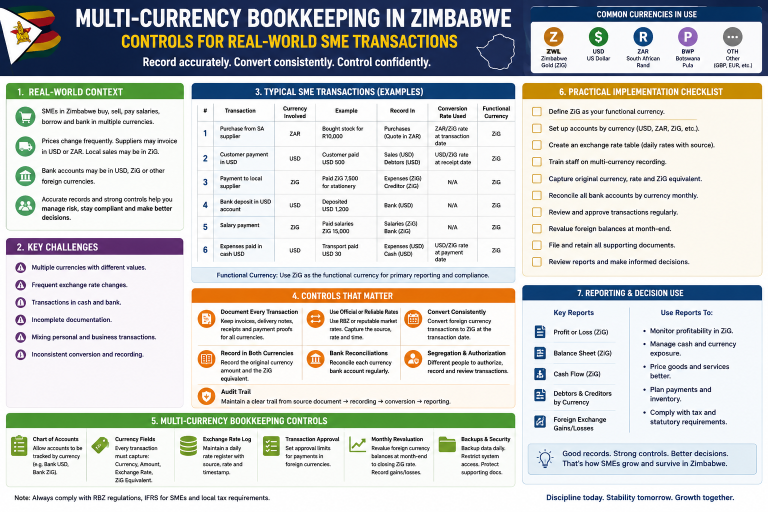
Multi-Currency Bookkeeping in Zimbabwe: Controls for Real-World SME Transactions

Small business decisions in Zimbabwe often become difficult because finance, tax, insurance, technology, and operations are treated as separate conversations. In practice they are connected. A weak invoice process can create tax errors. A poor contract can damage cash flow. A missing insurance schedule can leave a business exposed after a loss. This guide looks at multi-currency bookkeeping through a practical business lens, with the aim of helping owners, accountants, bookkeepers, finance teams, and advisers build a stronger operating system rather than another file of disconnected notes.

The article is written for growing businesses, not only large companies. A retailer, consulting firm, logistics operator, manufacturer, farm supplier, clinic, school, contractor, or online seller may not have a large finance department, but it still needs clean records, clear responsibilities, sensible controls, and evidence that can survive a bank review, investor discussion, tax query, insurance claim, or audit request. The same thinking also helps businesses outside Zimbabwe because many of the underlying problems are global: late payments, poor documentation, unclear ownership, manual spreadsheets, weak cyber hygiene, and decisions made without reliable numbers.

Why multi-currency bookkeeping matters in Zimbabwe

Zimbabwean businesses often operate in a complex currency environment, which makes bookkeeping discipline essential. The risk is not only exchange differences. It is the confusion that happens when invoices, receipts, bank accounts, cash tills, supplier bills, and management reports do not use consistent currency logic. Multi-currency bookkeeping should help owners understand real performance rather than hide uncertainty inside manual adjustments.

For a business owner, the danger is not only non-compliance. The danger is making decisions with partial information. If a business does not know which customers pay slowly, which costs are fixed, which risks are uninsured, which employees or contractors create obligations, or which systems hold the only copy of important documents, the owner may believe the business is healthier than it is. multi-currency bookkeeping should therefore be treated as part of management discipline, not as paperwork completed only when a lender, auditor, or authority asks for it.

In Zimbabwe, the practical environment can include currency pressure, changing customer demand, import and supplier constraints, informal-market competition, uneven digital adoption, and differences between urban and regional business conditions. Those realities do not remove the need for strong controls; they make controls more important. A simple but consistent system is usually better than an impressive policy that nobody follows.

A practical example

A Harare retailer may sell in more than one currency, pay some suppliers in foreign currency, pay staff partly through bank transfers, and hold cash in tills. If the business records only summary amounts without currency detail, it may not know true margin, cash exposure, or stock replacement cost. A Bulawayo services firm may invoice regional clients in foreign currency but pay local costs differently. Both need clear currency coding and reconciliations.

The lesson is that multi-currency bookkeeping is not a single decision. It is a chain of decisions: what evidence is created, who reviews it, how it is stored, how exceptions are handled, and how quickly management reacts when the numbers or documents stop making sense. Many African small businesses operate with real entrepreneurial strength, but the administrative side often develops after the business has already grown. That creates a gap between commercial activity and formal records. Closing that gap is where better finance and operations work begins.

What good practice looks like

Good practice starts with a written view of the business process. The document does not need to be long, but it should answer who does what, what evidence is required, what system is used, and what review happens before money moves or commitments are made. For multi-currency bookkeeping, the following controls are especially useful:

  • Set a documented currency policy for invoicing, receipts, supplier bills, cash holdings, and reporting.
  • Record the transaction currency separately from the reporting currency.
  • Reconcile each bank account, mobile wallet, and cash till by currency.
  • Use approved exchange-rate sources and keep evidence of rates used for material transactions.
  • Review realised and unrealised exchange differences separately from trading profit.

These controls work best when they are built into routine work. For example, a monthly finance meeting can review overdue invoices, bank reconciliations, insurance renewals, payroll exceptions, software access, tax deadlines, and supplier concentration in one sitting. The meeting does not need to be formal, but it should produce decisions and assigned actions. A business that reviews risks and numbers monthly will usually respond faster than a business that waits for year-end accounts.

Records and evidence to keep

The strength of any Accounting process depends on evidence. Evidence protects the business when memories fade, staff leave, systems change, or a third party asks questions months later. In practical terms, the business should keep:

  • Invoices, receipts, and supplier bills showing currency clearly.
  • Bank statements, cash counts, till reconciliations, and wallet statements.
  • Exchange-rate evidence and policy notes.
  • Stock-costing records showing replacement-cost assumptions.
  • Management accounts separating operating profit from exchange movements.

The point is not to keep documents for the sake of keeping documents. The point is to make the record easy to understand later. File names should be clear. Digital folders should follow a structure that another person can use. Where possible, key records should be linked to transactions in accounting software or stored in a shared business drive with restricted access. A receipt saved only in one person’s phone gallery is not a reliable business record.

Numbers management should review

A useful management report turns records into decisions. For multi-currency bookkeeping, these measures give owners a clearer view of whether the system is working:

  • Cash and bank balances by currency.
  • Gross margin by product line after replacement-cost review.
  • Exchange gains or losses by month.
  • Unreconciled currency differences.
  • Supplier and customer exposure by currency.

The specific targets will differ by sector, size, and country, but the habit is the same. Track a few important numbers every month. Compare them with last month and with the same period last year if the business has history. Ask why the movement happened. Decide what will change. The quality of the conversation matters more than the number of charts.

Common mistakes to avoid

The most expensive mistakes are often quiet at the beginning. They do not look dramatic when they start, but they compound. A missing contract clause can become a collection problem. A weak backup process can become a business continuity failure. A manual payroll adjustment can become a tax or labour dispute. A cheap insurance policy can become a rejected claim because the cover did not match the real risk.

  • Mixing currencies in one spreadsheet column without labels.
  • Using exchange differences to hide stock or cash-count problems.
  • Failing to reconcile cash tills by currency.
  • Pricing from historical cost when replacement cost has changed.
  • Not explaining currency assumptions in management reports.

Another common mistake is copying a system from another country without adapting it. A South African, Nigerian, Kenyan, Egyptian, Moroccan, or Canadian business may use similar accounting concepts, but banking systems, tax administration, customer behaviour, legal processes, and documentation expectations can differ. Global templates are useful, but they should be localised before being used as business policy.

Using technology without losing control

Technology can make multi-currency bookkeeping easier, but it can also hide weak processes behind attractive dashboards. Accounting software, payroll systems, document tools, AI assistants, cloud drives, e-signature platforms, and bank feeds all need governance. The business should decide who has access, what approvals are required, how data is backed up, and how changes are reviewed. A tool that saves time but removes accountability is not a control improvement.

AI is useful for drafting checklists, summarising contracts, extracting information from documents, comparing insurance clauses, preparing cash-flow scenarios, or turning messy notes into a first version of a policy. But the final decision should remain with a responsible person. AI can misunderstand context, miss local requirements, or produce confident wording that needs professional review. For Zimbabwe businesses, the safest approach is to use AI as a productivity assistant and keep human review for tax, legal, insurance, payroll, and financing decisions.

A 30-day improvement plan

A business does not need to fix everything at once. The following 30-day plan is realistic for an owner-managed business or small finance team:

  • Week 1: list the current process, the people involved, the systems used, and the documents created.
  • Week 2: identify the biggest gaps, such as missing approvals, unclear filing, old supplier terms, weak insurance records, or manual spreadsheet risk.
  • Week 3: update one policy or checklist and test it on real transactions rather than leaving it as a document nobody uses.
  • Week 4: review the first results, assign ownership, and add the process to the monthly management routine.

This approach is deliberately simple. Most small businesses do not fail because they lacked a perfect framework. They struggle because nobody owned the basics consistently. A monthly routine, clear evidence, and a short checklist can prevent many problems before they become expensive.

Global lessons for Zimbabwe businesses

Businesses in countries with dollarisation, high inflation, or cross-border trade face similar bookkeeping issues. Zimbabwean SMEs can borrow global multi-currency controls from exporters, NGOs, and regional traders: separate currency tracking, documented rates, frequent reconciliations, and clear management explanations.

The global lesson is not that African businesses must copy Europe, North America, or Asia. The better lesson is that formalisation helps businesses negotiate. Clean records support bank applications. Good insurance schedules support claims. Strong payroll files reduce disputes. Reliable management accounts help owners decide when to expand, hire, borrow, or slow down. A business with organised information has more options.

Final thoughts

Multi-currency bookkeeping in Zimbabwe is not just a technical accounting task. It is a survival tool for pricing, cash control, tax readiness, and honest management reporting.

This article is general business information, not tax, legal, insurance, or financial advice. Rules and market practice can change, and businesses should confirm country-specific requirements with a qualified adviser before making formal decisions. The practical value is in the discipline: understand the risk, keep evidence, review numbers, and improve the process before pressure arrives.

Business Continuity for Accounting Records: Backups, Access, and Recovery

Business Continuity for Accounting Records: Backups, Access, and Recovery

Sarah Martinez stared at her computer screen in disbelief. The message “File Corrupted. Cannot Open” glowed mockingly in red letters. It was 8 AM on a Monday morning, and she couldn’t access the accounting files for Martinez & Associates, the family business her grandfather had built over four decades.

Three months of meticulous bookkeeping, every invoice, every payment, every tax calculation—all gone in an instant. The backup drive that sat in the corner of her office? It hadn’t been tested since installation six months ago. As Sarah frantically called IT support, then her accountant, then her insurance company, the weight of potential disaster settled on her shoulders. This wasn’t just about missing data—it was about the livelihood of 15 employees and the trust of 200+ clients who depended on their services.

Sarah’s story isn’t unique. In today’s rapidly evolving business landscape, the integrity and availability of accounting records are not just important—they’re critical to survival. Every transaction, every receipt, and every financial adjustment tells a part of your business story. Losing this data can mean more than inconvenience; it can spell disaster. This article will guide you through practical strategies for ensuring your accounting records remain secure, accessible, and recoverable—because business continuity isn’t an option, it’s a necessity.

The Human Cost of Data Loss: Stories That Changed Everything

Let me share another story that illustrates the devastating impact of poor data management. Thomas Chen owned a thriving import-export business in Johannesburg. His company moved millions of dollars worth of goods monthly, and his accounting system tracked everything from shipping costs to customs duties. When his server crashed during a routine software update, Thomas was confident his weekly backups would save the day.

They didn’t. The backup system had been failing silently for three weeks due to a configuration error he’d never noticed. By the time he realized the problem, he’d lost two months of critical shipping documentation, customs filings, and client billing records. The ripple effect was immediate and severe. Clients couldn’t get their invoices, suppliers questioned payment delays, and customs authorities grew suspicious of missing documentation. Thomas spent six months manually reconstructing records from paper receipts and email confirmations. The stress took a toll on his health, his marriage suffered, and he eventually sold the business at a fraction of its value.

These stories aren’t meant to frighten you—they’re designed to illustrate why understanding your data’s vulnerability is crucial. Behind every corrupted file, failed backup, or inaccessible system, there’s a human story of stress, uncertainty, and often, significant financial loss.

Understanding the Stakes: Why Your Accounting Data Matters

Before diving into solutions, let’s understand what we’re protecting. Your accounting records aren’t just numbers on a screen—they’re the lifeblood of your business, representing years of hard work, careful planning, and stakeholder trust.

Legal Documentation Required for Compliance
Your accounting records serve as legal proof of every transaction. In Zimbabwe, businesses must maintain detailed records for ZIMRA compliance, including fiscal receipts, tax calculations, and financial statements. Without these, you’re not just facing potential fines—you’re risking your business license and reputation.

Historical Business Intelligence
Every entry in your accounting system represents a decision, a strategy, or a market response. These records contain invaluable insights about seasonal trends, customer preferences, vendor reliability, and operational efficiency. Losing this historical context means losing the ability to learn from past successes and mistakes.

Cash Flow Evidence
Your accounting records are the foundation for securing loans, attracting investors, and maintaining business credit. Banks and financial institutions rely on these documents to assess your creditworthiness. Without verifiable financial records, you lose access to capital that could fuel growth and expansion.

Operational Backbone
Daily operations depend on accurate accounting data. You need to know which customers owe money, which vendors expect payment, which products generate profit, and which departments consume resources. Without this operational intelligence, your business becomes reactive rather than proactive.

Regulatory Compliance
Modern businesses operate within complex regulatory frameworks. Whether it’s tax requirements, industry-specific reporting, or international trade regulations, your accounting records provide the evidence needed to demonstrate compliance. Regulatory violations can result in substantial penalties, legal action, and reputational damage.

Consider this scenario: A manufacturing company loses three months of inventory tracking data due to a server failure. Not only do they face potential audit issues, but they also struggle to fulfill orders, manage supplier relationships, and maintain accurate financial reporting. The cost of recovery far exceeds the investment in proper backup systems. More importantly, the company’s reputation among customers and suppliers takes a hit that may take years to repair.

The Three Pillars of Accounting Record Continuity

1. Comprehensive Backup Strategies: Building Your Safety Net

The first pillar of business continuity is creating multiple layers of protection around your critical accounting data. Think of it as building a safety net—not just one layer, but multiple interconnected safeguards that work together to protect your most valuable asset.

Multi-Tiered Backup Approach

Your backup strategy should mirror the complexity of your business operations, providing protection at different levels and frequencies:

Immediate Local Backups (Every Hour)
Picture this: You’re entering the final entries for a busy day of transactions, and suddenly, your computer freezes. In that moment, having an hourly backup becomes your lifeline. For QuickBooks users, this means configuring automated backup features with local saves that occur during natural breaks in activity. Use cloud-synced drives (like OneDrive or Google Drive) for real-time synchronization, ensuring that even if your local machine fails, your data remains accessible.

The emotional security of knowing that your most recent work is preserved can’t be overstated. Imagine the relief of discovering that despite a system crash, you’ve only lost five minutes of work instead of an entire day’s efforts.

Daily Cloud Backups (End of Each Business Day)
At the end of each productive day, when your books are balanced and your reports are generated, schedule automatic cloud backups to services like AWS S3, Google Cloud, or specialized accounting backup providers. These backups should occur after the day’s transactions are complete, capturing the full picture of your business activities.

Verify backup integrity through automated checksums—mathematical algorithms that ensure your backup matches your original data exactly. This verification process provides peace of mind that your backup is complete and usable when needed.

Weekly Archival Backups
Create compressed, encrypted archives of the week’s data, representing a comprehensive snapshot of your business activities. Store these in separate geographic locations to protect against localized disasters like fires, floods, or theft. Test recovery procedures monthly, not just to ensure technical functionality, but to build confidence in your disaster recovery capabilities.

Practical Implementation Steps:

  1. Set up automated backup schedules during low-usage periods – Choose times when your business naturally experiences lower activity, such as early morning or late evening, to minimize disruption to operations.
  2. Create verification scripts that confirm backup completion – Don’t just assume your backups are working; implement automated systems that notify you of success or failure, so you’re never caught unprepared.
  3. Establish alerts for backup failures – Immediate notification of backup failures allows for quick intervention before the problem compounds.
  4. Document backup locations and access procedures – In times of stress, having clear, written procedures prevents confusion and speeds recovery.

2. Secure Access Management: Protecting Your Digital Fortress

The second pillar focuses on controlling who can access your accounting data and how they can interact with it. This isn’t just about keeping out bad actors—it’s about managing internal access to prevent accidental changes, unauthorized modifications, and security breaches that could compromise your business continuity.

Multi-Factor Authentication (MFA): Your First Line of Defense

Your accounting data should be protected by more than just passwords. The emotional reassurance of knowing that even if someone steals or guesses your password, they still can’t access your critical data provides invaluable peace of mind:

  • Primary authentication: Strong, unique passwords (minimum 12 characters) that combine uppercase, lowercase, numbers, and special characters
  • Secondary authentication: SMS codes, authenticator apps, or hardware tokens that add an extra layer of security
  • Biometric backup: Fingerprint or facial recognition where available, providing seamless security for authorized users

Role-Based Access Control: Trust But Verify

Not everyone needs the same level of access, and understanding this principle can prevent both malicious and accidental data corruption. Consider the emotional comfort of knowing that your receptionist can view basic client information but cannot modify financial records, or that your bookkeeper can enter transactions but cannot approve payments above certain thresholds:

  • Administrative users: Full access for bookkeepers and accountants who need comprehensive system capabilities
  • Management users: Read-only access for executives and managers who need to monitor performance without modifying underlying data
  • Limited users: Specific function access for department heads who need particular information without broad system access
  • Emergency users: Locked accounts for disaster recovery scenarios, accessible only during genuine emergencies

Practical Access Controls:

  • Implement session timeouts after 15 minutes of inactivity – This simple measure protects data when users step away from their computers
  • Require password changes every 90 days – Regular updates reduce the risk of compromised credentials
  • Maintain access logs for audit trails – Documentation of who accessed what data when provides accountability and security
  • Have emergency access procedures documented and tested – Preparation prevents panic during actual emergencies

3. Rapid Recovery Protocols: Your Path Back to Normalcy

The third pillar addresses what happens when everything goes wrong. While prevention is ideal, preparation for recovery is essential. The difference between a minor inconvenience and a business-ending catastrophe often lies in how quickly and effectively you can recover from a data loss event.

Recovery Time Objectives (RTO) and Recovery Point Objectives (RPO)

Define your tolerance for data loss and downtime with realistic expectations that balance business needs with technical capabilities:

  • Critical systems: RTO < 4 hours, RPO < 1 hour – For businesses where every minute of downtime costs thousands of dollars
  • Important systems: RTO < 24 hours, RPO < 4 hours – For core business functions that are important but allow for some recovery time
  • Standard systems: RTO < 72 hours, RPO < 24 hours – For supporting systems that are useful but not mission-critical

Disaster Recovery Checklist: Your Roadmap to Recovery

Create a step-by-step recovery plan that transforms chaos into organized action:

Phase 1: Assessment (0-30 minutes)
When crisis strikes, panic is natural, but controlled assessment prevents hasty decisions that could make things worse:

  • Identify the scope of the incident with calm, systematic evaluation
  • Activate emergency response team members who know their roles
  • Notify key stakeholders with clear, factual information
  • Document the incident timeline for insurance claims and future reference

Phase 2: Containment (30 minutes – 2 hours)
Prevent the problem from spreading while gathering information:

  • Isolate affected systems to prevent further damage
  • Preserve evidence for analysis and potential legal requirements
  • Implement temporary workarounds to maintain critical business functions
  • Communicate with staff about expectations and next steps

Phase 3: Recovery (2 hours – 24 hours)
Execute your planned recovery procedures with confidence:

  • Restore from most recent backup using proven procedures
  • Verify data integrity through systematic validation
  • Test system functionality to ensure everything works correctly
  • Gradually restore normal operations to minimize disruption

Phase 4: Validation (24 hours – 1 week)
Ensure complete recovery and prepare for future events:

  • Confirm all data accuracy through reconciliation processes
  • Reconcile discrepancies and document resolution methods
  • Update stakeholders on status and any permanent changes
  • Document lessons learned to improve future responses

Hands-On Implementation Guide: From Theory to Practice

Understanding concepts is valuable, but implementing them creates real protection. This section provides concrete, actionable steps that transform your understanding into practical business continuity.

Step 1: Inventory Your Current Systems

Create a comprehensive list of all accounting-related systems, treating this exercise as an emotional journey through your business’s digital assets:

System Inventory Template:
- Software Name: ________________
- Version: ________________
- Server Location: ________________
- Primary User: ________________
- Backup Frequency: ________________
- Last Successful Backup: ________________
- Recovery Time Estimate: ________________
- Contact Person: ________________

This inventory process might reveal uncomfortable truths about gaps in your current protection, but facing these realities now prevents painful discoveries during actual crises.

Step 2: Implement the 3-2-1 Rule

This industry standard ensures maximum protection while providing emotional security:

  • 3 copies of your data (primary + 2 backups) – redundancy that provides peace of mind
  • 2 different media types (cloud + physical storage) – diversification that reduces single points of failure
  • 1 offsite copy (geographically separated) – protection against location-specific disasters

Step 3: Test Your Recovery Procedures Monthly

Schedule regular recovery tests that build confidence and identify weaknesses:

  • Select a random backup from 30 days ago to simulate realistic recovery scenarios
  • Attempt full restoration to a test environment without disrupting operations
  • Verify data integrity and completeness through systematic validation
  • Document any issues and update procedures to improve future responses
  • Train team members on recovery processes to distribute institutional knowledge

Step 4: Create Emergency Documentation

Prepare “go bags” with essential information that transforms potential panic into organized response:

Physical Emergency Kit:

  • Printed login credentials (securely stored) for situations where digital access is unavailable
  • Backup location addresses to ensure you know where your safety nets are located
  • Vendor support contact information for immediate technical assistance
  • Insurance policy details for claims processing and coverage verification
  • Legal counsel contact information for compliance and liability considerations

Digital Emergency Access:

  • Encrypted USB drive with critical access information for secure portability
  • Password-protected emergency contact list for coordinated response efforts
  • System architecture diagrams for technical recovery guidance
  • Vendor service agreements for understanding support obligations

Advanced Considerations for Growing Businesses

As your business evolves, your backup and recovery needs become more complex. Understanding these advanced considerations helps you scale your protection alongside your growth.

Scalability Planning: Growing Pains Without the Pain

As your business grows, your backup and recovery needs will evolve, requiring forward-thinking planning:

Small Business (< 10 employees):

  • Focus on automated cloud backups that require minimal technical expertise
  • Simple MFA implementation that doesn’t overwhelm limited staff
  • Basic role-based access that protects against common threats

Medium Business (10-100 employees):

  • Multi-location backup strategies that protect against regional disruptions
  • Advanced access controls that accommodate complex organizational structures
  • Automated compliance reporting that meets increasing regulatory requirements

Large Business (> 100 employees):

  • Dedicated IT infrastructure that supports enterprise-level protection
  • Real-time replication that minimizes data loss during disruptions
  • Comprehensive disaster recovery sites that ensure business continuity

Integration with Business Processes: Making Protection Seamless

Your backup and recovery strategy should integrate seamlessly with existing workflows, becoming part of your business culture rather than an additional burden:

  • End-of-day procedures should include backup verification as naturally as locking doors
  • Monthly reconciliations should verify backup integrity as part of standard checks
  • Annual audits should review disaster recovery effectiveness as part of compliance
  • Staff training should include backup awareness as part of general business education

Real-World Scenarios: Learning from Others’ Experiences

The Seasonal Business Challenge

Consider Maria’s situation: She runs a successful holiday decoration business that experiences extreme seasonal fluctuations. During peak season, she processes hundreds of transactions daily, but during off-season, activity drops to almost nothing. Her backup strategy needed to adapt to these patterns while maintaining consistent protection. By implementing adaptive backup scheduling that increased frequency during peak periods and maintained baseline protection during slow periods, Maria ensured her data remained protected regardless of seasonal variations.

The Multi-Location Challenge

James manages accounting for a restaurant chain with locations across three cities. Each location generates daily sales data that must be consolidated for corporate reporting. His challenge was ensuring that data from each location was backed up locally while maintaining centralized backup of consolidated information. By implementing location-specific backup protocols with centralized monitoring, James created a system that protected both local autonomy and corporate oversight.

Cost-Benefit Analysis: Investment vs. Potential Loss

Investment in backup and recovery typically represents 3-5% of total IT costs, but can prevent losses of 100x that amount in case of major data loss. The emotional cost of data loss—the stress, anxiety, and sleepless nights spent trying to recover what was lost—often exceeds the financial impact.

Consider the components of your investment:

Hardware costs: External drives, servers, network equipment that provide physical protection for your data
Software costs: Backup solutions, encryption tools, monitoring systems that automate protection processes
Service costs: Cloud storage, managed backup services, support contracts that provide professional protection
Training costs: Staff education, certification programs, drill exercises that build institutional capability

Compare this to potential losses:

  • Lost productivity during recovery periods
  • Revenue loss from interrupted operations
  • Compliance penalties for missing documentation
  • Reputation damage from service disruptions
  • Stress and emotional toll on business owners and employees

Emotional Intelligence in Data Protection

Protecting your accounting records isn’t just a technical exercise—it’s an emotional one. The anxiety of potential data loss, the relief of successful backups, the stress of recovery procedures, and the confidence of comprehensive protection all play roles in your overall business experience.

Managing Anxiety Through Preparation

Uncertainty breeds anxiety. When you don’t know whether your data is safe, every system glitch becomes a potential disaster. Comprehensive backup and recovery planning replaces uncertainty with confidence, allowing you to focus on growing your business rather than worrying about protecting it.

Building Confidence Through Testing

Regular testing builds confidence in your systems and procedures. When you know your backup works because you’ve tested it, you sleep better at night. When you’ve practiced recovery procedures, you approach potential problems with calm assurance rather than panicked desperation.

Creating Peace of Mind

The ultimate goal of comprehensive backup and recovery planning is peace of mind—the emotional state of knowing that your business is protected against data loss. This peace of mind allows you to take calculated risks, pursue growth opportunities, and focus on serving your customers rather than protecting your systems.

Future-Proofing Your Strategy

Technology evolves rapidly, and your backup and recovery strategy must evolve with it. Consider emerging trends and technologies that could enhance your protection:

Cloud Migration: Moving from local to cloud-based accounting systems can simplify backup management while providing enhanced security and accessibility.

Artificial Intelligence: AI-powered monitoring can detect backup failures, security breaches, and system anomalies before they become problems.

Blockchain Technology: Distributed ledger technology could provide immutable backup and recovery capabilities for critical financial records.

Internet of Things: Connected devices can provide real-time monitoring of backup systems and environmental conditions that could affect data safety.

Conclusion: Making Continuity a Competitive Advantage

Business continuity for accounting records isn’t just about preventing disasters—it’s about building confidence in your business operations. When you know your data is secure, accessible, and recoverable, you can focus on growth rather than worry about loss.

The key to success lies in treating backup and recovery as ongoing processes, not one-time implementations. Regular testing, continuous improvement, and staying current with technology advances will ensure your accounting records remain your business’s most reliable asset.

Remember: In accounting, precision matters. Your backup and recovery strategy should reflect the same attention to detail that you apply to your financial records. The investment in comprehensive business continuity pays dividends not just in peace of mind, but in operational resilience that can weather any storm.

Start implementing these strategies today. Your future self—and your business—will thank you for the preparation when challenges arise. Because in business, it’s not a question of whether problems will occur, but when—and how prepared you’ll be to handle them.

The stories of Sarah, Thomas, Maria, and James remind us that behind every backup system is a human story of preparation and protection. Make your story one of confidence, resilience, and continued success. Your business continuity strategy isn’t just about protecting data—it’s about protecting dreams, livelihoods, and the futures of everyone who depends on your business.

The emotional investment in comprehensive backup and recovery planning pays returns in confidence, security, and peace of mind that extend far beyond the technical benefits. Take action today, and transform your relationship with risk from one of anxiety to one of confident preparedness.

QuickBooks Online vs. Top Alternatives: Why Your 2026 Choice Could Save or Cost Your Business Thousands

0

Every year, thousands of businesses select accounting software based on surface-level features, marketing hype, or accountant recommendations—only to discover years later that their “simple” choice has become a costly bottleneck. The ripple effects extend far beyond monthly subscription fees, impacting productivity, growth potential, and ultimately, profitability.

The Full Landscape of Accounting Solutions

What is QuickBooks Online?

QuickBooks Online is Intuit’s cloud-based accounting platform that has dominated the small-to-medium business market for over two decades. Originally a desktop application, QuickBooks evolved into a comprehensive online solution offering features like invoicing, expense tracking, inventory management, and financial reporting. It’s particularly popular among businesses already using other Intuit products and those requiring complex accounting features.

What is Xero?

Xero is a New Zealand-based cloud accounting platform designed specifically for modern businesses. Unlike QuickBooks’ evolution from desktop to cloud, Xero was built from the ground up as a cloud-native solution. It emphasizes user collaboration, real-time bank feeds, and an intuitive interface, making it popular among businesses prioritizing ease of use and team collaboration.

What is FreshBooks?

FreshBooks is a Canadian accounting platform focused primarily on service-based businesses and freelancers. It excels in invoicing, time tracking, and client relationship management. FreshBooks positions itself as the go-to solution for businesses where customer interactions and billing efficiency are paramount.

What is Zoho Books?

Zoho Books is part of the broader Zoho ecosystem, offering integrated business applications. It targets small businesses looking for affordable, feature-rich accounting software with seamless integration to other Zoho products like CRM, inventory, and project management tools. Zoho Books is known for its automation capabilities and competitive pricing.

What is Wave Accounting?

Wave is a free accounting platform targeting freelancers, consultants, and very small businesses. Founded with the mission to democratize accounting software, Wave offers comprehensive features at no cost, supported by optional paid services like payment processing and payroll. It’s particularly appealing to startups and sole proprietors.

What is Sage Business Cloud?

Sage Business Cloud represents the cloud evolution of the established Sage accounting software, traditionally favored by larger businesses. It bridges the gap between small business tools and enterprise resource planning systems, offering advanced features for businesses requiring sophisticated financial management.

Comprehensive Pricing Analysis: Beyond Surface-Level Comparisons

QuickBooks Online Pricing Structure

Simple Start Plan – $15/month

  • Target audience: Very small businesses with basic needs
  • Features: Income and expense tracking, bank feeds, basic reporting, invoice creation
  • Users: 1 user
  • Bank accounts: Up to 5 accounts
  • Limitations: No inventory tracking, limited reporting, single user access
  • Hidden costs: Payment processing fees, third-party integrations

Essentials Plan – $27/month

  • Target audience: Growing businesses with multiple users
  • Features: Everything in Simple Start plus 3 users, bill management, time tracking, project profitability
  • Users: 3 users
  • Bank accounts: Unlimited
  • Best for: Businesses with employees or contractors
  • Hidden costs: Advanced integrations, payroll services

Plus Plan – $44/month

  • Target audience: Businesses needing advanced features
  • Features: Everything in Essentials plus inventory tracking, classes, advanced reporting, budgeting
  • Users: 5 users
  • Bank accounts: Unlimited
  • Best for: Growing businesses with inventory or multiple departments
  • Additional costs: Enhanced integrations, advanced payroll

Advanced Plan – $85/month

  • Target audience: Complex businesses requiring comprehensive features
  • Features: Everything in Plus plus unlimited users, advanced inventory, custom fields, advanced permissions, dedicated support
  • Users: Unlimited
  • Bank accounts: Unlimited
  • Best for: Large SMBs or those with complex accounting needs
  • Value proposition: Comprehensive features justify premium pricing

Total QuickBooks Cost Calculation:
Base subscription + integrations + payment processing + payroll + support = true monthly cost
Example for e-commerce business: $44 + $75 (integrations) + $25 (payment processing) = $144/month

Xero Pricing Structure

Starter Plan – $13/month

  • Target audience: Freelancers and very small businesses
  • Features: Up to 20 invoices/month, 20 bills/month, bank reconciliation, basic reporting
  • Contacts: 500 contacts
  • Bank accounts: Unlimited
  • Limitations: Transaction caps, limited user access
  • Upgrade trigger: When exceeding transaction limits

Standard Plan – $37/month

  • Target audience: Growing businesses with regular invoicing
  • Features: Everything in Starter plus unlimited invoices/bills, multi-currency, purchase orders, inventory tracking, expense claims
  • Contacts: 2,000 contacts
  • Bank accounts: Unlimited
  • Best for: Small businesses with moderate transaction volume
  • Integration advantage: Lower-cost add-ons compared to competitors

Premium Plan – $62/month

  • Target audience: Larger businesses with complex needs
  • Features: Everything in Standard plus unlimited contacts, advanced inventory, fixed asset tracking, multi-user access, advanced reporting
  • Contacts: Unlimited
  • Bank accounts: Unlimited
  • Best for: Medium-sized businesses requiring comprehensive features
  • Competitive edge: Superior bank reconciliation and user permissions

Xero Total Cost Analysis:
Base subscription + payment processing + payroll + third-party apps = true monthly cost
Example for service business: $37 + $18 (payment processing) + $20 (payroll) = $75/month

FreshBooks Pricing Structure

Lite Plan – $17/month

  • Target audience: Freelancers and very small businesses
  • Features: Invoicing, time tracking, basic expense tracking, 5 active projects
  • Clients: 5 clients
  • Best for: Single-person businesses with minimal client interaction
  • Limitations: Client and project restrictions

Plus Plan – $27/month

  • Target audience: Growing service-based businesses
  • Features: Everything in Lite plus 50 active projects, proposal creation, project profitability, time tracking, expense tracking
  • Clients: 50 clients
  • Best for: Small service businesses with multiple clients
  • Value proposition: Excellent invoicing automation

Premium Plan – $50/month

  • Target audience: Established service businesses
  • Features: Everything in Plus plus unlimited projects, advanced reporting, white-labeling, team management, advanced automation
  • Clients: 500 clients
  • Best for: Larger service businesses requiring advanced features
  • Competitive advantage: Superior client relationship management

Free Alternative: Wave Accounting

Core Features – Free:

  • Income and expense tracking
  • Bank reconciliation
  • Invoicing and quotes
  • Receipt scanning
  • Financial reports
  • Chart of accounts
  • Customer and vendor management

Limitations of Free Version:

  • No inventory tracking
  • Limited to 5 users
  • No project tracking
  • Basic reporting only
  • Payment processing fees apply

Paid Add-ons:

  • Payment processing: 2.9% + $0.30 per transaction
  • Payroll: $20/month + $6 per employee
  • Receipt scanning: Included free
  • Advanced reporting: $20/month (premium feature)

Wave Total Cost for Small Business:
Free base + $25 (payment processing) + $26 (payroll for 1 employee) = $51/month

Zoho Books Pricing Structure

Basic Plan – $15/month

  • Target audience: Freelancers and micro-businesses
  • Features: Up to 50 contacts, 50 transactions/month, basic invoicing, expense tracking
  • Contacts: 50 contacts
  • Transactions: 50 per month
  • Best for: Sole proprietors with minimal business activity
  • Upgrade trigger: Transaction limits exceeded

Standard Plan – $40/month

  • Target audience: Growing businesses
  • Features: Everything in Basic plus unlimited contacts, 500 transactions/month, inventory management, project tracking, time tracking
  • Contacts: Unlimited
  • Transactions: 500 per month
  • Best for: Small businesses with moderate activity
  • Integration advantage: Seamless Zoho ecosystem integration

Professional Plan – $60/month

  • Target audience: Established businesses
  • Features: Everything in Standard plus 1,000 transactions/month, advanced inventory, multi-currency, purchase orders, recurring transactions
  • Contacts: Unlimited
  • Transactions: 1,000 per month
  • Best for: Medium businesses with complex needs
  • Value proposition: Comprehensive features at competitive pricing

Premium Plan – $120/month

  • Target audience: Large SMBs
  • Features: Everything in Professional plus unlimited transactions, advanced reporting, custom fields, workflow automation
  • Contacts: Unlimited
  • Transactions: Unlimited
  • Best for: Large businesses requiring enterprise features
  • Competitive edge: Advanced automation capabilities

Zoho Ecosystem Benefits:

  • Zoho CRM integration: $25/month
  • Zoho Inventory: $29/month
  • Zoho Projects: $35/month
  • Combined ecosystem: Potential cost savings through bundling

Deep Feature Comparison: Where Each Platform Excels

Core Accounting Features Analysis

Bank Reconciliation Performance:
QuickBooks Online offers solid bank reconciliation with rule-based automation, achieving approximately 70% auto-matching accuracy. The process averages 45 minutes monthly for businesses processing 200 transactions. Xero leads with 85% auto-matching accuracy, reducing average reconciliation time to 15-20 minutes monthly. FreshBooks provides good reconciliation focusing on customer-facing features. Zoho Books achieves 80% auto-matching with intelligent categorization. Wave offers basic reconciliation suitable for simpler needs.

Invoice Creation and Management:
QuickBooks provides professional templates but requires HTML knowledge for advanced customization. Xero offers excellent template customization with drag-and-drop functionality. FreshBooks excels in invoicing automation with payment reminder sequences at 3, 7, 14, and 21 days. Zoho Books provides comprehensive automation including recurring invoices and payment reminders. Wave offers basic invoicing functionality with limited customization options.

Expense Tracking Capabilities:
Xero’s mobile app provides the most comprehensive functionality with photo capture and automatic categorization. QuickBooks integrates well with major credit cards but requires manual categorization. FreshBooks offers excellent expense categorization with project allocation. Zoho Books provides robust expense tracking with mileage tracking. Wave offers basic receipt scanning and categorization.

Inventory Management Features

QuickBooks Advanced:
Handles serial numbers, batch tracking, landed costs, and multi-location inventory with detailed cost tracking. Build assemblies and advanced inventory reports make it ideal for manufacturers. However, requires manual counting for physical inventory adjustments. Advanced features justify the $85/month cost for inventory-heavy businesses.

Xero:
Basic inventory module handles multi-location tracking and reorder points effectively. For advanced features, Xero Premium ($62) combined with inventory add-ons ($29) totals $91 monthly—more expensive than QuickBooks Advanced at $85 but with less comprehensive features.

Zoho Books:
Comprehensive inventory management including serial/batch tracking, landed costs, and multi-location management. Advanced features available in Professional and Premium plans. Integration with Zoho Inventory provides enterprise-level capabilities.

Wave:
No inventory tracking features, making it unsuitable for product-based businesses.

FreshBooks:
Limited inventory features, not suitable for businesses with significant inventory needs.

Multi-User Collaboration Features

QuickBooks:
Rigid user roles with “Company Admin” having full access and “Regular User” having broad permissions. Limited granular access control. QuickBooks Advanced offers better permissions but adds complexity.

Xero:
Excellent user permission controls allowing restriction by account, customer, vendor, or transaction type. Approval workflows for payments enhance internal controls. Superior for businesses with multiple stakeholders.

Zoho Books:
Comprehensive user management with role-based permissions and approval workflows. Integration with Zoho’s user management system provides enterprise-level access control.

Wave:
Limited to 5 users in free version, suitable for small teams only.

FreshBooks:
Good client portal access but limited internal user permissions. Best for client collaboration rather than internal team management.

Integration Capabilities Analysis

QuickBooks Integration Ecosystem:
650+ apps in marketplace with varying quality. Popular integrations: Shopify ($30/month), PayPal ($20/month), Square ($25/month). Some integrations break during updates, requiring manual intervention.

Xero Integration Network:
1,000+ apps, generally better reviewed. PayPal integration free, e-commerce integrations $15-25/month. API-first approach maintains 99.7% uptime for integrations.

Zoho Books Integration:
Seamless integration within Zoho ecosystem. 40+ Zoho apps integrate natively. Third-party integrations through Zoho Flow.

Wave Integration:
Limited third-party integrations. Focus on core accounting functionality rather than ecosystem expansion.

FreshBooks Integration:
Curated marketplace focused on service business needs. Payment processing built-in, reducing integration requirements.

Comprehensive Reporting Capabilities

Standard Financial Reports

QuickBooks Online:
50+ standard reports including profit & loss, balance sheet, cash flow statement, and aged receivables/payables. Custom report builder allows modification of existing reports. Advanced reports include consolidated companies, budget vs. actual, and project profitability analysis.

Xero:
40+ standard reports with superior drill-down capabilities. Reports can be customized with filters and date ranges. Includes outstanding invoices and bills for more accurate cash flow forecasting.

Zoho Books:
Comprehensive standard reports with customization options. Real-time reporting with drill-down capabilities. Integration with Zoho Analytics for advanced analytics.

Wave:
Basic standard reports suitable for small businesses. Limited customization options compared to paid alternatives.

FreshBooks:
Limited standard reports but excellent client-facing dashboards. Focus on income, expenses, and client profitability reports.

Advanced Reporting Features

Cash Flow Forecasting:
QuickBooks uses historical data but doesn’t account for pending orders. Xero includes outstanding invoices and bills for accurate projections. Zoho Books provides advanced forecasting with scenario modeling. Wave offers basic cash flow reporting. FreshBooks focuses on service business cash flow patterns.

Project and Job Costing:
QuickBooks Advanced provides comprehensive project profitability reports. Xero offers project tracking but limited costing analysis. Zoho Books provides detailed project profitability analysis. Wave lacks project costing features. FreshBooks shows project profitability but doesn’t integrate with inventory.

Multi-Currency Reporting:
QuickBooks Advanced handles multi-currency but requires workarounds. Xero offers native multi-currency P&L reporting. Zoho Books provides comprehensive multi-currency support. Wave doesn’t support multi-currency. FreshBooks offers basic multi-currency features.

Custom Reporting Capabilities

QuickBooks:
Custom report builder requires accounting knowledge but offers extensive customization.

Xero:
User-friendly custom reporting with easy filter application and export options.

Zoho Books:
Advanced custom reporting with integration to Zoho Analytics for sophisticated analysis.

Wave:
Limited custom reporting capabilities in free version.

FreshBooks:
Basic custom reporting focused on client profitability and time tracking.

Free vs. Paid Analysis: The Complete Picture

Wave Accounting: The Free Alternative

Advantages:

  • Completely free for core features
  • No transaction limits
  • Professional-looking reports
  • Good customer support
  • Suitable for freelancers and small businesses

Disadvantages:

  • No inventory tracking
  • Limited to 5 users
  • No project tracking
  • Payment processing fees apply
  • Limited advanced features
  • No mobile app for iOS/Android

Best For:

  • Freelancers and consultants
  • Small service businesses
  • Startups with minimal complexity
  • Businesses testing accounting software

Hidden Costs:
Payment processing: 2.9% + $0.30 per transaction
Payroll: $20/month + $6 per employee
Premium features: $20/month

Zoho Books: The Ecosystem Play

Advantages:

  • Competitive pricing for feature set
  • Seamless integration with Zoho ecosystem
  • Advanced automation capabilities
  • Comprehensive inventory management
  • Multi-currency support

Disadvantages:

  • Learning curve for Zoho ecosystem
  • Interface can feel overwhelming
  • Customer support quality varies
  • Some features require multiple Zoho apps

Best For:

  • Businesses already using Zoho products
  • Companies wanting integrated business solutions
  • Businesses with complex inventory needs
  • Multi-currency operations

Practical Decision Framework: Complete Analysis

For Service-Based Businesses

Top Choice: FreshBooks ($27/month)

  • Superior invoicing and client management
  • Built-in payment processing at 2.4%
  • Excellent time tracking and project profitability
  • Client portal enhances customer relationships

Alternative: Xero Standard ($37/month)

  • Better collaboration features
  • Superior bank reconciliation
  • More comprehensive reporting
  • Higher cost but more features

Budget Option: Wave (Free)

  • Completely free for core features
  • Good for freelancers and consultants
  • Limited features but sufficient for basic needs

For Retail and E-commerce Businesses

Top Choice: QuickBooks Plus ($44/month)

  • Comprehensive inventory management
  • Advanced reporting features
  • Better integration with major e-commerce platforms
  • Multi-location inventory tracking

Alternative: Zoho Books Standard ($40/month)

  • Competitive pricing
  • Excellent inventory features
  • Seamless e-commerce integration
  • Better value for money

Budget Option: Xero Standard ($37/month)

  • Superior user experience
  • Good inventory features (with add-ons)
  • Better bank reconciliation

For Manufacturing and Wholesale

Top Choice: QuickBooks Advanced ($85/month)

  • Superior inventory features including landed costs
  • Serial/batch tracking
  • Advanced cost accounting methods
  • Multi-location management

Alternative: Zoho Books Professional ($60/month)

  • Comprehensive inventory management
  • Multi-currency support
  • Better pricing than QuickBooks Advanced
  • Integration with Zoho Inventory

For International Operations

Top Choice: Xero Premium ($62/month)

  • Superior multi-currency handling
  • Better compliance features
  • Real-time exchange rates
  • International audit trail capabilities

Alternative: Zoho Books Professional ($60/month)

  • Comprehensive multi-currency support
  • Better pricing than Xero
  • Integration with international banking

For Startups and Freelancers

Top Choice: Wave (Free)

  • Completely free for core features
  • Professional appearance
  • Good for testing and small operations

Alternative: FreshBooks Lite ($17/month)

  • Professional invoicing
  • Time tracking capabilities
  • Good client management

Budget Alternative: Zoho Books Basic ($15/month)

  • Affordable entry point
  • Good for growing freelancers
  • Access to Zoho ecosystem

Migration Considerations and Total Cost of Ownership

Setup and Migration Costs Analysis

QuickBooks Migration:

  • Data import: $500-2,000 depending on complexity
  • Training: $300-1,000
  • Customization: $200-800
  • Total estimated cost: $1,000-3,800

Xero Migration:

  • Data import: $300-1,500
  • Training: $200-600
  • Customization: $100-500
  • Total estimated cost: $600-2,600

Zoho Books Migration:

  • Data import: $200-1,000
  • Training: $150-400
  • Customization: $50-300
  • Total estimated cost: $400-1,700

Wave Migration:

  • Data import: $100-500 (limited due to feature constraints)
  • Training: Minimal (intuitive interface)
  • Total estimated cost: $100-500

FreshBooks Migration:

  • Data import: $200-1,000
  • Training: $150-400
  • Total estimated cost: $350-1,400

Total Cost of Ownership Comparison

Service Business ($500K Revenue):

  • QuickBooks Essentials: $27 + $50 (integrations) = $77/month
  • Xero Standard: $37 + $35 (integrations) = $72/month
  • FreshBooks Plus: $27 + $20 (integrations) = $47/month
  • Zoho Books Standard: $40 + $25 (integrations) = $65/month
  • Wave: $0 + $45 (payment processing + payroll) = $45/month

Retail Business ($1M Revenue):

  • QuickBooks Plus: $44 + $75 (integrations) = $119/month
  • Xero Premium: $62 + $50 (integrations) = $112/month
  • Zoho Books Professional: $60 + $40 (integrations) = $100/month
  • Wave: Not suitable (no inventory features)

Making Your Decision: The Complete Framework

After analyzing pricing, features, and reporting capabilities across the complete spectrum of options, your choice should align with your specific business needs:

Choose QuickBooks Online if:

  • You have complex inventory needs
  • You require advanced reporting for management
  • You’re already using other Intuit products
  • You have multiple entities requiring consolidation
  • You need landed cost tracking for imports
  • Your budget allows for $44-85 monthly

Choose Xero if:

  • You prioritize user collaboration and permissions
  • You need superior bank reconciliation
  • You’re starting fresh (no legacy data concerns)
  • You operate internationally with multi-currency
  • You value real-time data access
  • Your budget allows for $13-62 monthly

Choose Zoho Books if:

  • You want integrated business solutions
  • You’re already using other Zoho products
  • You need comprehensive inventory management
  • You operate internationally
  • You want competitive pricing for features

Choose FreshBooks if:

  • You’re primarily service-based
  • Customer relationships are your priority
  • You need excellent invoicing automation
  • You want built-in payment processing
  • You don’t need complex inventory
  • Your budget allows for $17-50 monthly

Choose Wave if:

  • You’re a freelancer or consultant
  • You have simple accounting needs
  • You want completely free software
  • You’re testing accounting solutions
  • You don’t need inventory tracking

Remember, the “best” accounting software isn’t determined by features alone—it’s the platform that removes friction from your business processes while supporting your growth trajectory. Consider the total cost of ownership, including time savings, productivity gains, and the value of integrated features. Take advantage of free trials, test with real business data, and calculate the true return on investment for each option.

Your accounting software choice today will impact your business operations for years to come. Choose based on your current needs, future growth plans, and the total value proposition each platform offers. The right choice will pay for itself through increased efficiency and better business insights.

Using Spreadsheets Safely in Accounting Workflows: A Practical Governance Guide for Business Leaders and Professionals

I. The Spreadsheet Paradox in Modern Accounting

Spreadsheets remain the most widely used financial modeling tool on earth. According to industry surveys, over 85% of finance and accounting teams still rely on them for reconciliations, budgeting, tax calculations, and interim reporting. Yet they were never designed as accounting systems. They are flexible canvases, not controlled ledgers. This mismatch creates what practitioners now call the spreadsheet paradox: the very feature that makes them indispensable (unstructured flexibility) is the source of their most dangerous vulnerabilities.

Business owners, CFOs, and accounting professionals don’t need to abandon spreadsheets. They need to govern them. Safety isn’t about locking cells or banning macros; it’s about designing a disciplined architecture where every number has provenance, every change has accountability, and every workflow has fallback controls.

This guide provides a deep, actionable framework for using spreadsheets safely in accounting workflows. It moves beyond generic “best practices” into governance architecture, global case patterns, human-factor controls, and implementation roadmaps calibrated for 2026’s regulatory and technological landscape.


II. The Hidden Cost of “Flexible” Sheets: Risk Patterns and Real-World Scenarios

Spreadsheet failures rarely announce themselves. They compound silently until they trigger audit qualifications, tax penalties, cash flow distortions, or regulatory scrutiny. Four risk patterns dominate accounting workflows:

1. Silent Formula Drift

A cell reference shifts during copy-paste, a named range breaks after a column insertion, or an INDIRECT/VLOOKUP pulls stale data. The output looks plausible but is mathematically wrong. In 2023, a mid-sized Australian logistics firm underreported GST liabilities for 14 months due to a broken SUMIF range that excluded newly added vendor rows. The error surfaced only during a routine ATO data-match audit.

2. Version Sprawl and Shadow Ledgers

Email attachments, local saves, and ad-hoc duplicates create parallel “truths.” A European manufacturing group discovered three different versions of its monthly inventory valuation sheet circulating among regional controllers. Two used different depreciation assumptions; neither was flagged until external auditors requested reconciliation trails.

3. Permission and Access Decay

Cloud spreadsheets accelerate collaboration but decay into permission chaos. A Kenyan SME using shared Google Sheets for payroll and M-Pesa reconciliation accidentally granted “editor” access to an outsourced bookkeeper. An unlogged macro overwrite shifted 11 employee salary codes, triggering a 3-week payroll correction cycle and labor board inquiries.

4. Scaling Failure Under Compliance Pressure

What works for 50 transactions collapses at 5,000. Manual refresh cycles, volatile functions, and unindexed lookups cause performance degradation, forcing staff to bypass controls to meet filing deadlines. In Brazil’s eSocial tax environment, several SMEs faced penalties after spreadsheet-based payroll calculations timed out during monthly submissions, leading to rushed manual overrides and inconsistent social security withholdings.

The pattern is universal: spreadsheets fail not from malice, but from unmanaged complexity. Safety requires treating them as controlled artifacts, not disposable scratchpads.


III. The 5-Layer Spreadsheet Governance Architecture

To use spreadsheets safely, organizations need a structured control framework. The following architecture scales from solopreneurs to mid-market finance teams.

Layer 1: Inventory & Classification

Not all sheets carry equal risk. Classify every accounting spreadsheet using a Risk-Impact Matrix:

  • Critical: Drives financial statements, tax filings, payroll, or regulatory submissions.
  • Operational: Used for budgeting, forecasting, or internal reconciliations.
  • Disposable: Ad-hoc analysis, one-off calculations, or draft work.

Only Critical and Operational sheets require formal governance. Disposable sheets can remain flexible but must never feed downstream systems.

Layer 2: Access & Version Governance

  • Implement a single source of truth per workflow. Use cloud-native version history or a centralized SharePoint/Drive folder with strict naming conventions: [Workflow]_[Entity]_[YYYY-MM]_vX.X.
  • Disable “anyone with link” editing. Use role-based access: Viewer, Commenter, Editor, Owner.
  • Require change logs for Critical sheets. In Excel, enable Track Changes or use Power Automate to log edits to a separate audit sheet. In Google Sheets, use Apps Script to capture editor, timestamp, and changed range.

Layer 3: Formula & Data Validation Standards

  • Separate inputs, calculations, and outputs. Use color coding or sheet tabs: Data_Input, Engine, Output_Report.
  • Lock all non-input cells. Protect sheets with passwords, but store credentials in a password manager, not in email.
  • Use named ranges instead of cell references. Replace =SUM(C2:C50) with =SUM(Vendor_Invoices).
  • Enforce data validation: dropdowns, date constraints, numeric bounds, and cross-sheet reference checks.
  • Ban volatile functions (NOW(), RAND(), OFFSET()) in Critical sheets. They break recalculation predictability and audit trails.

Layer 4: Audit Trail & Reconciliation Protocols

  • Every Critical sheet must pass a Provenance Test: Can an independent reviewer trace any output number back to source data, assumptions, and calculation logic within 10 minutes?
  • Implement dual-control review: One person builds/updates, another verifies using a checklist. Document sign-offs.
  • Cross-reference spreadsheet outputs with ERP/GL balances monthly. Flag variances >0.5% or material thresholds.

Layer 5: Lifecycle & Decommissioning Rules

  • Assign an owner per Critical sheet. Owners review annually for relevance, accuracy, and control adequacy.
  • Archive outdated versions. Delete or move to cold storage after 24 months unless legally required otherwise.
  • Sunset sheets that can be automated. If a workflow repeats >3x/month, it belongs in an ERP, RPA, or dedicated module.

IV. Practical Controls: From Cell-Level to Process-Level

Governance without execution is theater. Below are actionable controls mapped to accounting workflows.

Reconciliation Workflows

  • Use Power Query (Excel) or IMPORTRANGE/API connectors (Google Sheets) to pull bank/GL data automatically. Never paste raw exports.
  • Add a Reconciliation_Status column with conditional formatting: Green (matched), Yellow (partial), Red (unmatched).
  • Require a written variance explanation for every Red/Yellow item before month-end close.

Tax & Payroll Calculations

  • Isolate tax rate tables on a protected Parameters sheet. Reference them via lookup, never hardcode.
  • Implement a “boundary test” row that calculates totals using two independent methods (e.g., SUM vs. SUMPRODUCT). Flag discrepancies.
  • Maintain a compliance calendar that triggers quarterly control reviews ahead of filing deadlines.

Budgeting & Forecasting

  • Use scenario managers or data tables instead of manual overwrite columns.
  • Lock historical actuals. Forecast sheets should only allow forward-looking assumption edits.
  • Require assumption documentation: Who approved growth rates? What macroeconomic data supports them?

Audit Preparation

  • Maintain an “Audit Ready” toggle sheet: A dashboard that lists all Critical sheets, owners, last review date, validation status, and known limitations.
  • Pre-package supporting files: Raw data exports, formula audits, approval logs, and version histories in a single read-only folder.

V. Global Patterns: What Works (and What Fails)

Spreadsheet governance isn’t theoretical. It’s shaped by regulatory environments, tech adoption, and organizational culture. Here’s how different markets navigate the landscape:

Singapore: API-Backed Validation Bridges

Under MAS guidelines, fintechs and regulated entities use spreadsheets as “analysis surfaces” but validate outputs against core systems via automated API checks. A common pattern: a sheet pulls trial balance data through a secure connector, runs allocation logic, then pushes results back for system-side reconciliation. Error rates dropped 70% when firms replaced manual exports with validated pipelines.

Germany: GOBD Compliance & Mittelstand Governance

Germany’s GOBD (Principles for Proper Accounting and Data Processing) requires full traceability of financial data. Mittelstand manufacturers respond by establishing cross-functional “spreadsheet committees” (Finance + IT + Compliance). They maintain a registered template library, enforce macro-free policies for tax-critical sheets, and conduct quarterly control audits. Companies adopting this model saw external audit findings fall by over 60% between 2022–2025.

Kenya: Cloud Collaboration & Permission Discipline

Mobile-first SMEs heavily use cloud sheets for real-time reconciliation with M-Pesa and supplier ledgers. Success hinges on strict permission matrices and automated logging. Failures consistently trace to over-permissioned shared links or unversioned template copies. Firms that implement role-based access + monthly permission reviews report near-zero payroll/tax discrepancies.

Canada: Macro Accountability & Payroll Reform

Following a 2023 provincial payroll error traced to an unlogged VBA macro that altered deduction logic, Canadian accounting bodies issued guidance mandating “macro-free accounting templates” for regulated filings. Where macros are necessary, they must be digitally signed, version-controlled, and reviewed by an independent developer. This shift reduced reconciliation disputes by 45% in public-sector-adjacent firms.

Cross-market lesson: Regulatory pressure accelerates discipline, but proactive governance delivers compounding returns. Safety scales when controls are embedded, not bolted on.


VI. Integrating Spreadsheets with Modern Accounting Technology

Spreadsheets are safest when they serve as analytical endpoints, not data origins. Integration strategy matters:

  1. Pull, Don’t Paste: Use native connectors (Power Query, Google Apps Script, ERP APIs) to import data. Manual copy-paste breaks provenance and invites version drift.
  2. Validate at Ingestion: Apply data type checks, duplicate detection, and range validation immediately upon import. Flag anomalies before calculation begins.
  3. Use Sheets for What They Do Best: Scenario modeling, sensitivity analysis, executive visualization, and exception handling. Let ERP systems handle transaction recording, posting, and archival.
  4. Leverage AI-Assisted Auditing (2024–2026 Trends): Modern tools can scan formulas for broken references, detect outlier outputs, and suggest validation rules. Use them as second reviewers, not replacements for human oversight.
  5. Avoid Over-Automation Traps: Automating a flawed process magnifies errors. Validate logic manually first, then automate. Document assumptions transparently.

VII. The Human Factor: Culture, Training, and Accountability

Controls fail without culture. Spreadsheet safety is 30% technology, 70% human discipline.

Training That Sticks

  • Move beyond “how to use Excel” to “how to think about data integrity.”
  • Run scenario-based drills: “Find the error in this payroll sheet,” “Trace this tax output to its source,” “Fix a broken version control chain.”
  • Certify staff on your organization’s spreadsheet policy. Require annual refreshers.

Accountability Without Blame

  • Establish clear ownership matrices. Every Critical sheet has a named owner and backup.
  • Implement a “no-penalty error reporting” channel. Silent errors kill more organizations than disclosed ones.
  • Tie control adherence to performance metrics. Reward proactive decommissioning, not heroic firefighting.

Leadership Modeling

Owners and finance leaders must use governed templates, document assumptions, and respect version control. When executives bypass controls to “move fast,” the entire organization learns that compliance is optional.


VIII. Implementation Roadmap for Business Owners & Professionals

Adopt this phased approach over 90–120 days. Scale controls to your team size and risk profile.

PhaseActionDeliverableMetric
Week 1–2Inventory all accounting sheets. Classify by risk/impact.Risk-Impact Matrix + Critical Sheet Registry% of sheets classified
Week 3–4Draft Spreadsheet Governance Policy (access, naming, review cadence, macros, versioning).Signed Policy DocumentPolicy adoption rate
Week 5–6Implement controls on top 5 Critical sheets: input/output separation, data validation, protection, change logging.Controlled Template Library% of Critical sheets governed
Week 7–8Train staff on policy + provenance tracing. Run error-detection drills.Training Completion LogsPass rate on scenario drills
Week 9–10Integrate automated data pulls for recurring workflows. Disable manual exports.Connector Map + Validation RulesManual paste incidents
Week 11–12Establish quarterly review cycle + annual decommissioning rule. Assign owners.Review Calendar + Owner MatrixOn-time review completion
OngoingMonitor error rates, audit findings, and reconciliation variances. Iterate controls.Monthly Control DashboardTrend in error/audit metrics

Cost vs. Benefit: A disciplined spreadsheet program typically pays for itself within 6–9 months through reduced audit hours, fewer correction cycles, and lower compliance risk. The real ROI is resilience: the ability to scale, defend, and trust your numbers.


IX. Conclusion: Spreadsheets as Mirrors of Organizational Discipline

Spreadsheets don’t fail accounting teams. Unmanaged complexity does. When treated as governed artifacts—with clear ownership, traceable logic, controlled access, and lifecycle discipline—spreadsheets become powerful extensions of modern accounting workflows. When left to drift, they become shadow ledgers that quietly distort reality.

Safety isn’t about perfection. It’s about transparency, accountability, and continuous improvement. Start by mapping your risk. Govern your critical sheets. Train your people. Integrate with your systems. Review relentlessly.

In 2026’s landscape of real-time reporting, AI-assisted auditing, and heightened regulatory scrutiny, spreadsheet discipline isn’t optional. It’s competitive advantage. Treat your sheets not as disposable tools, but as financial infrastructure. The numbers will thank you.


Appendix: Quick-Reference Audit & Control Checklist

Before Month-End Close

  • [ ] All Critical sheets have named ranges, no hardcodes, and locked non-input cells
  • [ ] Data inputs pulled via connector, not manual paste
  • [ ] Reconciliation variances >0.5% documented and approved
  • [ ] Version history clean; no local copies in use

Quarterly Review

  • [ ] Owner verifies formula integrity, assumptions, and compliance alignment
  • [ ] Access permissions audited; inactive editors removed
  • [ ] Macro inventory updated; signed macros only where justified
  • [ ] Performance tested; volatile functions replaced

Annual Lifecycle

  • [ ] Critical sheets stress-tested with edge-case data
  • [ ] Outdated or automated workflows decommissioned
  • [ ] Training refreshed; new staff certified on policy
  • [ ] Governance policy updated for regulatory/tech changes

Red Flags (Immediate Action Required)

  • Multiple versions circulating via email/chat
  • “Editor” access granted to external parties without logging
  • Hardcoded tax rates, salaries, or compliance thresholds
  • No sign-off trail for outputs used in filings or reporting
  • Staff bypassing controls to meet deadlines

Print this. Post it. Enforce it. Your spreadsheets will outlive your guesswork.

Beyond the Ledger: The Uncomfortable, Essential Questions for VAT & Sales Tax Readiness in Africa’s Fractured Fiscal Landscape (2026)

Beyond the Ledger: The Uncomfortable, Essential Questions for VAT & Sales Tax Readiness in Africa’s Fractured Fiscal Landscape (2026)

Forget compliance checklists. In the volatile, rapidly evolving tax terrain of Africa – where a street vendor in Lusaka might navigate more complex digital tax interfaces than a mid-sized manufacturer in Johannesburg, and where “readiness” can mean the difference between growth and garnishment – true VAT and Sales Tax preparedness demands brutal self-interrogation. It’s not about ticking boxes; it’s about survival in an ecosystem where rules shift faster than mobile money transactions. As of May 2026, with digital service taxes proliferating, SADC harmonization stalling, and informal economies straining formal systems, asking the right questions is the only shield against crippling penalties and operational paralysis. This isn’t theoretical; it’s the difference between thriving and drowning in red ink.

Why “Readiness” is Different (and Harder) in Africa: The Crucible

Africa isn’t a monolith, but a constellation of fiscal experiments. Consider:

  • The Digital Leapfrog Trap: Rwanda’s mandatory e-invoicing (TIMS) and Kenya’s phased-in iTax integration work in theory, but what about the Tanzanian SME owner whose internet cuts out during the 5 PM filing window, triggering automatic penalties? Or the Nigerian business trying to reconcile sales across 36 state VAT regimes with differing digital portals, all while battling unreliable power? “Readiness” here means infrastructure resilience, not just software.
  • The Informal Economy Chasm: In Ghana, over 80% of economic activity is informal. A Kumasi textile trader selling to both formal retailers (requiring VAT invoices) and street hawkers (cash-only) faces a daily compliance nightmare. How do you track “mixed supplies” when half your customers operate entirely outside the digital tax net? Readiness means designing systems that acknowledge this duality, not pretending it doesn’t exist.
  • Currency Volatility & Border Chaos: A Zambian importer bringing goods from South Africa faces VAT at the border in ZMW, but their sales revenue is often in USD. With the Kwacha fluctuating 15% in a quarter (as seen in early 2026), how do you accurately calculate input VAT recovery without constant manual recalibration? And what happens when Botswana suddenly changes cross-border e-services tax rules, catching your e-commerce platform flat-footed?

The 12 Non-Negotiable Questions: Moving Beyond “Do I Register?”

True readiness starts before you even consider registration. Ask these – painfully, honestly – and map the answers to your specific African reality:

  1. “What Exactly Constitutes My ‘Taxable Supply’ in This Jurisdiction… Today?” (Not what the manual says, but what the revenue authority enforces).
    • Southern Africa Example: In South Africa (SARS), is your cloud-based agritech service for smallholder farmers in Lesotho a “digital service” subject to the 15% VAT? What if the farmer pays via M-Pesa? SARS guidance is evolving, but Lesotho’s VAT Act (2024 amendment) is silent. Action: Map every product/service against current, active interpretations from each relevant tax authority (SARS, URA Uganda, ZIMRA), not just the law text. Document assumptions. Review quarterly.
  2. “Where is My ‘Place of Supply’ Really Determined – By the Customer’s IP, Bank Account, SIM Card, or Physical Location?” (The digital tax quagmire).
    • West Africa Example: Your Lagos-based edtech platform sells subscriptions to users in Niger Republic. The user pays with a Nigerian debit card, logs in from Niamey, but their billing address is in Abuja. Which country’s VAT applies? Nigeria’s new Digital Services Tax (DST) rules (2025) claim jurisdiction based on billing address, but Niger’s 2026 VAT Decree claims based on IP. Action: Implement multi-factor location validation (IP + billing + SIM country code where possible). Assume double taxation risk; build contingency reserves. Lobby industry associations for clarity.
  3. “Can My Current Systems Handle Real-Time Currency Conversion with Official Rates, at the Point of Transaction, for Input VAT Recovery?” (The volatility killer).
    • Southern Africa Example: Your Zimbabwean manufacturing firm imports raw materials from Mozambique. You pay VAT in MZN at the border using the official RBZ rate. You sell finished goods in ZWL. SARS (South Africa) requires VAT recovery claims in ZAR using their official rate, which differs significantly from the parallel market rate your business actually uses for operational costs. Action: Integrate your ERP with live, authoritative FX feeds from central banks (not Google). Build automated recalculation triggers for high-volatility currencies (ZWL, SDG, SOS). Manual spreadsheets are a time bomb.
  4. “How Do I Capture and Validate Exemptions/Zero-Ratings for Informal Customers Who Can’t Provide Valid Tax IDs?” (The reality of the African market).
    • East Africa Example: Your Nairobi dairy processor sells bulk milk to formal supermarkets (requiring KRA PINs) and to numerous mama mbogas (street vendors) who operate cash-only with no PIN. KRA demands proof for zero-rated sales to “final consumers,” but the vendors have no documentation. Action: Implement tiered verification: Formal clients = mandatory PIN capture. Informal clients = documented sales logs with descriptive evidence (e.g., “Sale to Jane Mwangi, Githurai Market Stall #12, Cash, 50L @ KES 50/L”). Train staff on acceptable evidence thresholds. This isn’t perfect, but it’s defensible.
  5. “What Happens When the Power/Internet Fails During a Mandatory E-Filing Window?” (The infrastructure gap).
    • Pan-African Reality: Kenya’s iTax, Zambia’s eTIMS, Ghana’s GRA e-Services – all require online filing. But nationwide outages hit South Africa (Eskom) and Nigeria (multiple grids) regularly. A 2-hour outage during the last filing day = automatic penalties. Action: Mandate offline-first capability for critical tax data capture (mobile apps that sync later). Negotiate verified offline submission protocols with your tax authority before the crisis. Build buffer time (file 72h early). Document every outage attempt with ISP proof.
  6. “How Do I Reconcile Mobile Money Transactions (M-Pesa, Airtel Money) for VAT Reporting When the Platform Doesn’t Distinguish Tax Components?” (The cashless trap).
    • East Africa Example: Your Dar es Salaam restaurant sees 70% of sales via Tigo Pesa. The transaction shows “Total: TZS 15,000” but doesn’t split the 18% VAT. Manually calculating VAT per transaction is impossible at scale. Action: Demand API integration from your mobile money provider (or use a specialized fintech aggregator like Paddle or DLocal) that can capture and report the VAT component separately at point of sale. If unavailable, implement a daily reconciliation process where total mobile money receipts are manually split using the known VAT rate – and document the methodology rigorously for auditors.
  7. “What is My Actual Risk of Double Taxation on Cross-Border Digital Services Within SADC, and Do I Have a Recovery Plan?” (The harmonization myth).
    • SADC Example: Your Botswanan software company sells SaaS to a client in Eswatini. Botswana charges 12% VAT on exports? Eswatini’s VAT Act (2025) claims jurisdiction over digital services consumed within its borders, charging 15%. Both authorities demand payment. SADC’s VAT protocol exists but lacks enforcement mechanisms. Action: Map all cross-border digital sales against each country’s active rules. Assume double taxation is likely. Build the higher rate into pricing for high-risk corridors. Document all payments meticulously. Pursue refunds aggressively through mutual agreement procedures (MAPs), even if slow – it’s your only recourse.
  8. “How Do I Track ‘Mixed Supplies’ When Selling to Both Formal and Informal Channels Simultaneously?” (The ubiquitous African business model).
    • West Africa Example: Your Accra wholesaler sells packaged rice (standard VAT rate) to supermarkets and loose grain (zero-rated as staple food) to local mama lokes. The same bag might be sold either way. Tracking this manually at the point of sale is error-prone. Action: Implement POS system flags at checkout: “Formal Sale (PIN Required)” vs. “Informal Sale (Cash, Zero-Rated)”. Train cashiers rigorously. Conduct weekly spot audits comparing PIN usage to zero-rated sales volumes. Discrepancies >5% trigger immediate investigation.
  9. “What is the True Cost of ‘Compliance’ Beyond the Tax Itself – Staff Time, System Upgrades, Penalties Buffer?”
    • Southern Africa Reality: A mid-sized Johannesburg logistics firm spends 3 FTEs just managing VAT across 9 provinces (pre-SARS centralization) and cross-border SADC movements. The software costs R120,000/year. They maintain a R500,000 “penalty buffer” due to past filing glitches. Action: Conduct a full TCO (Total Cost of Ownership) analysis: Staff hours x blended rate + Software/licenses + Professional fees + Estimated penalty buffer (based on historical error rates). Compare this to potential savings from process automation or outsourcing. If TCO > 3% of VAT liability, your system is broken.
  10. “How Quickly Can I Adapt to a Sudden Regulatory Change (e.g., New DST Rate, E-Invoicing Mandate) Without Operational Shutdown?”
    • Pan-African Trend: Nigeria’s abrupt 2025 DST increase from 6% to 8.5%, or Kenya’s rushed 2026 e-invoicing phase 2 rollout. Action: Build a “Regulatory Radar” team (even if it’s just the CFO + IT lead). Subscribe to primary sources (not just news): KRA e-bulletins, SARS tax updates, ZIMRA gazettes. Run quarterly “Regulation Shock” simulations: “What if Zimbabwe imposes 2% VAT on all mobile money transactions next Monday? What systems break? Who does what?” Test your response playbook.
  11. “Do I Have a Viable Strategy for Input VAT Recovery in High-Risk Jurisdictions (e.g., Zimbabwe, Sudan) Where Refunds Are Chronically Delayed or Partial?”
    • Southern/East Africa Example: ZIMRA’s VAT refund backlog exceeded 18 months in Q1 2026, often paid in heavily discounted ZWL. Sudan’s authority pays refunds in USD but takes 2+ years. Action: In high-risk countries: 1) Minimize upfront VAT payable where possible (negotiate EXW terms), 2) Factor extreme delay (24+ months) and significant discounting (30-50% loss) into pricing and cash flow forecasts, 3) Explore legal avenues for early recovery (e.g., assignment to a local partner), 4) Document everything for potential future claims if regimes change.
  12. “If My Systems Fail or I’m Audited Tomorrow, Can I Prove Every VAT Calculation in the Format the Authority Demands Within 72 Hours?”
    • The Ultimate Test: SARS demands iTax data in a specific XML schema. ZIMRA wants physical ledgers and digital copies. KRA requires granular eTIMS logs. Action: Conduct a “72-Hour Audit Drill” quarterly: Simulate an audit notice. Can your team produce all required records (sales/purchase ledgers, reconciliations, exemption proofs, FX calculations) in the exact format demanded by each relevant authority, within 3 days? If not, your “readiness” is a mirage. Fix the gaps now.

The Path Forward: Readiness as Continuous Adaptation, Not a Project

VAT/Sales Tax readiness in Africa in 2026 is not a one-time IT implementation or a compliance certificate. It is a core operational capability, woven into the fabric of your business, as vital as your supply chain or cash management. It demands:

  • Hyper-Local Awareness: Treat each country (often each state/province) as a distinct tax universe. No regional shortcuts.
  • Embrace the Mess: Design systems for the reality of cash, mobile money, power cuts, and the informal sector – not an idealized digital utopia.
  • Build for Volatility: FX, regulation, and infrastructure are your primary risks. Your tax function must be as agile as your sales team.
  • Invest in People, Not Just Tech: The best software fails without staff trained on African tax nuances and empowered to make judgment calls.
  • Document Relentlessly: In an environment of shifting rules and potential disputes, your audit trail is your defense.

The businesses thriving in Africa’s tax landscape aren’t those with the simplest operations; they are those with the most resilient, adaptable, and brutally honest approach to compliance. They ask the uncomfortable questions before the penalty notice arrives. They understand that in a continent where the rules are being written as we speak, readiness isn’t about knowing all the answers – it’s about having the systems and mindset to find them, fast, when the ground shifts beneath you. Start asking these questions today. Your survival in the African marketplace depends on it. The clock, as ever in Africa, is ticking – but this time, it’s counting down to your next VAT filing deadline.

Disclaimer: Our guides provides educational information for software evaluation purposes,Accounting standards, tax regulations, payroll requirements, and data compliance laws vary by jurisdiction and change regularly. Consult a qualified accountant, tax professional, or legal advisor in your region before making financial or compliance-related decisions.

The Silent Siege: Cybersecurity as Your Finance Team’s Unseen Business Partner (A Practical Lifeline for Small Business Leaders)

The Silent Siege: Cybersecurity as Your Finance Team’s Unseen Business Partner (A Practical Lifeline for Small Business Leaders)

Forget the Hollywood Hacks. The Real Threat is Quiet, Relentless, and Targeting Your Payroll Right Now.

It’s 3:17 AM. Sarah Chen, owner of “Bloom & Bud,” a thriving floral design studio in Portland, stares at her laptop screen, heart pounding. The bank notification reads: “Outgoing Wire Transfer: $87,450.00 to Account #XXXXXX (Overseas).” It’s labeled “Q3 Vendor Payment – GreenScape Supplies.” She’s never heard of GreenScape. Her finance manager, Mark, swears he didn’t authorize it. The email looked like it came from her – same signature, same slightly rushed tone. But her phone, sitting silent on the nightstand, holds the truth: she didn’t send it. This isn’t a movie plot; it’s the devastating reality for over 60% of small businesses that experience a cyberattack, with finance teams as the primary bullseye. Your money isn’t just in the system; you are the system. This isn’t IT’s problem – it’s your survival.

Why Finance Teams Are Ground Zero (And Why “Basic” Isn’t Enough Anymore)

Small business finance teams operate in a uniquely perilous space:

  • The Golden Key: You control the purse strings – bank logins, payment systems, payroll data, tax IDs, vendor lists. You are the ultimate prize.
  • The Trusted Gatekeeper: You process requests from “the CEO,” “vendors,” and “HR” daily. Trust is your operational fuel – and attackers weaponize it.
  • The Resource Crunch: Unlike Fortune 500s, you lack dedicated security teams, advanced threat detection, or unlimited budgets. Your “security” might be an outdated antivirus and hope.
  • The Evolving Threat: Attackers aren’t script-kiddies anymore. They’re sophisticated, patient, and studying your business.

The Panama Payroll Heist (2025): A Case Study in Complacency

Consider Café del Mar, a boutique coffee chain with 12 locations in Panama City. Their finance manager, Luis, received an email seemingly from the CEO: “Urgent: Need updated payroll direct deposit info for new regional manager ASAP. Attached form. – Carlos.” The email used Carlos’s real name, correct title, and mimicked his slightly informal Spanish. The attached “form” was a malicious macro-laden Excel file. Luis, busy during peak season, opened it. Result: Within 48 hours, attackers had:

  1. Harvested Luis’s credentials for the payroll provider (ADP).
  2. Created a new “employee” profile linked to a mule account in Eastern Europe.
  3. Altered existing employee direct deposit info for 3 key staff (including Luis!).
  4. Siphoned $124,000 over two pay cycles before discrepancies were noticed.

This wasn’t a “hack” of ADP. It was a social engineering masterstroke exploiting trust, urgency, and a single point of failure: Luis clicking one link. Panama’s small business cyber insurance premiums spiked 30% in the following quarter. Café del Mar survived only because their bank had a rarely-used manual verification step for new account additions – a step almost bypassed.

Your Practical Cybersecurity Survival Kit: Beyond Passwords and Prayers

Forget theoretical frameworks. Here’s what you need to do today, tailored for the finance trenches:

1. Shatter the Illusion of “Just an Email”: Implement Rigorous Verification Protocols (Your New Reflex)
* The “3 AM Rule”: Could this request be verified if it happened at 3 AM? If not, it’s not secure. Practical Action: Mandate TWO distinct, out-of-band verification methods for any financial transaction or data change request, especially:
* Wire Transfers > $1,000: Phone call to a pre-verified, known number (NOT the number in the email!) + confirmation code via SMS/app. Example: The Nairobi-based textile exporter “Savanna Weaves” requires the CFO to call the vendor’s known office number (from their master vendor list) using a code phrase changed weekly. After a near-miss phishing attempt mimicking a major client, this saved $45,000.
* Payroll Changes (New Employees, Account Updates): In-person verification with photo ID or a pre-arranged verbal code phrase via a company phone call (not personal cell). No email-only changes. Ever.
* Vendor Bank Account Changes: Require a formal letter on company letterhead, plus a phone call to the vendor’s known accounts payable contact using a number from your official records (not the email).
* Why it Works: Attackers can spoof one channel (email), but spoofing two simultaneously (email + a call to a known, secure number) is exponentially harder and often alerts the real party.

2. Fortify Your Digital Door: Credential Hygiene is Non-Negotiable
* The Myth of “Strong Enough”: “Fl0wer$2026!” is not strong. Reusing it across systems is suicide. Practical Action:
* Mandate a Password Manager (Non-Negotiable): Tools like Bitwarden (free for business), 1Password Business, or Keeper are cheap ($3-$5/user/month). This is your single most impactful step. Train staff to generate and store unique, complex passwords (20+ characters) for every single account – bank, payroll, accounting software, email. No exceptions.
* Enforce MFA (Multi-Factor Authentication) EVERYWHERE: Not just “available,” but MANDATORY on all financial systems, email, cloud storage. Use authenticator apps (Google Authenticator, Microsoft Authenticator) or hardware keys (YubiKey). Avoid SMS if possible (SIM swapping attacks are rampant, especially targeting finance staff – see the 2024 Brazil payroll scam where attackers ported CFOs’ numbers). Example: A small architectural firm in Lisbon, Portugal, uses YubiKeys for their Xero accounting and bank logins. When phishing emails compromised an employee’s email password, the attackers were blocked cold at the MFA step – the keys were physical objects on the employee’s desk.
* Why it Works: Passwords are the #1 breach vector. MFA blocks over 99.9% of automated attacks. A password manager eliminates the human weakness of reuse and weak passwords.

3. Treat Your Accounting Software Like Fort Knox (Because It Is)
* Beyond the Login: QuickBooks Online, Xero, Sage – these are treasure troves. Practical Action:
* Principle of Least Privilege (POLP): Does every finance staff member need “Admin” access? No. Create roles: “Accounts Payable Clerk” (can enter bills, cannot approve payments or change vendor bank details), “Accounts Receivable Clerk” (can apply payments, cannot create invoices), “Finance Manager” (approves payments, manages vendors). Revoke admin rights from all but 1-2 essential people.
* Transaction Alerts: Set up real-time email/SMS alerts for all payments above a low threshold (e.g., $500), all new vendor creations, and any bank account changes. Assign alerts to multiple people (e.g., AP Clerk and Owner). Example: A family-owned winery in Sonoma, California, caught a fraudulent $18,000 “vendor” payment because the owner got an alert for a payment over $500 while the AP clerk was on vacation. The “vendor” was fake, created via a compromised employee email.
* Regular Reconciliation (The Human Firewall): Don’t just match bank statements. Scrutinize every line item. Does this vendor name match your master list exactly? Is the payment amount consistent with past invoices? Is the invoice number sequential? Fraudsters often slip in small, inconsistent payments.

4. Your People Are Your First (and Last) Line of Defense – Train Them Like It
* Beyond the Annual Video: Generic “be careful” training is useless. Practical Action:
* Simulated Phishing Drills (Monthly, Targeted): Use services like KnowBe4 or even free tools to send realistic, finance-specific phishing emails (e.g., “Urgent: Tax Document Update Required – Click Here,” “Payment Discrepancy Alert – Verify Now”). Focus on the scenarios THEY face. Debrief immediately after a click – not to shame, but to educate: “This email tried to trick you because it used [specific tactic]. Here’s how to spot it next time.”
* “Red Flag” Recognition Drills: In team meetings, show real (anonymized) examples: “This vendor change request email has a slightly off domain (green-scape-supplies.com vs greenscapesupplies.com). What should you do?” Reward vigilance.
* Empower the “No”: Cultivate a culture where any staff member feels safe saying, “This request seems odd, I need to verify,” without fear of slowing things down. Verification is the process.

5. The Unseen Shield: Backup & Incident Response (Don’t Wait for Disaster)
* “It Won’t Happen to Me” is Bankruptcy: Ransomware encrypting your financial records or a fraudulent transfer can kill you in weeks. Practical Action:
* 3-2-1 Backup Rule (Non-Negotiable): 3 copies of critical data (financial records, transaction logs, vendor lists), on 2 different media (e.g., cloud + external drive), with 1 copy air-gapped/offsite (e.g., encrypted cloud storage not constantly synced, or a physical drive stored securely off-premises). Test restores quarterly. Example: After a ransomware attack crippled their local server, a small HVAC company in Cleveland recovered all financial data within 4 hours because they had daily encrypted backups to Backblaze B2 (cloud) and a weekly offline backup on a drive stored at the owner’s home.
* Simple Incident Response Plan (1 Page): Who do you call first if fraud is detected? (Bank! Then IT/security contact). What systems do you shut down immediately? (Block online banking access). Who notifies the owner? Write it down. Post it by every finance desk. Practice it annually. Minutes matter in fraud recovery.

The Thai Exporter’s Triumph: Verification as Competitive Advantage

“Silk Horizon,” a small Thai silk exporter, faced constant pressure to expedite payments to secure rare materials. Attackers, knowing this, launched a sophisticated BEC (Business Email Compromise) campaign, spoofing a major European buyer’s email domain. The fake “buyer” urgently requested a change to their payment details for the next shipment. Because Silk Horizon had a strict policy requiring two verification steps – a call to the buyer’s known procurement manager and a confirmation code sent via their secure supplier portal – the fraud was caught. The real buyer confirmed they never sent the request. Instead of losing $220,000, Silk Horizon alerted the buyer to a breach in their systems, strengthening the relationship. Security became their trust signal.

The Bottom Line: Cybersecurity Isn’t an IT Cost – It’s Your Financial Lifeline

For small business finance teams, cybersecurity isn’t about firewalls and jargon; it’s about preserving trust, ensuring continuity, and protecting the very lifeblood of your operation: cash flow. The Panama payroll heist, the Nairobi near-miss, the Lisbon lockout – these aren’t anomalies. They are the new normal.

Implementing these practical steps – rigorous verification, ironclad credentials, software hardening, targeted training, and rock-solid backups – isn’t about achieving perfection. It’s about building resilience. It’s about ensuring that when (not if) an attacker targets your finance team, they hit a wall of process, not a door left ajar. It’s about sleeping at 3 AM, knowing your systems, your people, and your protocols are your strongest defense.

Your action today isn’t just good practice; it’s the difference between being the cautionary tale and the success story that outsmarted the silent siege. Start with one step: Mandate MFA on your bank login before lunch. Your future self, staring at that screen at 3:17 AM, will thank you. The cost of inaction isn’t measured in IT budgets; it’s measured in shuttered doors, lost livelihoods, and the quiet devastation of a business that could have been saved by a simple phone call. Don’t be the next headline. Be the vigilant guardian of your financial fortress.

Why Your Monthly Management Accounts Are Your Business’s Beating Heart (And How to Actually Use Them)

Why Your Monthly Management Accounts Are Your Business’s Beating Heart (And How to Actually Use Them)

Thursday, May 14, 2026. 10:47 AM. The quarterly board meeting is in 48 hours. Maria Chen, founder of Lumina Solar, a fast-growing Nigerian off-grid energy provider, stares at her screen. The “Management Accounts – April 2026” file sits unopened. Again. “It’s just numbers,” she sighs, reaching for the latest sales dashboard instead. “The real story is in the field.” Meanwhile, in Osaka, Kenji Tanaka of Sakura Precision Components, a Tier-2 automotive supplier, glances at his dense 50-page P&L report. “Profitable,” he notes, relieved. He misses the subtle, accelerating decline in margins on his key EV motor housings – a decline triggered by new EU carbon border taxes that kicked in last month. By the time he sees it, the damage is done.

This isn’t negligence; it’s a systemic failure in how management accounts are presented, understood, and used. For too many owners, these monthly reports are a compliance chore, a historical autopsy, or a source of overwhelming confusion. The tragic truth? Your management accounts aren’t about the past month. They are your most potent forward-looking navigation system, revealing the hidden currents threatening your business right now and the opportunities shimmering just ahead. Ignoring them isn’t saving time; it’s flying blind into a storm you could have seen coming.

Beyond Bookkeeping: The Radical Rethink Management Accounts Demand

Forget the dusty stereotype of accountants crunching numbers for tax season. Modern management accounts, when done right, are a dynamic, strategic conversation between your business reality and your future. They are not:

  • A replica of your financial statements: GAAP/IFRS reports are for outsiders. Management accounts are for you, tailored to your critical drivers.
  • A historical tombstone: Reporting what happened last month is useless if it doesn’t illuminate next month.
  • An accountant’s monologue: They must be a dialogue between finance and operations, sales, and leadership.

They are your real-time business intelligence cockpit. Think of them as the fusion of your GPS, weather radar, and engine diagnostics – all rolled into one, updated monthly. Their sole purpose: to answer the only question that matters: “What do I need to do differently this month to ensure we hit our targets next quarter?”

The Three Non-Negotiables: What Every Owner Must Review (and Why Most Don’t)

Most reports drown owners in irrelevant detail. Strip it back. Focus relentlessly on these three pillars, presented with brutal clarity and actionable context:

  1. The Cash Runway & Pulse (Not Just the Balance):
    • The Trap: Owners see “Cash Balance: $150,000” and feel safe. They miss the velocity – the rate at which cash is burning relative to obligations.
    • The Reality Check: True Cash Runway = (Current Cash + Expected Near-Term Inflows) / (Monthly Burn Rate + Committed Near-Term Outflows). This isn’t accounting; it’s survival math.
    • The Deep Dive (What to Demand):
      • 30/60/90-Day Cash Flow Forecast (Dynamic): Not a static projection. Show actuals vs. forecast for the past month, then revised projections for the next 90 days, highlighting why variances occurred (e.g., “Client X delayed payment by 15 days due to internal audit – now resolved, payment expected May 20th”).
      • “Critical Path” Triggers: Flag dates where cash dips below critical thresholds (e.g., “Below $50k on June 15th – payroll risk”). Link these to specific actions: “Secure $30k bridge loan from Founder Y by May 25th OR accelerate Collection Z by offering 2% discount.”
      • Working Capital Health Snapshot: Days Sales Outstanding (DSO), Days Payable Outstanding (DPO), Inventory Turns – trended. Is DSO creeping up? Why? (e.g., “New enterprise clients on 60-day terms increasing DSO from 45 to 58 days – requires credit policy review”).
    • World Example (Nigeria – Lumina Solar): Maria should have seen that while revenue grew 20%, her DSO exploded from 30 to 65 days because new municipal contracts had complex approval chains. Her “healthy” cash balance masked a runway shrinking to 45 days. Action Taken (Too Late): She had to offer aggressive mobile money discounts for instant payment, eroding margins. The Fix: Her management report now includes a “Mobile Money Penetration Rate” metric and flags contracts exceeding 45-day DSO at signing.
  2. Margin Decay & True Profitability (Beyond Gross Profit %):
    • The Trap: Seeing “Gross Margin: 55%” and assuming health. Ignoring which products, customers, or channels are actually profitable, and how external shocks erode margins silently.
    • The Reality Check: True Profitability = Revenue minus all costs directly attributable to generating that revenue (including a fair share of overhead). A product can have 70% gross margin but be unprofitable due to high support costs or complex logistics.
    • The Deep Dive (What to Demand):
      • Product/Service/Customer Tier Profitability: Not just revenue, but contribution margin (Revenue – Direct Costs). Show the top 3 value destroyers alongside the top 3 value creators. (e.g., “Customer Tier C: 25% of revenue, but consumes 40% of support hours – net margin negative”).
      • Cost Driver Analysis: Link cost fluctuations to operational events. Don’t just say “Logistics costs up 12%.” Say “Logistics costs up 12% due to: 1) New EU Carbon Border Adjustment Mechanism (CBAM) fee on imported components (+$8,200), 2) Fuel surcharge spike on key route (+$3,500).”
      • “What-If” Sensitivity: Show the impact of key variables on future margins. “If CBAM fees increase another 5% next quarter (as projected), margin on Product Line A drops from 22% to 18%. Mitigation: Shift 30% of sourcing to local supplier (est. cost +5%, but avoids CBAM) OR absorb cost (reduces net profit by $15k/mo).”
    • World Example (Japan – Sakura Precision): Kenji saw overall profit. He didn’t see that his flagship EV motor housings, 60% of revenue, saw margins collapse from 32% to 24% due to the new EU CBAM on the specific aluminum alloy used. His report listed “Materials Cost Increase” generically. Action Taken (Too Late): Lost a major contract renewal due to inability to meet price targets. The Fix: His new report isolates regulatory/cost impacts per product line and flags compliance deadlines months in advance, triggering proactive sourcing reviews.
  3. The Leading Indicator Pulse (Your Business’s Vital Signs):
    • The Trap: Relying solely on lagging indicators (revenue, profit). By the time these change, the problem is entrenched.
    • The Reality Check: Leading indicators predict future financial performance. They are the symptoms before the disease shows up in the P&L.
    • The Deep Dive (What to Demand):
      • 3-5 Critical, Actionable Leading Indicators: Tailored specifically to your business model. Examples:
        • SaaS: Net Revenue Retention (NRR) Rate, not just MRR; Lead-to-Trial Conversion Rate; Customer Health Score (aggregate).
        • Manufacturing: On-Time Delivery % (to key clients); Machine Uptime %; First-Pass Yield Rate.
        • Retail: Foot Traffic Conversion Rate; Inventory Sell-Through Rate (by category); Staff Turnover Rate (high turnover = future service/cost issues).
      • Trend Analysis & Thresholds: Show the 6-month trend. Set clear “Green/Yellow/Red” thresholds based on your targets. “On-Time Delivery: 92% (Green) BUT Trend: Downward (94% -> 92% -> 90% over 3 months) – Investigate Root Cause (Logistics? Quality rework?)”.
      • The “So What?” Link: Explicitly state how a change in this leading indicator will impact the next financial period. “If Lead-to-Trial Conversion drops below 15% (current: 16.2%), projected new MRR in 60 days falls by $8,500.”
    • World Example (Chile – Coastal Vineyards): Facing volatile export markets, a Chilean winery owner ignored lagging revenue reports. His management report tracked “Confirmed Export Orders 90 Days Out” and “Port Congestion Index (Valparaiso)”. In March 2026, “Confirmed Orders” dipped 10% while “Port Congestion” spiked. Action Taken: Immediately shifted focus to domestic tourism and direct-to-consumer sales before the quarterly revenue report showed the drop, stabilizing cash flow. The Fix: Leading indicators are now the first page of his report, with clear action triggers.

Building Your Actionable Management Account Ritual: A Practical 5-Step Guide

This isn’t about more work; it’s about smarter, focused work. Implement this monthly:

  1. Define Your “Big 3” Leading Indicators (This Month!): Sit down with your ops/sales leads. What 3 things, if they changed next week, would most impact your ability to hit next quarter’s targets? (e.g., Sales Pipeline Velocity, Key Supplier Lead Times, Critical Staff Vacancy Rate). Action: Document these. This is your new report’s anchor.
  2. Demand Context, Not Just Columns: Instruct your finance team: Every number must answer “Why?” and “So What?”. Replace “Sales: $500k (Budget: $480k)” with “Sales: $500k (+$20k vs Budget). Primary Driver: New enterprise deal with TechCorp closed early (+$35k), partially offset by slower SMB renewals (-$15k). Impact: Q2 target now 92% achieved vs 88% projected.”
  3. The 15-Minute “Red Flag” Scan (Do This FIRST): Before diving deep, scan for:
    • Cash runway < 60 days? (RED)
    • Any leading indicator in “Red” threshold? (RED)
    • Margin on core product/service down > 5% MoM? (YELLOW/RED)
    • Unexplained variance > 10% on any key metric? (YELLOW)
    • Action: If any RED, stop. Investigate immediately. Schedule a 30-min cross-functional huddle within 48 hours.
  4. The 30-Minute Deep Dive (Focus on Drivers & Actions): For each pillar (Cash, Margin, Pulse):
    • What changed significantly? (Focus on why, not just the number).
    • How does this impact the next 30-60 days?
    • What specific action is required? (Owner, Deadline, Expected Outcome).
    • Action: Document one key action per pillar. (e.g., “Action: Renegotiate payment terms with Municipal Client X by May 25th. Owner: Maria. Outcome: Reduce DSO to 45 days, extending cash runway by 20 days.”).
  5. Close the Loop: Track Actions Relentlessly: Your next month’s report must start with: “Last Month’s Key Actions: Status.” Did Maria get the terms changed? Did it work? This builds accountability and proves the report’s value. This transforms the report from a rear-view mirror into a steering wheel.

The Ultimate Test: Is Your Report Driving Action This Month?

In May 2026, as interest rates remain volatile and geopolitical tensions reshape supply chains (remember the Red Sea disruptions that lingered into Q1?), generic financial reports are fatal. Your management accounts must be your early-warning system and your strategic playbook.

Maria Chen now opens her report first. She sees the mobile money penetration rate is below target, triggering an immediate SMS campaign to field agents. Kenji Tanaka spots the trend in port congestion data for his key European route and proactively books alternative freight before costs spike. The Chilean winemaker adjusts his harvest plan based on the “Confirmed Orders” dip, minimizing waste.

Management accounts are not a record of where you’ve been. They are the seismic sensors detecting the tremors before the earthquake, the compass pointing through the fog. They transform hindsight into foresight, and data into decisive action. Stop reviewing history. Start commanding your future. The only report worth its weight is the one that compels you to pick up the phone, send that email, or change that plan – before Tuesday’s payroll. Your business’s heartbeat depends on it.

The clock is ticking. Your management report is waiting. What action will it demand of you before the month ends?