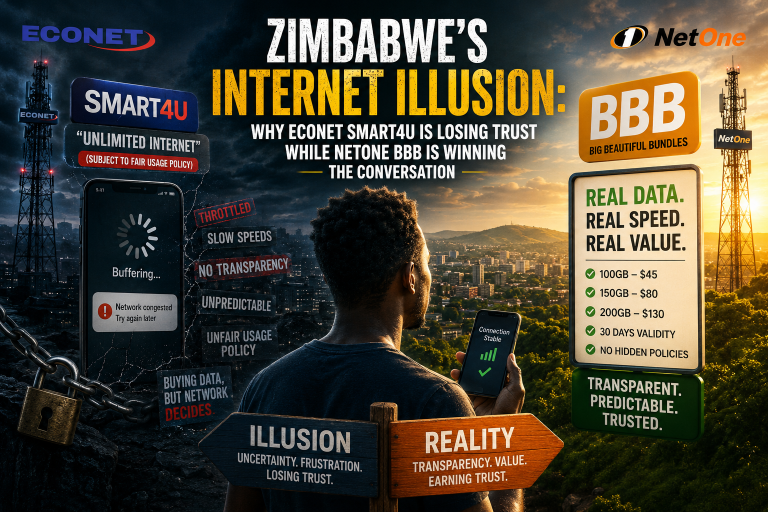
For years, Econet Wireless Zimbabwe has dominated Zimbabwe’s mobile internet market with a near-unquestioned grip on consumers. Its coverage remains unmatched in many areas, EcoCash is deeply embedded into daily life, and for millions of Zimbabweans, Econet is not just a network — it is infrastructure.
But the rise of Smart4U has exposed something uncomfortable about Zimbabwe’s telecom industry:
The difference between marketing internet and delivering internet.
And increasingly, Zimbabweans are beginning to notice.
The Seductive Promise of Smart4U
On paper, Smart4U sounds revolutionary.
Unlimited internet.
Affordable pricing.
Calls and SMS included.
Personalized bundles.
Thirty-day validity.
At first glance, it feels like Econet finally listened to ordinary Zimbabweans struggling under crushing data costs.
A user sees:
- $15 for “unlimited” internet
- $23 for “unlimited” internet
- voice minutes included
- SMS included
And naturally, the conclusion is:
“This is finally affordable internet.”
But that is precisely where the psychological trap begins.
Because Smart4U is not truly selling unlimited internet.
It is selling the idea of unlimited internet.
And those are not the same thing.
The Fair Usage Policy Nobody Truly Understands
The entire Smart4U ecosystem revolves around something Econet repeatedly references but never clearly defines:
The Fair Usage Policy (FUP). (econet.co.zw)
Econet openly states that:
- speeds may be reduced after thresholds are reached,
- thresholds may change,
- users are selected through internal criteria,
- speeds are not guaranteed,
- tethering is not supported. (econet.co.zw)
That alone would be acceptable — if the limits were transparent.
But they are not.
Users are never clearly told:
- what their real high-speed cap is,
- when throttling begins,
- how severe throttling becomes,
- what network priority Smart4U users receive,
- or why performance varies so wildly.
Instead, customers are thrown into a vague “best effort” pool after crossing invisible thresholds. (Paynow)
This creates one of the most frustrating customer experiences imaginable:
You never know whether your internet is working normally or whether you are already being punished by the system.
Smart4U’s Biggest Problem: It Feels Dishonest
This is where public frustration becomes emotional rather than technical.
The criticism surrounding Smart4U is not simply about speed.
It is about trust.
Consumers can tolerate limits.
Consumers can tolerate caps.
Consumers can tolerate lower speeds on cheaper plans.
What they struggle to tolerate is ambiguity.
And Smart4U thrives on ambiguity.
Econet markets “unlimited” connectivity while simultaneously designing a system where users often report:
- inability to stream reliably,
- severe throttling,
- unusable upload speeds,
- poor performance during peak hours,
- failure to send media files,
- inconsistent browsing experience. (Reddit)
The contradiction is glaring.
How can a product advertise freedom while delivering restriction?
How can “unlimited internet” become so slow that even Instagram pictures fail to load?
At that point, the debate stops being technical.
It becomes philosophical.
Because consumers begin asking:
“What exactly did I buy?”
The Psychological Manipulation of Smart4U
Perhaps the most brilliant — and controversial — thing about Smart4U is how it psychologically locks users into dependence.
Users complain constantly.
Users mock the bundle publicly.
Users call it “SmartScam.”
Users joke:
“Smart4U unotenga data but network unozvionera.”
And yet they keep buying it.
Why?
Because Econet understands something fundamental about Zimbabwe’s telecom market:
People are not buying Smart4U because it is excellent.
They are buying it because alternatives historically felt worse.
This is not customer loyalty.
This is market captivity.
And that distinction matters.
Why NetOne BBB Changed the Conversation
Then came NetOne Big Beautiful Bundles (BBB).
Suddenly, the conversation shifted.
Instead of selling “unlimited” internet governed by mysterious policies, NetOne introduced something radically simple:
- 100GB for $45
- 150GB for $80
- 200GB for $130
- fixed allocations
- defined validity
- advertised speed expectations (netone.co.zw)
That transparency alone became disruptive.
Because users finally knew:
- what they were paying for,
- what they were receiving,
- and what would happen when the bundle ended.
No illusion.
No hidden thresholds.
No undefined “fairness.”
Just data.
And in modern internet economics, predictability is powerful.
Smart4U Is Not SmartSuite — And That Is The Problem
Many consumers initially assumed Smart4U would behave similarly to Econet’s SmartSuite offerings.
But SmartSuite was designed more as a structured broadband replacement:
- more stable,
- more predictable,
- optimized for fixed environments,
- intended for shared connectivity.
Smart4U, by contrast, feels heavily traffic-managed.
And users quickly notice the difference.
A Smart4U connection often feels like:
- heavily deprioritized traffic,
- restricted throughput,
- aggressive congestion management,
- bandwidth rationing disguised as unlimited access.
The result is a package that technically keeps you online while functionally limiting what you can meaningfully do online.
That distinction is crucial.
Because modern internet usage is not merely about “being connected.”
It is about:
- Zoom calls,
- cloud backups,
- YouTube uploads,
- remote work,
- large file transfers,
- streaming,
- online education,
- digital business operations.
An internet connection that only reliably supports WhatsApp text messaging is not modern broadband.
It is digital survival mode.
Econet’s Core Problem: Market Dominance Without Pressure
The deeper issue here is not merely Smart4U.
It is what happens when a dominant telecom operator faces limited competitive pressure.
For years, Econet could:
- shape pricing,
- define consumer expectations,
- normalize vague terms,
- and rely on network superiority to retain customers.
But BBB represents something dangerous for Econet:
A competitor finally competing on value perception.
Even people who have not yet switched to NetOne are beginning to ask:
“Why am I paying for uncertainty?”
That question alone is strategically significant.
NetOne Is Not Perfect — But It Is Clearer
To be fair, NetOne still struggles with:
- inconsistent coverage in some regions,
- congestion in certain areas,
- infrastructure limitations,
- and public skepticism rooted in historical performance. (Techzim)
But BBB succeeds where Smart4U fails:
Expectation management.
NetOne is not promising magical unlimited internet.
It is promising measurable internet.
And consumers increasingly prefer brutal honesty over marketing poetry.
The Tragedy of Zimbabwe’s Internet Economy
The saddest part is that Smart4U could have transformed internet accessibility in Zimbabwe.
If properly implemented, it had the potential to:
- democratize internet access,
- empower students,
- help freelancers,
- support SMEs,
- reduce digital exclusion,
- and create affordable productivity connectivity.
Instead, many users describe it as:
- unreliable,
- unpredictable,
- frustrating,
- and psychologically exhausting.
Not because the idea was bad.
But because the execution damaged trust.
The Future: Consumers Are Becoming More Intelligent
Zimbabwean consumers are no longer passive.
They now:
- compare speeds,
- test latency,
- share experiences online,
- expose throttling,
- discuss FUPs,
- benchmark providers,
- and publicly critique telecom behavior.
The telecom industry is entering a new era where marketing alone is no longer enough.
Consumers want:
- transparency,
- consistency,
- predictability,
- and dignity.
And whichever network delivers those first will dominate the next decade.
Right now, NetOne BBB is winning something more important than pricing wars.
It is winning the perception war.
And in telecommunications, perception eventually becomes market reality.
The Deeper Implications for Digital Trust
The growing skepticism towards Smart4U reflects a broader shift in how Zimbabweans view digital services. In an economy where every dollar counts and financial resources are stretched thin, consumers demand clarity and reliability. The ambiguity surrounding Smart4U’s Fair Usage Policy doesn’t just frustrate users—it erodes confidence in the entire digital ecosystem.
When users cannot predict whether their internet connection will support basic video conferencing or file uploads, it impacts their ability to engage in remote work, online learning, or e-commerce. This uncertainty creates a barrier to digital inclusion, the very problem Smart4U was supposedly designed to solve.
The Transparency Advantage: Why Clarity Wins
NetOne’s approach with BBB, despite its own challenges, highlights a critical lesson: consumers value knowing exactly what they’re purchasing. Even if the quantity seems smaller compared to an ambiguous “unlimited” offering, the guarantee of a specific data amount provides peace of mind and allows users to plan their digital activities effectively.
This preference for transparency extends beyond telecommunications. In a market where trust in institutions and services has been tested by economic volatility, consumers gravitate towards options that minimize risk and maximize predictability. Businesses that understand and cater to this need position themselves advantageously in the marketplace.
The Competitive Landscape Ahead
The emergence of NetOne BBB as a credible alternative signals a healthy evolution in Zimbabwe’s telecom sector. Competition drives innovation, efficiency, and ultimately, better value for consumers. For Econet, the challenge is no longer just maintaining market share through network dominance, but earning it through superior service and honest communication.
If Econet wishes to reclaim the trust lost through Smart4U’s opacity, it must address the core issue: the disconnect between marketing promises and user experience. This might involve revising the FUP to be more transparent, offering clearer speed guarantees, or restructuring the bundles to align more closely with user expectations.
Conclusion: The Price of Trust
The narrative around Smart4U versus NetOne BBB transcends simple product comparison. It illustrates the fundamental importance of trust in digital services. In Zimbabwe’s evolving digital landscape, companies that prioritize clear communication, reliable service, and predictable value propositions will thrive.
Econet’s historical dominance cannot shield it indefinitely from the consequences of eroding consumer trust. Meanwhile, NetOne’s opportunity lies not just in offering competitive bundles, but in establishing itself as the provider that respects the intelligence and financial constraints of its customers. The future of Zimbabwe’s internet market will likely belong to the company that best balances affordability, transparency, and performance.
Zimbabwe’s Internet Illusion: Why Econet Smart4U Is Losing Trust While NetOne BBB Is Winning the Conversation
For years, Econet Wireless Zimbabwe has dominated Zimbabwe’s mobile internet market with a near-unquestioned grip on consumers. Its coverage remains unmatched in many areas, EcoCash is deeply embedded into daily life, and for millions of Zimbabweans, Econet is not just a network — it is infrastructure.
But the rise of Smart4U has exposed something uncomfortable about Zimbabwe’s telecom industry:
The difference between marketing internet and delivering internet.
And increasingly, Zimbabweans are beginning to notice.
The Seductive Promise of Smart4U
On paper, Smart4U sounds revolutionary.
Unlimited internet.
Affordable pricing.
Calls and SMS included.
Personalized bundles.
Thirty-day validity.
At first glance, it feels like Econet finally listened to ordinary Zimbabweans struggling under crushing data costs.
A user sees:
- $15 for “unlimited” internet
- $23 for “unlimited” internet
- voice minutes included
- SMS included
And naturally, the conclusion is:
“This is finally affordable internet.”
But that is precisely where the psychological trap begins.
Because Smart4U is not truly selling unlimited internet.
It is selling the idea of unlimited internet.
And those are not the same thing.
The Fair Usage Policy Nobody Truly Understands
The entire Smart4U ecosystem revolves around something Econet repeatedly references but never clearly defines:
The Fair Usage Policy (FUP). (econet.co.zw)
Econet openly states that:
- speeds may be reduced after thresholds are reached,
- thresholds may change,
- users are selected through internal criteria,
- speeds are not guaranteed,
- tethering is not supported. (econet.co.zw)
That alone would be acceptable — if the limits were transparent.
But they are not.
Users are never clearly told:
- what their real high-speed cap is,
- when throttling begins,
- how severe throttling becomes,
- what network priority Smart4U users receive,
- or why performance varies so wildly.
Instead, customers are thrown into a vague “best effort” pool after crossing invisible thresholds. (Paynow)
This creates one of the most frustrating customer experiences imaginable:
You never know whether your internet is working normally or whether you are already being punished by the system.
Smart4U’s Biggest Problem: It Feels Dishonest
This is where public frustration becomes emotional rather than technical.
The criticism surrounding Smart4U is not simply about speed.
It is about trust.
Consumers can tolerate limits.
Consumers can tolerate caps.
Consumers can tolerate lower speeds on cheaper plans.
What they struggle to tolerate is ambiguity.
And Smart4U thrives on ambiguity.
Econet markets “unlimited” connectivity while simultaneously designing a system where users often report:
- inability to stream reliably,
- severe throttling,
- unusable upload speeds,
- poor performance during peak hours,
- failure to send media files,
- inconsistent browsing experience. (Reddit)
The contradiction is glaring.
How can a product advertise freedom while delivering restriction?
How can “unlimited internet” become so slow that even Instagram pictures fail to load?
At that point, the debate stops being technical.
It becomes philosophical.
Because consumers begin asking:
“What exactly did I buy?”
The Psychological Manipulation of Smart4U
Perhaps the most brilliant — and controversial — thing about Smart4U is how it psychologically locks users into dependence.
Users complain constantly.
Users mock the bundle publicly.
Users call it “SmartScam.”
Users joke:
“Smart4U unotenga data but network unozvionera.”
And yet they keep buying it.
Why?
Because Econet understands something fundamental about Zimbabwe’s telecom market:
People are not buying Smart4U because it is excellent.
They are buying it because alternatives historically felt worse.
This is not customer loyalty.
This is market captivity.
And that distinction matters.
Why NetOne BBB Changed the Conversation
Then came NetOne Big Beautiful Bundles (BBB).
Suddenly, the conversation shifted.
Instead of selling “unlimited” internet governed by mysterious policies, NetOne introduced something radically simple:
- 100GB for $45
- 150GB for $80
- 200GB for $130
- fixed allocations
- defined validity
- advertised speed expectations (netone.co.zw)
That transparency alone became disruptive.
Because users finally knew:
- what they were paying for,
- what they were receiving,
- and what would happen when the bundle ended.
No illusion.
No hidden thresholds.
No undefined “fairness.”
Just data.
And in modern internet economics, predictability is powerful.
Smart4U Is Not SmartSuite — And That Is The Problem
Many consumers initially assumed Smart4U would behave similarly to Econet’s SmartSuite offerings.
But SmartSuite was designed more as a structured broadband replacement:
- more stable,
- more predictable,
- optimized for fixed environments,
- intended for shared connectivity.
Smart4U, by contrast, feels heavily traffic-managed.
And users quickly notice the difference.
A Smart4U connection often feels like:
- heavily deprioritized traffic,
- restricted throughput,
- aggressive congestion management,
- bandwidth rationing disguised as unlimited access.
The result is a package that technically keeps you online while functionally limiting what you can meaningfully do online.
That distinction is crucial.
Because modern internet usage is not merely about “being connected.”
It is about:
- Zoom calls,
- cloud backups,
- YouTube uploads,
- remote work,
- large file transfers,
- streaming,
- online education,
- digital business operations.
An internet connection that only reliably supports WhatsApp text messaging is not modern broadband.
It is digital survival mode.
Econet’s Core Problem: Market Dominance Without Pressure
The deeper issue here is not merely Smart4U.
It is what happens when a dominant telecom operator faces limited competitive pressure.
For years, Econet could:
- shape pricing,
- define consumer expectations,
- normalize vague terms,
- and rely on network superiority to retain customers.
But BBB represents something dangerous for Econet:
A competitor finally competing on value perception.
Even people who have not yet switched to NetOne are beginning to ask:
“Why am I paying for uncertainty?”
That question alone is strategically significant.
NetOne Is Not Perfect — But It Is Clearer
To be fair, NetOne still struggles with:
- inconsistent coverage in some regions,
- congestion in certain areas,
- infrastructure limitations,
- and public skepticism rooted in historical performance. (Techzim)
But BBB succeeds where Smart4U fails:
Expectation management.
NetOne is not promising magical unlimited internet.
It is promising measurable internet.
And consumers increasingly prefer brutal honesty over marketing poetry.
The Tragedy of Zimbabwe’s Internet Economy
The saddest part is that Smart4U could have transformed internet accessibility in Zimbabwe.
If properly implemented, it had the potential to:
- democratize internet access,
- empower students,
- help freelancers,
- support SMEs,
- reduce digital exclusion,
- and create affordable productivity connectivity.
Instead, many users describe it as:
- unreliable,
- unpredictable,
- frustrating,
- and psychologically exhausting.
Not because the idea was bad.
But because the execution damaged trust.
The Future: Consumers Are Becoming More Intelligent
Zimbabwean consumers are no longer passive.
They now:
- compare speeds,
- test latency,
- share experiences online,
- expose throttling,
- discuss FUPs,
- benchmark providers,
- and publicly critique telecom behavior.
The telecom industry is entering a new era where marketing alone is no longer enough.
Consumers want:
- transparency,
- consistency,
- predictability,
- and dignity.
And whichever network delivers those first will dominate the next decade.
Right now, NetOne BBB is winning something more important than pricing wars.
It is winning the perception war.
And in telecommunications, perception eventually becomes market reality.
The Deeper Implications for Digital Trust
The growing skepticism towards Smart4U reflects a broader shift in how Zimbabweans view digital services. In an economy where every dollar counts and financial resources are stretched thin, consumers demand clarity and reliability. The ambiguity surrounding Smart4U’s Fair Usage Policy doesn’t just frustrate users—it erodes confidence in the entire digital ecosystem.
When users cannot predict whether their internet connection will support basic video conferencing or file uploads, it impacts their ability to engage in remote work, online learning, or e-commerce. This uncertainty creates a barrier to digital inclusion, the very problem Smart4U was supposedly designed to solve.
The Transparency Advantage: Why Clarity Wins
NetOne’s approach with BBB, despite its own challenges, highlights a critical lesson: consumers value knowing exactly what they’re purchasing. Even if the quantity seems smaller compared to an ambiguous “unlimited” offering, the guarantee of a specific data amount provides peace of mind and allows users to plan their digital activities effectively.
This preference for transparency extends beyond telecommunications. In a market where trust in institutions and services has been tested by economic volatility, consumers gravitate towards options that minimize risk and maximize predictability. Businesses that understand and cater to this need position themselves advantageously in the marketplace.
The Competitive Landscape Ahead
The emergence of NetOne BBB as a credible alternative signals a healthy evolution in Zimbabwe’s telecom sector. Competition drives innovation, efficiency, and ultimately, better value for consumers. For Econet, the challenge is no longer just maintaining market share through network dominance, but earning it through superior service and honest communication.
If Econet wishes to reclaim the trust lost through Smart4U’s opacity, it must address the core issue: the disconnect between marketing promises and user experience. This might involve revising the FUP to be more transparent, offering clearer speed guarantees, or restructuring the bundles to align more closely with user expectations.
Conclusion: The Price of Trust
The narrative around Smart4U versus NetOne BBB transcends simple product comparison. It illustrates the fundamental importance of trust in digital services. In Zimbabwe’s evolving digital landscape, companies that prioritize clear communication, reliable service, and predictable value propositions will thrive.
Econet’s historical dominance cannot shield it indefinitely from the consequences of eroding consumer trust. Meanwhile, NetOne’s opportunity lies not just in offering competitive bundles, but in establishing itself as the provider that respects the intelligence and financial constraints of its customers. The future of Zimbabwe’s internet market will likely belong to the company that best balances affordability, transparency, and performance.